
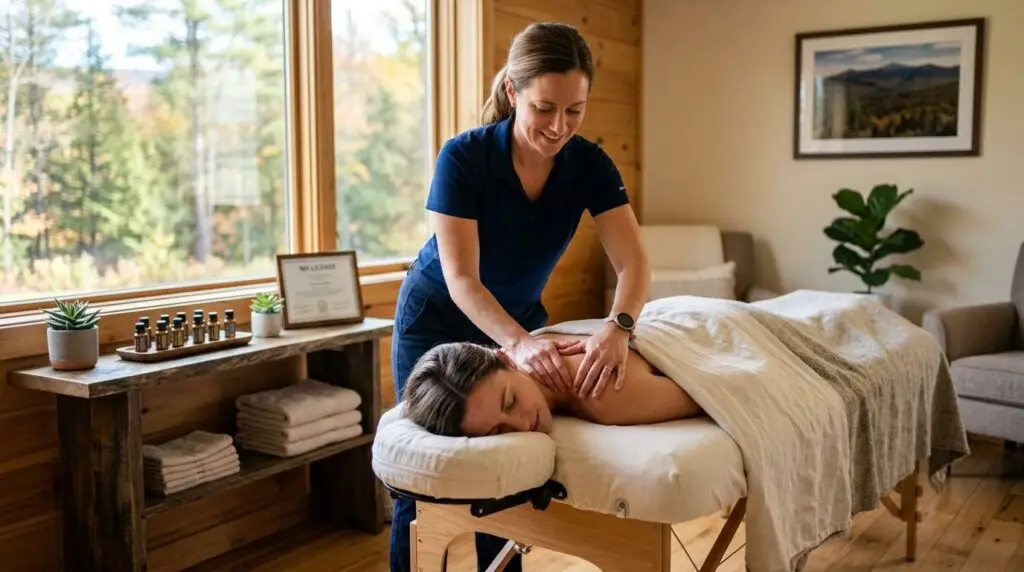
Massage therapist insurance in New Hampshire is business coverage built around one exposure other professions don't carry: hands-on physical contact with a client's body, every single session. That single fact changes what "enough coverage" looks like — a spa owner in Manchester needs different limits than a solo practitioner running a home studio in Keene, but both need protection general liability alone doesn't provide.
- Massage therapist insurance NH starts with general liability, but professional liability covers the claims tied to actual treatment outcomes.
- New Hampshire requires workers’ compensation the moment you hire even one employee, under RSA 281-A.
- A business owners policy bundles general liability and property coverage, the fastest route for a single-room studio.
- Home-based massage practices in New Hampshire need a business policy separate from a homeowners policy — most homeowners policies exclude client injuries tied to business activity.
Why massage therapist insurance NH matters
A massage therapist's risk profile isn't hypothetical. Clients slip on oil residue, react to a product used during a session, or claim an injury occurred during treatment. Each of those is a different type of claim, and each requires a different policy to respond.
General liability handles the slip-and-fall in your waiting room. Professional liability — sometimes called malpractice or errors and omissions coverage — handles the claim that your technique caused or worsened an injury. Skip one and you're covered for half the job.
New Hampshire doesn't license massage therapy at the state level the same way some states do, but many municipalities and landlords require proof of liability coverage before you can lease space or take clients. Coverage isn't optional paperwork here — it's often the condition that lets you operate at all.
Build your coverage step by step
Get general liability insurance first
This is the floor, not the ceiling. It responds to bodily injury and property damage claims that happen on your premises or as a result of your business operations — not the treatment itself.
- Confirm the policy covers premises liability (slips, falls, product spills)
- Check that it includes products-completed operations if you sell oils, lotions, or retail items
- Ask whether the policy extends to off-site work if you do house calls or mobile massage
- Verify limits — many landlords require $1 million per occurrence before signing a lease
- Confirm the policy names your business entity correctly, not just you personally
Add professional liability for treatment-related claims
General liability won't respond if a client alleges your massage technique caused a nerve injury or aggravated an existing condition. That's a professional liability claim, and it needs its own coverage line.
- Ask if the policy covers claims made after a client stops seeing you (tail coverage)
- Confirm coverage applies to the specific modalities you practice — deep tissue, prenatal, sports massage each carry different claim patterns
- Check whether continuing education or certification status affects your premium or eligibility
- Review whether the policy defends you even if a claim is later found groundless — legal defense costs add up regardless of outcome
Cover your equipment and space
Massage tables, linens, hot stone warmers, and retail inventory represent real replacement cost if a pipe bursts or a fire damages your studio.
- List tables, chairs, and specialty equipment (hot stones, cupping sets) at replacement value, not purchase price
- Confirm business personal property coverage extends to a home studio if that's where you operate
- Ask about coverage for spoiled or damaged product inventory (oils, lotions, retail stock)
- Check business interruption coverage — lost income if your space is unusable for weeks after a covered loss
Add workers' compensation if you hire anyone
New Hampshire law (RSA 281-A) requires workers' compensation coverage as soon as you have one employee, full-time or part-time. This isn't optional once you cross that line, and it isn't waived for family members working in the business.
- Confirm coverage applies to part-time and contract-classified staff who function as employees
- Ask how your rate is calculated — payroll and job classification both matter
- Check whether independent contractors you bring in still need proof of their own coverage
- Review what happens if a therapist is injured performing a treatment on a coworker or trainee
Bundle into a business owners policy where it fits
A business owners policy (BOP) combines general liability and commercial property into one contract, and for a single-location massage practice it's usually the most efficient structure.
- Confirm the BOP includes the liability limits your landlord or lease requires
- Ask whether professional liability can be added as an endorsement or needs a separate policy
- Check if the BOP covers business income loss, not just physical property
- Verify the policy fits a service business, not a retail-heavy operation, if you sell significant product inventory
Layer on cyber and data protection if you take online bookings
Online scheduling, client intake forms, and card payments all create data you're responsible for protecting. A breach involving client health notes or payment information is a real, provable cost.
- Check if your booking platform's own coverage is sufficient or if you need a standalone cyber policy
- Confirm coverage for notification costs if client data is exposed
- Ask whether the policy covers ransomware or system lockout, not just data theft
Review coverage annually as your practice changes
A solo practitioner who adds a second room, hires a receptionist, or starts offering prenatal massage has changed their risk profile — and their policy needs to change with it.
- Re-run your limits every time you add a service, hire staff, or move locations
- Update equipment lists after every major purchase
- Confirm your policy still matches your entity type if you incorporated after starting as a sole proprietor
“If you touch clients for a living, general liability without professional liability is coverage with a gap in the middle.”
Comparing coverage options for New Hampshire massage therapists
| Option | Best for | Key limitation |
|---|---|---|
| Standalone general liability | Solo therapists just starting out | Doesn't cover treatment-related injury claims |
| Professional liability (add-on or standalone) | Anyone performing hands-on modalities | Needs pairing with general liability for full protection |
| Business owners policy (BOP) | Single-location studios with a lease | May not include professional liability by default |
| Workers' compensation | Any practice with one or more employees | Legally required once you hire, regardless of hours worked |
| Home-based business policy | Therapists operating from a home studio | Standard homeowners policies typically exclude business activity |
For most New Hampshire massage therapists, the practical starting point is a general liability insurance policy paired with professional liability, then a decision on whether a full business owners policy makes sense once you have a fixed location.
Common mistakes massage therapists make
- Assuming homeowners insurance covers a home studio. It typically excludes injuries tied to business activity, even in a room you built specifically for clients.
- Carrying general liability only. It's the most commonly sold policy but doesn't respond to the claim type massage therapists actually face most — treatment-related injury allegations.
- Skipping workers' compensation for part-time help. New Hampshire's requirement kicks in with the first employee, not at a headcount threshold.
- Underinsuring equipment. A hot stone set or specialty table often costs more to replace in 2026 than the original purchase price reflected on an old policy.
- Letting coverage lapse between locations. Therapists renting studio space at multiple locations sometimes assume one policy automatically follows them — confirm it does before you move.
Many massage therapists in New Hampshire operate out of a spare room or converted space at home, which puts them in the same coverage gap as other home-based operators. The mechanics of fixing that gap are the same regardless of profession — see how to insure a home-based business in New Hampshire for the specifics on what a homeowners policy actually excludes.
FAQ
What insurance does a massage therapist need in New Hampshire?
A massage therapist in New Hampshire needs general liability insurance and professional liability insurance at minimum. General liability covers slip-and-fall type claims, while professional liability covers claims tied to the treatment itself.
Is professional liability the same as general liability for massage therapists?
No. General liability covers premises and product-related injuries, while professional liability covers claims that your massage technique caused or worsened a client’s condition. Most practices need both.
Do I need workers’ compensation if I only have one part-time employee?
Yes. New Hampshire’s RSA 281-A requires workers’ compensation coverage once you have even one employee, full-time or part-time.
Does my homeowners policy cover a home massage studio?
Typically not. Most homeowners policies exclude injuries connected to business activity, even when the studio is inside your own home.
What’s the fastest way to get insured as a new massage therapist?
A business owners policy bundling general liability and property coverage is usually the quickest setup for a single-location practice, with professional liability added separately if it isn’t included.
Do mobile massage therapists need different coverage?
Yes. Confirm your general liability policy extends to off-site work, since some policies only cover incidents at a fixed business address.
How much general liability coverage do landlords usually require?
Many New Hampshire landlords require at least $1 million per occurrence before signing a commercial lease for studio space.
Does massage therapist insurance cover product reactions from oils or lotions?
General liability with products-completed operations coverage typically responds to claims involving reactions to products used or sold during a session.
One last thing
The gap most New Hampshire massage therapists don't see coming isn't a missing policy — it's a mismatched one. A general liability policy bought off a template rarely names the right entity, covers off-site work, or extends to a home studio, and none of that surfaces until a claim gets denied. Reading the actual exclusions before you sign costs you twenty minutes; skipping that step costs a lot more later.
Related guides
- General liability insurance for New Hampshire small businesses
- Business insurance for hair salons and spas in New Hampshire
- Workers' compensation insurance for New Hampshire small businesses
- How to insure a home-based business in New Hampshire
- How to choose a business owners policy in New Hampshire