
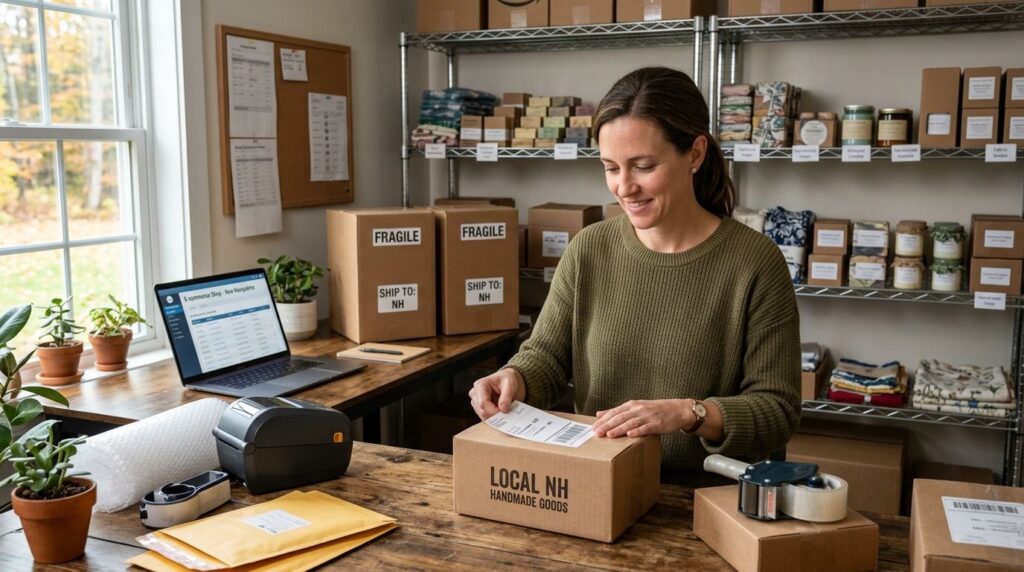
Ecommerce business insurance in New Hampshire covers online sellers against product liability claims, cyber incidents, inventory loss, and shipping damage that a personal homeowners policy excludes entirely. Sellers running shops from a spare bedroom in Manchester or Nashua need different protection than a big-box retailer, because the risk sits in data, packaging, and product defects rather than foot traffic.
- Ecommerce business insurance nh should include product liability, cyber liability, and inventory coverage at minimum in 2026.
- A standard homeowners policy caps business property coverage around $2,500 on-premises, leaving most inventory uninsured.
- General liability is the base layer most New Hampshire online sellers need before adding product-specific coverage.
- A Business Owners Policy bundles general liability and property coverage into one cheaper package for sellers holding inventory.
- Cyber liability matters the moment a shop stores customer payment data, even through Shopify or Etsy.
Why this matters for online sellers in NH
Most New Hampshire online sellers start as a side hustle on Etsy, Shopify, or Amazon and never update coverage once revenue grows. That gap shows up the moment a customer claims a product caused injury, a supplier ships defective goods under your label, or a data breach exposes order records.
New Hampshire does not require general liability insurance by law for most sole proprietors, which is exactly why so many sellers skip it. Marketplaces are stricter than the state: Amazon requires sellers past a set sales threshold to carry commercial liability coverage to keep the account active. General liability insurance for New Hampshire small businesses is usually the first policy an online seller buys to satisfy that requirement and cover third-party claims.
Inventory sitting in a garage or basement is the other blind spot. Sellers assume the home policy covers it. It does not, and the gap widens every year sales grow.
Get your coverage baseline right first
Before adding specialty coverage, confirm the basics match how the business actually operates in 2026.
- Register your entity with the NH Secretary of State if you operate under a business name.
- Separate business and personal bank accounts before applying for commercial coverage. Insurers ask.
- Keep a certificate of insurance on hand for marketplaces and wholesale partners that demand proof.
- Document inventory value monthly so limits track real stock, not last year's guess.
- Check whether your homeowners policy already carries a business-use exclusion.
Add general liability coverage first
General liability handles the most common claims online sellers face: a customer alleges a product caused bodily injury, or your shipment damaged someone's property on delivery.
- Weigh your product category. Handmade candles, skincare, and food carry far more liability exposure than digital goods.
- Confirm the policy covers advertising injury, which matters if a competitor claims your listing copy or images infringe.
- Match per-occurrence and aggregate limits to order volume, not just revenue.
- Bundle with property coverage if you also hold physical inventory and run a home office.
- Reject any form that excludes internet or ecommerce sales outright. Some older carrier forms still do.
Add product liability if you manufacture, private-label, or resell
Product liability sits separate from general liability in most policies. It covers claims tied to defects in what you sell rather than how you operate.
- Private-label supplements, cosmetics, and food carry the highest exposure. Never skip this coverage on those.
- Dropshippers still need it. The seller of record can be named in a claim without ever touching the product.
- Confirm the policy covers recall costs, not just injury claims, on anything consumable or wearable.
- Request your supplier's certificate of insurance. It does not replace your coverage, but it documents shared risk.
- Read product liability insurance for New Hampshire manufacturers before you assemble or bottle anything in-house.
Compare a standalone policy against a Business Owners Policy
Most small ecommerce operations in New Hampshire choose between separate policies and one bundled Business Owners Policy.
- A BOP combines general liability and commercial property into a single policy, usually cheaper than buying both separately.
- Standalone general liability fits shops with no physical inventory, like print-on-demand or digital products.
- Ask whether business interruption coverage is included. It pays lost income if a fire or storm stops fulfillment.
- Set inventory limits to peak holiday stock levels, not the annual average.
- Work through how to choose a business owners policy in New Hampshire before signing, since limits vary widely between carriers.
Add cyber liability once you store customer data
Any shop processing payments, even through Shopify or Stripe, holds customer names, addresses, and order histories that a breach can expose.
- Cyber liability typically covers breach notification costs, which New Hampshire law requires after a breach is discovered.
- Confirm it covers ransomware and business interruption from a system lockout, not just data theft.
- Check that coverage extends to third-party tools you use, since a breach at your email platform or POS still exposes your customers.
- Review cyber liability insurance for New Hampshire small businesses if you process orders weekly.
- Read the cyber sublimit inside any BOP. Bundled cyber add-ons often cap far below what real remediation costs.
Cover shipping, returns, and inventory in transit
Lost and damaged shipments are routine. Carrier reimbursement from USPS, UPS, and FedEx caps well below the value of many orders.
- Add a shipping or inland marine rider when average order value exceeds standard carrier reimbursement caps.
- Track return rates by category. Apparel and electronics need higher in-transit limits than low-return goods.
- Confirm whether inventory stored at a third-party fulfillment center is covered. Coverage often stops at your own address.
- Photograph inventory condition before shipping so damage disputes have evidence behind them.
- Keep a small loss reserve for claims that land under the deductible.
Add commercial auto if you deliver locally
Sellers making deliveries around Nashua, Manchester, or Concord instead of shipping through a carrier need commercial auto, not a personal policy.
- Personal auto policies exclude business use once delivery becomes routine rather than occasional.
- Confirm coverage applies to every vehicle used for the business, including a personal car used part-time.
- Add hired and non-owned auto coverage if employees or contractors ever drive their own vehicles for you.
Get your ecommerce coverage reviewed
A quick review covers what your shop actually needs before renewal.
Comparison: coverage options for NH online sellers
| Coverage | Best for | Key limitation |
|---|---|---|
| General liability | Sellers needing marketplace-required proof of coverage | Does not cover product defects specifically |
| Business Owners Policy | Sellers with inventory and a home office setup | Property limits often too low for peak-season stock |
| Product liability | Private-label, handmade, and manufactured goods | Usually sold as an endorsement, not standalone |
| Cyber liability | Any shop processing customer payment data | Sublimits inside a BOP fall short of real breach costs |
| Commercial auto | Sellers making local deliveries | Personal auto will not cover regular business use |
The verdict: New Hampshire online sellers shipping physical products or processing customer payment data need general liability plus cyber coverage at minimum in 2026, with product liability added the moment a supplier or private label enters the picture.
“If your inventory would not fit in a closet, your homeowners policy is no longer insuring your business.”
Common mistakes NH online sellers make
- Running the business under a homeowners policy. Most HO-3 forms exclude business activity once sales become regular income rather than occasional sales.
- Underinsuring inventory in Q4. Limits set in January rarely match the stock level sitting in the house in November.
- Assuming the platform handles security. Shopify and Etsy secure their own systems, not your liability when customer data leaks.
- Waiting until a marketplace flags the account. Amazon can suspend high-volume sellers who cannot produce proof of commercial liability coverage.
- Treating a supplier's policy as your own. A manufacturer's coverage protects the manufacturer, not the seller named on the customer's order.
FAQ
Do I need business insurance to sell online in New Hampshire?
New Hampshire does not legally require general liability insurance for most online sellers, but marketplaces like Amazon require proof of coverage past a set sales threshold. A homeowners policy typically excludes business activity, so most sellers need a standalone policy or a Business Owners Policy in 2026.
What does ecommerce business insurance in NH cover?
It usually combines general liability, product liability, and cyber liability, with inventory and shipping coverage added based on what you sell. Sellers who private-label or manufacture need product liability specifically, not just general liability.
Is a Business Owners Policy better than separate policies for online sellers?
A BOP bundles general liability and property coverage into one policy and is usually cheaper for sellers holding physical inventory. Shops with no physical inventory, like digital product stores, often do fine with standalone general liability.
Does homeowners insurance cover an online store run from home?
No. Standard homeowners policies typically cap business property coverage around $2,500 on-premises and exclude business liability once sales become a regular income source. A separate business policy is needed once the shop passes hobby level.
Do dropshippers need product liability insurance in New Hampshire?
Yes, in most cases. The seller of record can be named in a product liability claim without ever handling the product, because the customer’s contract is with the seller rather than the manufacturer.
How much cyber liability coverage does a small online shop need?
Coverage should scale with order volume and how much customer payment and personal data the shop stores or processes. Any shop handling regular transactions through Shopify, Stripe, or a similar platform should carry cyber liability rather than rely on the platform’s security.
Can I use my personal car for business deliveries without commercial auto insurance?
Occasional use is often fine, but regular business deliveries fall outside personal auto coverage. Insurers can deny a claim entirely if the vehicle was in business use at the time of the accident.
What happens if I sell on Amazon without business insurance?
Amazon requires proof of commercial liability insurance from sellers past a set sales threshold and can suspend accounts that cannot provide it. Liability exposure exists regardless of what any platform enforces.
One last thing
That roughly $2,500 cap on business property inside a standard homeowners policy has barely moved in years, and it applies to items kept on the premises. One pallet of holiday inventory in a spare room clears it easily. Move inventory onto a real business policy before the next renewal, not after a denied claim in 2026.
Related guides
- How to insure a home-based business in New Hampshire
- Business insurance for craft fair and pop-up vendors in New Hampshire