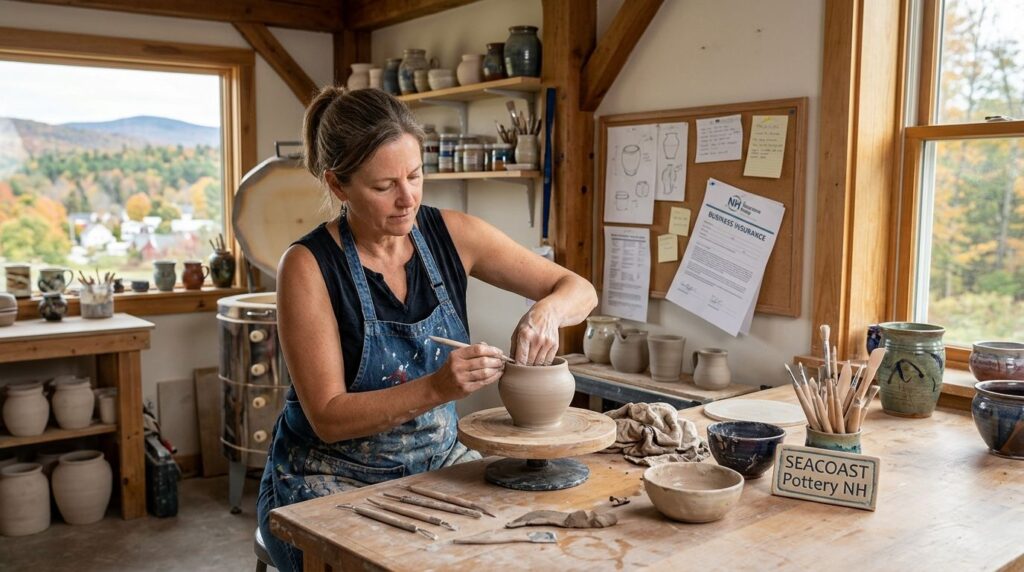
Artist and craftsperson insurance in New Hampshire covers the liability, property, and inventory risks that come with selling handmade work at craft fairs, out of a home studio, or through a small retail storefront. This segment carries risks that a typical office-based small business doesn't face: transporting fragile inventory to weekend markets, working with kilns, torches, or power tools, and selling products that get used in someone's home.
- Artist craftsperson insurance NH starts with general liability, which most craft fairs and markets require before you can set up a booth.
- A homeowners policy will not cover a home-based art or craft business past a small equipment limit, even in 2026.
- Product liability matters most for makers selling candles, jewelry, food-adjacent items, or anything with an electrical or chemical component.
- Inland marine coverage protects tools, kilns, and inventory while they’re on the road between your studio and a vendor event.
- A business owners policy bundles liability and property coverage at a lower administrative cost than buying each piece separately.
Why business insurance matters for New Hampshire artists and craftspeople
New Hampshire's craft fair and farmers market circuit runs heavy from May through December, and most event organizers now require a certificate of insurance before they'll assign you a booth. That's not a formality — it protects the venue and protects you if a customer trips over your display table or a shelf of your work falls on someone. General liability insurance for New Hampshire small businesses is the coverage most event applications ask for by name.
Beyond the booth, makers face a second layer of exposure most hobbyists don't think about: what happens after the sale. A candle that starts a fire, a piece of jewelry that causes a skin reaction, a wood toy with a small part that breaks off — these are product liability claims, and they land on the maker, not the venue. Craftspeople who sell through a shop, online, or wholesale to a boutique carry this exposure every day of the year, not just on market weekends.
The verdict for most New Hampshire makers in 2026: pair general liability with a product liability endorsement, add coverage for your studio and equipment, and layer in vendor-event or inland marine coverage if your work travels. Below is the step-by-step build.
Get general liability coverage first
This is the base layer and the one most craft fair applications actually check for.
- Confirm the policy covers bodily injury and property damage at off-site events, not just your home or studio address
- Ask whether the policy includes products-completed operations, which covers claims after the item leaves your hands
- Check the per-occurrence and aggregate limits against what local fairs and markets typically require
- Add the event organizer as an additional insured if the application asks for it — most do
- Keep a digital copy of your certificate of insurance on your phone for market-day check-in
Add product liability if you sell physical goods
General liability and product liability often live on the same policy, but not always automatically.
- Flag anything with heat, electricity, or a flame — candles, resin work, wired lamps
- Flag anything worn against skin — jewelry, soaps, lotions, fiber goods with dye
- Ask your carrier whether wholesale sales through a boutique or gallery change your exposure
- Keep ingredient or material lists for anything topical, in case a reaction claim comes up
- Review coverage annually as your product line grows past what you started with
Cover your studio and equipment separately from your homeowners policy
A standard homeowners policy caps business property coverage low, often a few thousand dollars, and it will not cover a customer injury tied to your business at all. How to insure a home-based business in New Hampshire walks through the endorsement and standalone options that close this gap.
- Inventory your kiln, wheel, loom, press, or power tools at replacement cost, not what you paid years ago
- Ask whether your homeowners carrier allows a business endorsement or requires a separate policy
- Confirm coverage extends to a detached studio, garage workshop, or converted barn if that's where you work
- Document raw material and finished-goods inventory with photos, updated each season
- Flag any customer foot traffic to your home studio — that's a liability trigger most homeowners policies exclude outright
Add craft fair and vendor event coverage
If your calendar includes regular market weekends, this is where your risk concentrates. Business insurance for craft fair and pop-up vendors in New Hampshire covers the booth-specific exposures a standard policy sometimes misses.
- Confirm the policy covers tents, tables, and display fixtures, not just the products on them
- Check whether coverage applies at every event you attend or only a listed address
- Ask about single-event versus season-long policies if you only do a handful of fairs a year
- Review whether transit coverage applies while inventory rides in your vehicle between stops
- Keep proof of coverage ready for organizers who require it 30 days out, not the morning of
Cover tools and inventory while they travel
A kiln that cracks in transit or a tote of finished pottery that shatters in the back of a van isn't covered by most general liability policies — that's a property gap, not a liability one.
- Ask about coverage for equipment and inventory while in transit, not just at a fixed address
- Get replacement-cost valuations on kilns, presses, and specialty tools, which run higher to replace than to buy used
- Confirm coverage follows the goods to the event location and back, not just one leg of the trip
- Review seasonal fluctuations — inventory value peaks before the holiday market season
Layer in workers' compensation if you hire help
Once you bring on a part-time assistant for market season or studio production, that relationship gets treated like any other employer-employee arrangement for coverage purposes.
- Confirm whether your help counts as an employee or a genuine independent contractor
- Check state thresholds for when workers' comp becomes mandatory rather than optional
- Cover injuries from kiln burns, tool cuts, or lifting strain during load-in and load-out
- Keep payroll records clean since comp premiums are usually tied to wages paid
Add umbrella coverage as your business grows
Once your studio sells wholesale, ships out of state, or your annual revenue climbs past what a standalone policy comfortably covers, an umbrella layer adds room above your existing limits without restructuring everything underneath it.
- Check what limit your current general liability and product liability policies max out at
- Ask whether the umbrella follows all your underlying policies or only some
- Revisit the limit annually as wholesale accounts or online sales volume grows
Comparison: coverage options for New Hampshire makers in 2026
| Option | Best for | Key limitation |
|---|---|---|
| General liability | Any maker who sells at fairs, markets, or a shop | Doesn't cover your tools, kiln, or inventory in transit |
| Product liability endorsement | Makers selling candles, jewelry, food-adjacent, or skin-contact items | Usually an add-on, not automatic on a base policy |
| Home-based business endorsement | Studio work done at home with occasional customer visits | Coverage limits are lower than a standalone commercial policy |
| Business owners policy | Makers who want liability and property bundled in one policy | Not every carrier offers one sized for a solo maker |
| Vendor event / craft fair coverage | Anyone doing a regular seasonal fair or market circuit | Some policies are single-event only, not season-long |
| Inland marine | Tools, kilns, and inventory that travel between studio and events | Requires accurate, updated equipment valuations |
| Workers' compensation | Studios with even one part-time employee or seasonal help | Mandatory once you cross the employee threshold, not optional |
How to choose a business owners policy in New Hampshire breaks down how a bundled policy compares to buying general liability and property coverage separately, which matters most once you're running more than a weekend hobby table.
Get your craft business covered
Quick review of your studio, booth, and equipment coverage.
Common mistakes New Hampshire artists and craftspeople make
- Assuming a homeowners policy covers the studio. It caps business property low and excludes customer injury tied to the business entirely.
- Skipping product liability because the work is handmade. Handmade doesn't mean low-risk — candles, jewelry, and skin-contact goods carry real claim exposure.
- Insuring the booth but not the transit. A cracked kiln or shattered pottery tote in the back of a vehicle is a property claim most general liability policies won't touch.
- Waiting until an event organizer asks for a certificate. Scrambling for coverage the week of a market often means paying more for a rushed single-event policy.
- Never updating inventory values. A studio that grows from a hobby table to wholesale accounts needs current equipment and inventory numbers, not figures from three years ago.
FAQ
What’s the best business insurance for artists and craftspeople in New Hampshire?
General liability paired with a product liability endorsement covers most New Hampshire makers, with a home-based business endorsement or a business owners policy added depending on where you work. Makers who sell at regular fairs should add vendor event or inland marine coverage for equipment in transit.
Do I need business insurance if I only sell at craft fairs a few times a year?
Most fair and market organizers in New Hampshire require a certificate of insurance before assigning a booth, regardless of how often you attend. A single-event or season-long vendor policy usually covers this without a full annual commercial policy.
Is my homeowners policy enough if I work out of a home studio?
No. Homeowners policies cap business property coverage low and exclude customer injuries tied to a home business. A home-based business endorsement or standalone policy closes both gaps.
How much does product liability insurance cost for handmade goods?
Cost varies by product type, sales volume, and whether items are worn, ingested, or involve heat or electricity. A quick review of your product line against your current policy is the fastest way to see where the gap sits.
Do craft fairs and markets require proof of insurance?
Many New Hampshire fairs and farmers markets require a certificate of insurance before confirming a vendor spot, especially larger seasonal events. Some also require the organizer be listed as an additional insured on the policy.
What happens if a customer is injured by something I made?
That’s a product liability claim, and it follows the maker even if the sale happened months earlier at a market or through a wholesale account. A products-completed operations clause on your liability policy is what responds to this type of claim.
Should I insure my tools and equipment separately from my studio?
Yes, if your kiln, wheel, or power tools travel to events or sit in a detached studio, since property coverage tied to a home address often doesn’t follow equipment off-site. Inland marine coverage is built for exactly this gap.
Is a bundled business owners policy better than standalone general liability for artists?
A business owners policy combines liability and property coverage into one policy, which is usually simpler to manage once a studio has real equipment and inventory value. A solo maker starting out at a single market table may not need the full bundle yet.
One last thing
The gap that catches the most New Hampshire makers in 2026 isn't liability at the booth — it's the gear between the studio and the market. A kiln or press that cracks in transit rarely shows up on a standard general liability quote, and it's the claim most craftspeople find out about the hard way, mid-season, with a holiday market three weeks out.
Related guides
- Inland marine insurance for New Hampshire contractors
- Product liability insurance for New Hampshire manufacturers