
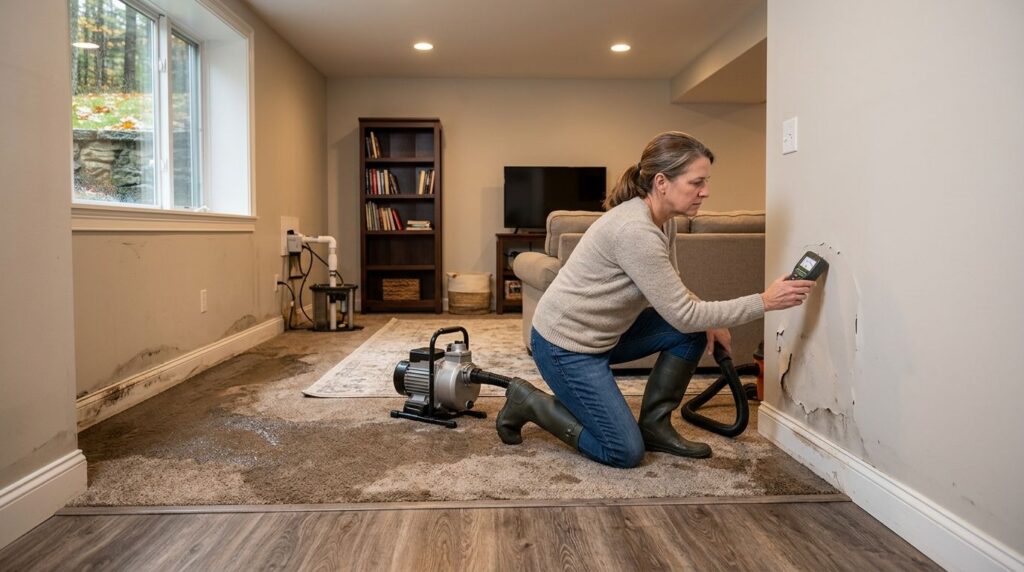
Flood insurance for finished basements in New Hampshire pays for structural repairs below grade, but a standard National Flood Insurance Program (NFIP) policy excludes almost everything you added to make that basement livable — drywall, flooring, carpet, paneling, and most furniture. If your basement has a bedroom, home office, or family room, that gap matters more in 2026 than the coverage limit on your policy declaration page.
- NFIP building coverage tops out at $250,000 and contents at $100,000, and finished basement surfaces are excluded by design.
- Flood insurance for a finished basement NH homeowners actually need usually requires a private policy layered on top of NFIP.
- Standard NFIP flood policies carry a 30-day waiting period, so buy coverage before storm season, not during it.
- Homes near the Merrimack, Connecticut, and Pemigewasset rivers and NH’s Lakes Region carry the highest basement flood exposure.
Why this matters for finished basements
A homeowners policy in New Hampshire does not cover flood damage — rising water from a river, lake, or heavy rain runoff is a named exclusion on almost every HO-3 form sold in the state. Flood insurance is the only policy type built to pay that claim, and NFIP's rules treat a finished basement like an unfinished one on purpose: the program pays to repair the studs, the foundation, and the furnace, not the finish work sitting on top of them.
Before you shop, take the time to determine your home insurance coverage needs for the rest of the house, because a flood claim on a finished basement rarely stands alone — it usually follows storm damage that hits the roof, siding, or main-floor systems too. Knowing your baseline homeowners coverage tells you exactly how big the flood gap actually is.
Check your flood zone and NFIP eligibility first
Start with your address, not your policy. New Hampshire's Special Flood Hazard Areas run through river towns, the Lakes Region around Winnipesaukee, and the seacoast from Hampton to Seabrook, and your zone determines both eligibility and how a lender treats the requirement.
- Pull your flood zone from FEMA's Flood Map Service Center using your street address
- Confirm your NH town participates in the NFIP (most do, but a handful of unincorporated areas don't)
- Get an elevation certificate if your basement sits below the base flood elevation
- Check whether your mortgage lender already requires flood coverage — many do in Zone AE
- Ask if your town has adopted higher freeboard standards, which can lower your premium
Understand what NFIP actually pays for a finished basement
This is the step most NH homeowners skip, and it's the one that causes claim disputes. NFIP's Dwelling Form treats anything below the lowest elevated floor as a basement regardless of how finished it looks, and the exclusion list is long.
- Covered: foundation walls, footings, and structural framing
- Covered: furnaces, water heaters, and central AC units installed in the basement
- Covered: unfinished flooring, staircases, and entryways
- Not covered: drywall, paneling, and finished ceilings
- Not covered: carpet, tile, and most flooring finishes over a concrete slab
- Not covered: furniture, electronics, and most personal property stored below grade
Document every basement finish before a claim, not after
An adjuster settles based on what they can verify, and a finished basement with no paper trail gets valued like an empty one. Build the file now, before there's water on the floor.
- Photograph and video every wall, ceiling, and flooring surface currently
- Keep receipts or contracts for basement renovation work
- Inventory anything stored below grade, including serial numbers for equipment
- Note whether the basement includes a bedroom or an in-law apartment insurance setup, since rental or separate-unit use changes how a claim gets adjusted
- Save your elevation certificate with the rest of the file
Add private flood insurance to close the finished-basement gap
NFIP was never built to cover renovation-grade finishes, and that's exactly what private flood insurance is designed to fill. Private carriers write flood policies that treat a finished basement more like the rest of the house.
- Coverage for drywall, flooring, paneling, and built-ins that NFIP excludes outright
- Building limits that can exceed NFIP's $250,000 cap for higher-value NH homes
- Contents limits that can exceed NFIP's $100,000 cap
- Waiting periods that are often shorter than NFIP's standard 30 days
- Replacement cost settlement on finishes, instead of NFIP's actual cash value approach on some items
Bundle flood coverage with your homeowners policy where it fits
A flood policy doesn't replace your homeowners policy — it sits next to it, and coordinating the two avoids gaps at the edges of a claim. This matters more for waterfront and near-water properties, where the line between wind, rain, and flood damage gets argued over in every claim.
- Confirm your homeowners policy's water backup endorsement covers sewer and drain backup separately from flood
- Check that your flood policy and homeowners policy use matching replacement cost values
- If you're near Winnipesaukee or another NH lake, compare your setup against flood insurance for NH lake homes, since lakefront exposure and river exposure carry different renewal patterns
- Ask whether your insurer requires a joint renewal date for both policies
Review your basement coverage every time you renovate
A flood policy written before you finished the basement doesn't automatically catch up when the work is done. Treat every renovation as a trigger to call your agent, not an annual chore.
- Update contents coverage after adding furniture, electronics, or appliances below grade
- Increase building coverage after drywall, flooring, or a bathroom addition
- Re-file your elevation certificate if you've altered grading or added a sump system
- Confirm your private flood carrier still writes in your NH zip code after any rate filing changes
Get your basement flood coverage checked
A quick review shows exactly what NFIP would and wouldn’t pay on your finished basement.
Comparing your flood coverage options
| Option | Best for | Key limitation |
|---|---|---|
| NFIP standard policy | Homeowners who need baseline coverage fast and live in a participating NH town | Excludes finished basement surfaces; caps at $250,000 building / $100,000 contents |
| Private flood insurance | Finished basements with drywall, flooring, and furniture below grade | Availability varies by carrier and by NH zip code |
| NFIP + private excess layer | Higher-value homes near rivers, lakes, or the seacoast that exceed NFIP limits | Two policies to track, two renewal dates to coordinate |
Verdict: a standalone NFIP policy is not flood insurance for a finished basement — it's flood insurance for the shell of the house the basement happens to be built inside.
“If your basement is finished, NFIP still pays it like it’s unfinished — that’s the gap private flood insurance is built to close.”
Common mistakes NH homeowners make with basement flood coverage
- Assuming homeowners insurance covers it. Standard HO-3 policies in New Hampshire exclude flood damage outright, including basement flooding from river overflow or heavy rain.
- Buying flood coverage after a storm forecast. The 30-day NFIP waiting period means coverage bought the week before a storm often doesn't apply to that storm.
- Insuring the basement at pre-renovation value. Homeowners who finish a basement and never call their agent are carrying flood limits sized for an empty concrete room.
- Skipping documentation on rental or in-law basement units. A finished basement used as separate living space gets adjusted differently than a rec room, and undocumented improvements get undervalued.
- Confusing NFIP's $250,000 cap with total protection. Homeowners with higher-value NH properties assume the federal limit is enough and skip the private excess layer entirely.
FAQ
Does flood insurance cover a finished basement in New Hampshire?
Standard NFIP flood insurance does not cover finished basement surfaces like drywall, flooring, or carpet in New Hampshire — it covers structural elements and certain systems. Private flood insurance is generally the option that covers the finished portions.
How much does NFIP flood insurance cover for a basement?
NFIP building coverage caps at $250,000 and contents coverage at $100,000 for a single-family home in 2026, and basement finishes are excluded regardless of the limit chosen. Private flood policies can offer higher limits and cover finishes NFIP excludes.
Is private flood insurance better than NFIP for a finished basement?
Private flood insurance is generally the better fit for a finished basement because it can cover drywall, flooring, and furniture that NFIP excludes. NFIP remains useful as a baseline, especially where a lender requires it.
How long is the waiting period for flood insurance in NH?
A standard NFIP policy has a 30-day waiting period before coverage takes effect. Many private flood insurers offer shorter waiting periods, which matters if a storm is already in the forecast.
Does homeowners insurance cover basement flooding from a storm?
No — homeowners insurance in New Hampshire excludes flood damage from rising water, including storm-driven river or lake overflow. It typically covers sudden water damage from a burst pipe, which is a separate cause of loss.
Which NH homes need flood insurance for a finished basement most?
Homes near the Merrimack, Connecticut, and Pemigewasset rivers, properties in NH’s Lakes Region, and seacoast homes from Hampton to Seabrook carry the highest basement flood exposure. A flood zone check from FEMA’s map service confirms individual risk.
Can I add flood coverage to an existing homeowners policy?
Flood coverage is written as a separate policy, either through NFIP or a private flood carrier, rather than added as an endorsement to a homeowners policy. The two policies are coordinated but remain distinct.
One last thing
The detail that trips up most NH homeowners: NFIP treats your basement as a basement even if it has a finished ceiling, recessed lighting, and a full bathroom. The federal definition is about the floor's position relative to grade, not how the room looks — so a $250,000 NFIP limit can still leave every finished surface below grade uninsured. Get a quick review of your flood coverage before you finish the next renovation, not after.
Related guides