
New Hampshire small business owners need life insurance for two separate jobs: replacing personal income for a family and protecting the business itself from the financial shock of losing an owner, partner, or key employee. A sole proprietor running a landscaping crew in Nashua has different exposure than two partners who co-own a Manchester machine shop, and the right policy structure reflects that difference.
- Life insurance for New Hampshire business owners covers two risks: family income replacement and business continuity.
- Term life insurance is the standard starting point for owners under 55 who need coverage tied to a loan or a young family.
- Buy-sell agreements funded by life insurance keep partnerships from collapsing when one owner dies unexpectedly.
- Key person coverage protects the business’s cash flow, not the owner’s family, and the two should never be confused.
- The Mello Agency reviews personal and business coverage together so New Hampshire owners don’t end up double-paying or underinsured.
Why life insurance matters for New Hampshire business owners
Most New Hampshire businesses are small enough that one person's death or disability creates an immediate cash problem, not just an emotional one. A business owners policy covers property and liability, but it does nothing if the owner who signed the SBA loan, holds the state contractor license, or personally guaranteed the commercial lease is gone.
Banks in New Hampshire routinely require life insurance as a condition of a business loan, especially for LLCs and partnerships with fewer than five employees. Without that coverage, the loan can come due immediately on the owner's death, forcing a surviving spouse or partner to sell equipment or the building itself to satisfy the balance.
Partnerships carry a second, quieter risk: an owner's spouse or heirs can inherit that owner's share of the business with no obligation to run it, sell it, or even communicate with the surviving partner. A buy-sell agreement funded by life insurance is the only mechanism that resolves this cleanly before it becomes a legal fight.
Calculate your true coverage need
Start with a number, not a guess. New Hampshire business owners typically need to stack three separate figures: outstanding business debt, the replacement cost of the owner's role, and personal income replacement for dependents.
- List every business loan, line of credit, and equipment lease with the owner's personal guarantee attached
- Estimate what it would cost to hire and train a replacement for the owner's specific role
- Add 5-10 times annual personal income if a spouse or children depend on that income
- Include any commercial lease with a personal guarantee clause
- Check whether existing general liability coverage already addresses any of these gaps before doubling up
Owners who skip this step tend to buy a round number like $500,000 because it sounds sufficient, then discover during underwriting that it covers less than half their actual exposure. A short conversation on how much life insurance coverage New Hampshire residents need turns a guess into a figure tied to actual debt and income.
Choose between term and permanent coverage
Most New Hampshire business owners start with term life insurance because it's cheaper per dollar of coverage and matches a defined obligation like a 10-year loan or a mortgage on the shop building. Permanent policies make sense when the goal is estate planning or funding a buy-sell agreement that never expires as long as the business exists.
- Match a term length to the life of the debt it's protecting, not a round number of years
- Choose term coverage when the primary goal is income replacement for a young family
- Consider whole or universal life when the buy-sell agreement needs to stay funded indefinitely
- Compare term life insurance for New Hampshire families against whole life insurance for New Hampshire families before committing to one structure for the whole business
- Avoid stacking multiple small policies from different carriers when one properly sized policy costs less in aggregate
A 15-year term policy tied to a business loan usually costs a fraction of a permanent policy with the same face amount — but it also expires, which is exactly the wrong outcome for a buy-sell agreement meant to last as long as the partnership does.
Set up a buy-sell agreement funded by life insurance
A buy-sell agreement is a contract between owners that dictates what happens to a deceased owner's share. Without funding, the agreement is just a promise; life insurance turns it into cash the surviving owner can actually use.
- Draft a cross-purchase agreement if there are two or three owners, where each buys a policy on the others
- Use an entity-purchase structure if there are four or more owners, with the business itself as policyholder and beneficiary
- Set the policy face amount to match the current valuation of each owner's share, not the founding valuation
- Revisit the agreement every time the business takes on debt or adds a partner
- Confirm the agreement specifies exactly how the payout price is calculated, since vague language causes disputes even with funding in place
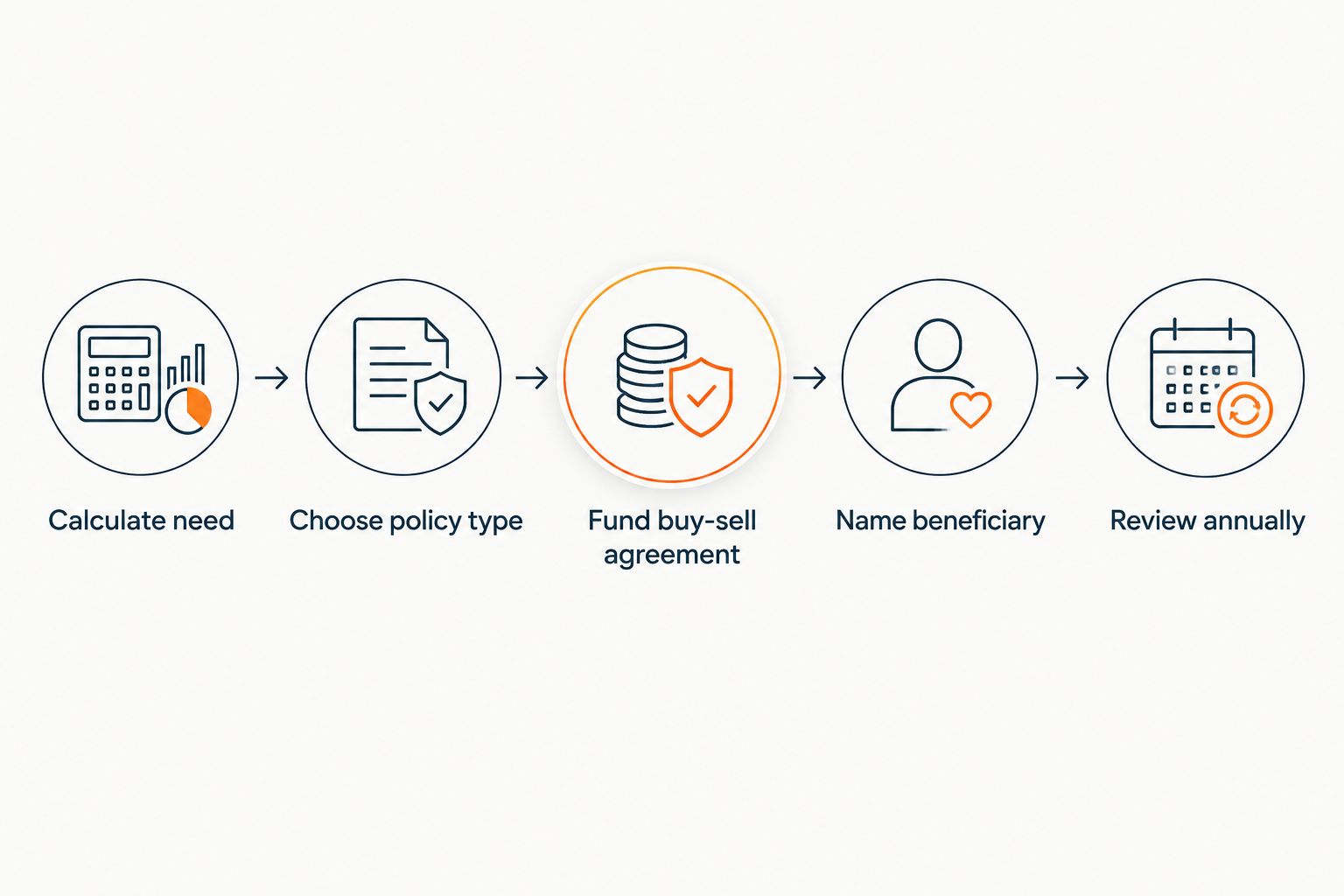
Name the right beneficiary
Beneficiary designation errors are the most common reason a business life insurance payout doesn't do what the owner intended. A policy meant to fund a buy-sell agreement but naming the owner's spouse as beneficiary defeats the entire purpose.
- Name the business entity as beneficiary for key person and entity-purchase buy-sell policies
- Name the co-owner directly for cross-purchase agreements, not the business
- Keep personal income-replacement policies separate, with the spouse or a trust as beneficiary
- Update beneficiary designations any time ownership percentages change
- Check state filing requirements if the business is structured as an LLC versus a corporation
Coordinate personal and business coverage
Owners frequently buy business coverage and personal coverage from different points in time, with different agents, and end up with overlapping or contradictory protection. A single review catches both.
- Compare total coverage across all policies against the combined debt and income-replacement target calculated earlier
- Check whether umbrella insurance for New Hampshire business owners is needed on top of the base liability limits once the business grows past its startup size
- Confirm the business's business owners policy and the life insurance program don't leave gaps between property, liability, and continuity coverage
- Review all policies together at least once a year, or any time revenue, headcount, or ownership changes
“A buy-sell agreement without funding behind it is a plan on paper, not a plan a surviving partner can actually execute.”
Comparison: life insurance options for New Hampshire business owners
| Option | Best for | Key limitation |
|---|---|---|
| Term life insurance | Owners with a defined loan term or young dependents | Coverage ends when the term expires, even if the business is still operating |
| Whole/permanent life insurance | Buy-sell agreements meant to last indefinitely | Costs more per dollar of coverage than term |
| Key person life insurance | Businesses dependent on one specialized owner or employee | Protects business cash flow only, not the owner's own family |
| Cross-purchase buy-sell policy | Partnerships with two or three owners | Gets complicated fast once a fourth owner joins |
Review your business coverage
A quick review lines up your personal and business life insurance in one conversation.
Common mistakes New Hampshire business owners make
- Treating key person insurance like personal life insurance — the payout goes to the business to cover lost revenue and hiring costs, not to the owner's family.
- Letting a buy-sell agreement go unfunded for years after the partnership forms, leaving heirs and surviving partners with no clear mechanism to settle ownership.
- Buying coverage once at startup and never revisiting it, even as the business takes on new debt or the owner's income grows.
- Skipping the personal guarantee check on business loans and leases, missing the exact liability that life insurance was supposed to cover.
- Mixing personal and business coverage into one policy without clear beneficiary language, which creates confusion during underwriting and at claim time.
Each of these mistakes shows up more often in 2026 as New Hampshire small businesses take on more debt and more owners retire without a funded exit plan in place.
FAQ
Do New Hampshire business owners need life insurance separate from personal life insurance?
Yes. Business-focused coverage like key person insurance or a buy-sell funded policy protects the company’s cash flow and ownership structure, while personal life insurance replaces income for a spouse or children. Most owners in New Hampshire need both, sized differently.
How much life insurance does a small business owner need in New Hampshire?
Add outstanding business debt with personal guarantees, the cost to replace the owner’s role, and 5-10 times personal income if dependents rely on that income. A review of how much life insurance coverage New Hampshire residents need turns that estimate into an exact figure.
What is key person life insurance?
Key person life insurance pays the business, not the owner’s family, when a critical owner or employee dies, covering lost revenue and the cost of finding a replacement. It’s separate from any personal coverage that owner also carries.
Is term or whole life insurance better for a business owner?
Term life insurance works best when coverage is tied to a specific debt or loan term, since it costs less per dollar of coverage. Whole life insurance fits buy-sell agreements meant to stay funded for as long as the business operates.
What happens to a business partner’s share if they die without a funded buy-sell agreement?
Their share typically passes to their heirs, who have no obligation to run the business or sell it back to the surviving partner. A life insurance-funded buy-sell agreement gives the surviving partner cash to buy that share on agreed terms instead.
Can an LLC be the beneficiary of a life insurance policy in New Hampshire?
Yes, an LLC or corporation can be named as beneficiary for key person or entity-purchase buy-sell policies. The designation should be updated any time ownership percentages change.
Does a business loan in New Hampshire require life insurance?
Many banks require it as a condition of approval for small business loans, especially when the loan carries a personal guarantee. Without it, the loan balance can come due immediately if the guaranteeing owner dies.
Should life insurance for a business owner be reviewed every year?
Yes, at minimum whenever the business takes on new debt, adds a partner, or the owner’s personal income changes significantly. A policy sized correctly in 2024 can be badly undersized two years later as the business grows.
One last thing
The single most overlooked step isn't buying the policy — it's the beneficiary line. A surprising share of business life insurance claims in partnerships get delayed or disputed because the policy names an individual instead of the entity the buy-sell agreement requires, or vice versa. Check that line before the first premium payment, not after a claim is filed.
Related guides
- How much life insurance coverage New Hampshire residents need
- Term life insurance for New Hampshire families
- Whole life insurance for New Hampshire families
- Best business insurance policies for New Hampshire startups
- Umbrella insurance for New Hampshire business owners