

Auto insurance for drivers with moving violations in New Hampshire costs more with each infraction on the record, and the fastest way to control that cost is understanding exactly how insurers count violations before shopping for a new policy in 2026.
- Auto insurance for drivers with moving violations nh climbs sharply after a second infraction inside 24 months.
- New Hampshire suspends licenses at 12 points in 24 months for drivers over 21, 6 points under 21.
- SR-22 filings are common after serious New Hampshire violations and must stay active without a single lapse.
- Nonstandard and high-risk carriers price this segment more consistently than standard-market insurers do in 2026.
- Re-shopping every renewal beats waiting for a standard insurer to lower a surcharge on its own.
Why multiple moving violations change your auto insurance in New Hampshire
New Hampshire is one of the only states that doesn't mandate auto insurance for every driver, but that changes fast once a court conviction or a license suspension triggers the state's financial responsibility law. A driver with two or three violations inside two years often crosses from "pay a bit more" into "the standard-market insurer won't renew this policy at all." That's when high-risk auto insurance for New Hampshire drivers stops being a fallback and becomes the only realistic option.
Insurers generally pull 3 to 5 years of driving history when pricing a policy, so a violation doesn't disappear from underwriting the moment it drops off a DMV record. New Hampshire's own demerit point system suspends a license at 12 points within a 24-month window for drivers 21 and over, and at 6 points for drivers under 21. Getting close to that threshold, or having already crossed it once, is exactly what pushes a standard carrier to non-renew.
Pull your New Hampshire driving record before you shop
Every quote conversation goes faster and gets more accurate when the driver, not the carrier, controls the record.
- Request the official driving history through the NH DMV rather than relying on memory of what was on the ticket
- Note the conviction date on each violation, since that's what insurers count, not the citation date
- Confirm which entries carry points and which are fine-only with no point value
- Check for any error or duplicate entry before it gets baked into a quote
- Keep a copy on hand for every agent who quotes the policy
Understand New Hampshire's point system and the 24-month lookback
A single violation rarely moves the needle much on its own. Two violations in a short span usually signals "high-risk" to an underwriter even below the 12-point suspension line, and a third inside 24 months almost always forces a move to the nonstandard market.
- Points reset on the DMV side over time, but the underlying conviction can still sit on an insurer's file for years after that
- A violation stacked on top of an at-fault accident compounds the surcharge faster than either would alone
- Reckless operation and repeat offenses carry more underwriting weight than a single speeding ticket, even at the same point value
- A conviction that later gets reduced in court doesn't automatically update on an insurer's file
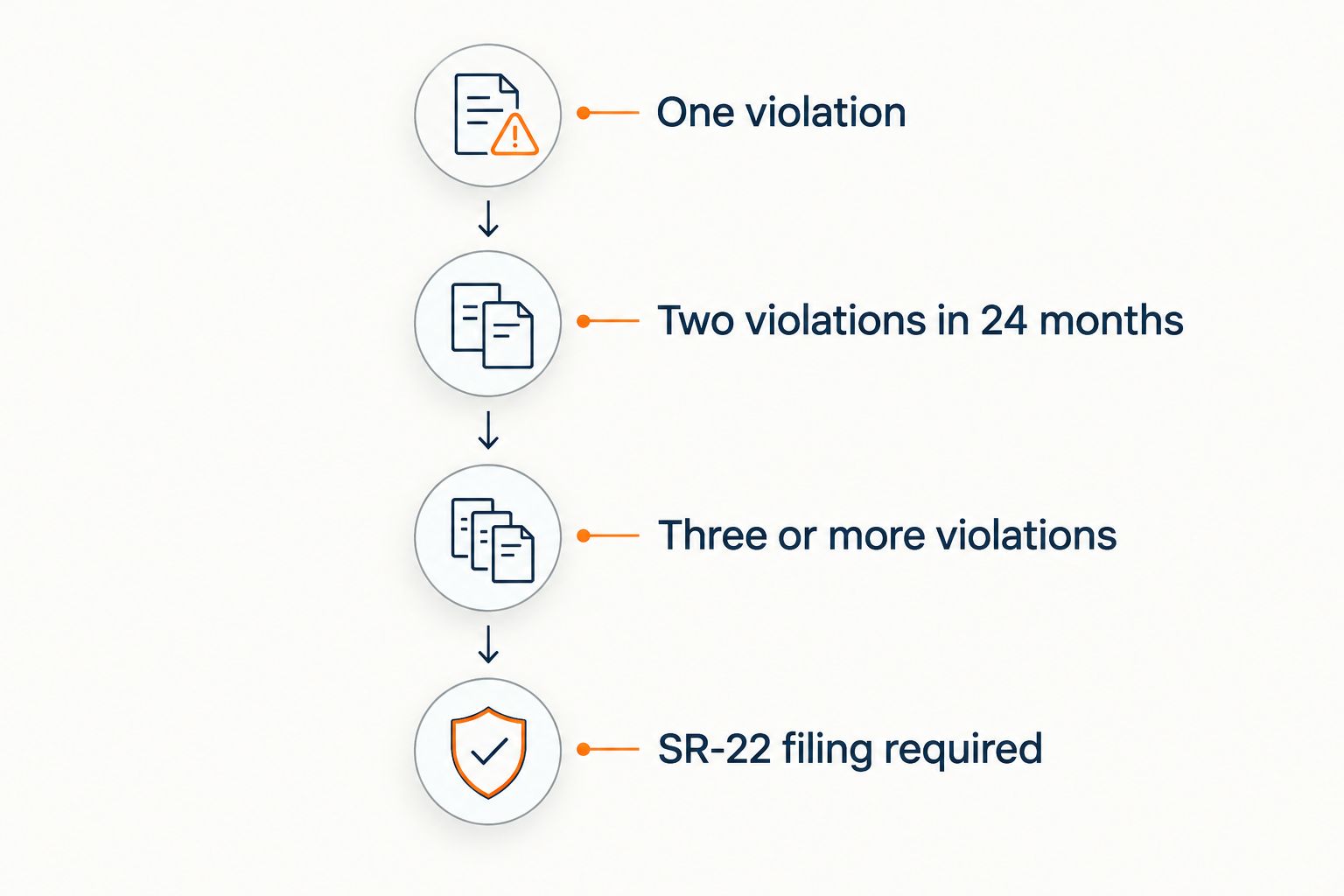
Compare high-risk and nonstandard auto insurers before renewing
A standard carrier that declines to renew isn't punishing the driver personally, it's applying a rule that a nonstandard insurer is built to price around instead.
- Get quotes from at least three nonstandard or high-risk carriers, not just the standard insurer already on file
- Ask whether an SR-22 filing fee is included in the quote or billed as a separate line item
- Compare offered liability limits against New Hampshire's own financial responsibility minimums, not just the lowest number quoted
- Ask if the carrier reports payment history in a way that helps requalify for standard rates later
- Confirm uninsured motorist coverage isn't quietly dropped to make the premium look lower
File an SR-22 if New Hampshire requires it
SR-22 filings show up most often after a DUI, reckless operation, an at-fault accident without insurance, or a license reinstatement following suspension. The filing itself isn't a policy, it's proof to the state that a policy exists.
- Confirm with NH DMV whether the specific violation combination on record actually triggers an SR-22 requirement
- Have the SR-22 insurance filed electronically by the insurer so there's no gap between policy and filing
- Track the required filing period independently; a lapse restarts the clock from zero
- Budget for the filing fee as a cost on top of the premium itself
- Stay with the same insurer through the full filing window if switching carriers risks even a one-day lapse
Cut the cost without dropping required coverage
The fastest savings come from the parts of the policy that were never mandatory in the first place.
- Raise the collision and comprehensive deductible on any vehicle a few years past new
- Bundle auto with a home, condo, or renters policy through the same carrier for a multi-policy credit
- Drop rental reimbursement or roadside assistance if there's another way to cover those costs
- Ask directly whether a usage-based or telematics program will even accept an application with recent violations
- Keep liability limits at or above New Hampshire's financial responsibility minimums while trimming everything else
Take a defensive driving course
A completion certificate can do two different things depending on the carrier, and it pays to know which one applies before enrolling.
- Confirm the course is DMV-approved, not just any generic online class
- Ask the insurer in advance whether completion earns a rate credit or only DMV point relief
- Complete it as early as possible since credits typically apply at the next renewal, not retroactively
- Keep the certificate on file; some carriers ask for proof more than once during a filing period
Re-shop the policy every renewal, not just after the first violation
Nonstandard pricing rarely corrects itself the way a standard policy's surcharge fades over a few claim-free years.
- Get new quotes at every 6-month or annual renewal since violations age off the insurer's lookback window over time
- Ask each carrier exactly which entries they still count and which have already dropped off
- Move back to a standard carrier the moment the record qualifies; nonstandard premiums don't drop on their own
- Keep coverage continuous through any switch, since even a one-day lapse can reset the risk tier
Comparison table: options for New Hampshire drivers with multiple violations
| Option | Best for | Key limitation | Verdict |
|---|---|---|---|
| Standard-market insurer | One older violation, no SR-22 requirement | Often non-renews after a second violation inside 24 months | Hold if you still qualify, otherwise skip |
| Nonstandard/high-risk insurer | Two or more violations or a recent at-fault accident | Coverage options are typically narrower than standard policies | Buy for most drivers in this segment |
| SR-22 specialist carrier | Drivers ordered to file an SR-22 | Filing fee and stricter payment terms add friction | Buy if the state requires the filing |
| Non-owner auto policy | Suspended-license drivers who still need proof of insurance | Doesn't cover a vehicle you own or drive regularly | Buy only if you don't own a car |
| Telematics/usage-based program | Drivers whose actual habits have improved since the violations | Some programs exclude recent-violation applicants outright | Wait and confirm eligibility before assuming a discount |
Common mistakes New Hampshire drivers with multiple violations make
- Assuming New Hampshire's no-mandatory-insurance rule offers protection. Once financial responsibility law or an SR-22 filing applies, letting coverage lapse for even a day can add a license suspension on top of the record already working against the driver.
- Comparing only two quotes. Nonstandard pricing varies more carrier to carrier than standard pricing does, and drivers with a DUI on record in particular benefit from comparing more than two carriers before signing anything.
- Not reporting a reduced charge to the insurer. A carrier prices off the original charge until it receives proof from the driver that the court disposition changed.
- Letting the claims file get messy after a violation-related accident. Every detail entered during that claim follows the driver into the next quote, and a sloppy file reads as higher risk even when the outcome was minor.
- Treating a serious charge as an insurance-only problem. A reckless operation charge or a second offense inside New Hampshire's lookback window can carry criminal exposure on top of the insurance surcharge, and a criminal defense lawyer guide covering charges, costs and how to choose counsel lays out what to ask before hiring someone to handle that half of the situation.
Get your NH auto policy reviewed
A quick review of your driving record and current coverage before you renew.
FAQ
What’s the best auto insurance for drivers with multiple moving violations in New Hampshire?
A nonstandard or high-risk carrier is usually the best fit once a driver has two or more violations inside 24 months, since standard-market insurers frequently decline to renew at that point. Themello Agency compares several nonstandard options rather than quoting just one.
How many points before New Hampshire suspends a license?
New Hampshire suspends a license at 12 points within a 24-month window for drivers 21 and over, and at 6 points for drivers under 21. Points from older violations can still show up on an insurer’s file after they’ve cleared with the DMV.
Does New Hampshire require auto insurance?
New Hampshire is one of the only states that doesn’t mandate auto insurance for every driver. Financial responsibility law and SR-22 filings after certain violations still require proof of coverage, so most drivers with multiple violations end up needing a policy regardless.
How long does a moving violation affect car insurance rates in New Hampshire?
Insurers typically look at 3 to 5 years of driving history when pricing a policy in 2026. A violation can still influence the quote after it drops off a DMV record, depending on the carrier’s own lookback window.
Is SR-22 insurance required after multiple violations in New Hampshire?
It depends on the violation type. DUI convictions, reckless operation, at-fault accidents without insurance, and license reinstatements after suspension are the situations most likely to trigger an SR-22 requirement in New Hampshire.
Can I lower my rate after a DUI or multiple violations in New Hampshire?
Yes. Completing a DMV-approved defensive driving course, raising deductibles, bundling policies, and re-shopping every renewal all reduce cost without dropping required coverage.
What happens if I let my New Hampshire auto insurance lapse after a violation?
A lapse can restart an SR-22 filing period from zero and may trigger an additional license suspension on top of the existing violations. Continuous coverage matters more for this segment than for a clean-record driver.
Is non-owner car insurance an option after a license suspension in New Hampshire?
Yes, a non-owner policy provides proof of insurance for drivers who don’t own a vehicle but still need coverage on file, often to satisfy a reinstatement or SR-22 requirement.
One last thing
The DMV's point clock and an insurer's underwriting clock don't run on the same schedule, which is why two drivers with the same New Hampshire record can get different quotes six months apart. Re-shop the exact month a violation would drop off an insurer's stated lookback window, not just at the annual renewal date — some carriers reprice mid-term when a driver asks, and waiting for the renewal notice to arrive leaves money on the table for months in 2026.
Related guides
- How to lower car insurance rates after an accident in NH
- Auto insurance for drivers with a suspended license in NH