
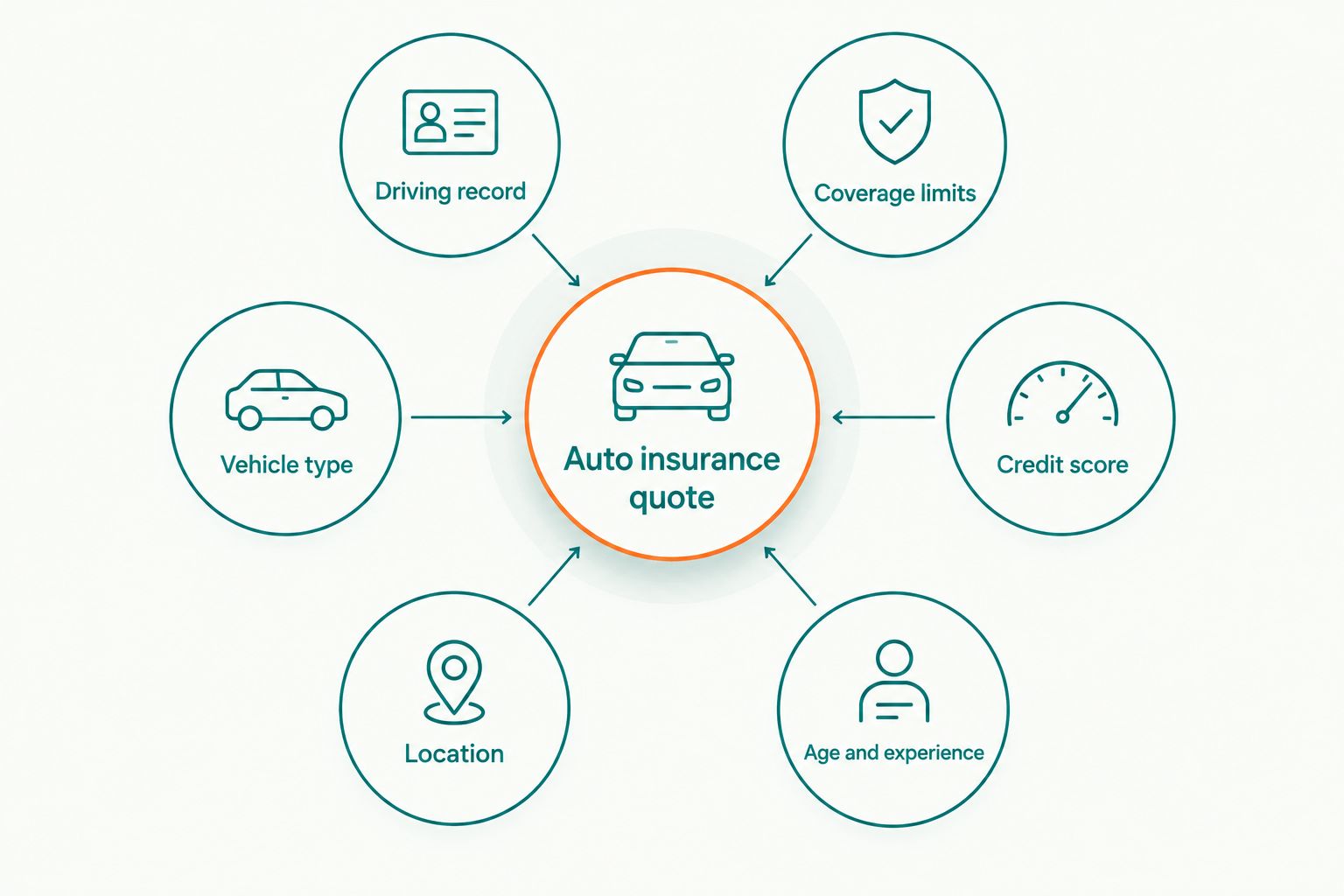
New Hampshire is unusual: it's the only state that doesn't force drivers to carry auto insurance, yet the quotes issued by carriers there still swing widely based on the same handful of risk factors used everywhere else. Your driving record, coverage limits, vehicle, credit-based insurance score, and location decide what affects your auto insurance quote in New Hampshire more than any other inputs.
- Driving record, coverage limits, vehicle type, credit score, and location decide what affects your auto insurance quote in New Hampshire.
- New Hampshire is the only state that doesn’t require auto insurance unless specific triggers apply, like financing a car.
- Multiple moving violations or a DUI push a quote into high-risk pricing fast in 2026.
- Bundling home and auto, raising deductibles, and clean renewals are the most direct ways to bring a quote down.
- Compare quotes from more than one New Hampshire carrier — the same driver profile can price very differently.
Why this matters
Most New Hampshire drivers assume their quote is set by age and zip code alone, then get surprised when a clean-record neighbor pays less for the same coverage. It isn't one factor — it's a stack of them, and a few carry far more weight than the rest.
Understanding which levers actually move the number means you stop wasting time on things that don't matter (like your car's paint color) and focus on the ones that do, like the state's minimum auto insurance requirements and how your coverage choices sit against them. New Hampshire's lack of a mandatory insurance law doesn't mean the underwriting math is any different — carriers still price risk the same way they do in states with strict requirements.
What affects your auto insurance quote in New Hampshire
Here's how the major factors rank by typical influence on a New Hampshire quote:
| Factor | Impact on quote | Can you control it? |
|---|---|---|
| Driving record (tickets, accidents, DUIs) | High | Yes |
| Coverage limits and deductible | High | Yes |
| Vehicle make, model, and age | Medium-High | Yes |
| Credit-based insurance score | Medium | Partially |
| Garaging location / zip code | Medium | No |
| Age and years licensed | Medium | No |
| Annual mileage | Low-Medium | Yes |
| Marital status | Low | No |
The top three rows do most of the work. A driver with a clean record who carries state-minimum limits on an older sedan will always quote lower than a driver with a recent at-fault accident carrying full coverage on a new SUV, regardless of where either of them lives in New Hampshire.
Driving record
This is the single heaviest factor on a New Hampshire auto insurance quote. One at-fault accident or a DUI can push your premium into a different pricing tier entirely, and carriers typically look back three to five years depending on the violation type. Drivers carrying multiple moving violations often need to shop specialty or non-standard carriers because standard-market insurers price them out or decline coverage outright.
A lapse in coverage counts against you too, even without a ticket attached — insurers read a gap as unmanaged risk.
Coverage limits and deductible
Raising your liability limits above New Hampshire's baseline adds cost, but it's cost you control directly. The trade-off runs the other way with deductibles: a higher collision or comprehensive deductible lowers your premium but means more out-of-pocket cash if you file a claim.
This is the fastest lever to pull if a quote comes back higher than expected — adjust the deductible before you assume the carrier is wrong.
Vehicle make, model, and age
Repair cost, safety ratings, and theft rates all factor into what a specific vehicle costs to insure. A newer vehicle with advanced safety features can sometimes offset its higher replacement cost with a lower risk score, while a vehicle with a history of expensive parts or high theft rates in New Hampshire pushes the other way.
Credit-based insurance score
New Hampshire allows insurers to use credit-based insurance scores as a rating factor, and it's one of the more misunderstood pieces of a quote. It isn't your credit score in the traditional sense — it's a separate model that weighs payment history and credit utilization to predict claims likelihood. Drivers with bad credit in New Hampshire often see meaningfully higher quotes even with a perfect driving record, which is why shopping multiple carriers matters more for this group than almost any other.
Location and garaging zip code
Where your vehicle is garaged overnight affects claims frequency data tied to that area — traffic density, weather exposure, and local claims history all factor in. You can't change your address to chase a lower rate, but it's worth knowing this line item exists so a quote difference between towns doesn't look like an error.
Why quotes vary between drivers
Beyond the core rating factors, a few New Hampshire-specific details shift a quote further:
- SR-22 filing requirements after certain violations add a filing fee and typically move you into a higher-risk rate class.
- Coverage lapses of any length signal risk to underwriters, even for otherwise clean drivers.
- Annual mileage — low-mileage drivers who commute short distances or work from home often qualify for reduced rates.
- Multi-policy bundling, pairing auto with a homeowners or renters policy, is one of the more reliable discounts carriers offer.
- Vehicle usage type — a car used for rideshare or delivery work needs different coverage than personal use and prices differently.
- Number of vehicles and drivers on one policy — insuring multiple cars together can lower the per-vehicle rate compared to separate policies.
Does New Hampshire require auto insurance?
No — New Hampshire is the only state in the country that doesn't mandate auto insurance for most drivers, though financial responsibility laws still apply if you're in an at-fault accident, and lenders require coverage if you finance or lease a vehicle. Once one of those triggers hits, you're expected to meet the state's minimum auto insurance requirements just like a driver in any other state.
How can I lower my auto insurance quote in New Hampshire?
The fastest changes are raising your deductible, bundling policies, and asking about every auto insurance discount available in New Hampshire before you finalize a policy — discounts for safe driving, low mileage, and multi-vehicle households stack in ways a single quote screen won't show automatically.
Get a quick quote review
Call or text to compare your current auto insurance against other New Hampshire carriers.
FAQ
Does New Hampshire require auto insurance?
New Hampshire does not require most drivers to carry auto insurance, making it the only state with no general mandate. Financial responsibility rules still apply after an at-fault accident, and any lender financing your vehicle will require coverage regardless of state law.
What’s the minimum auto insurance coverage in New Hampshire?
New Hampshire’s minimum liability limits, when insurance is carried or required, are 25/50/25 for bodily injury and property damage plus matching uninsured/underinsured motorist coverage. These limits apply once a driver triggers the state’s financial responsibility requirement.
How does credit affect my auto insurance quote in New Hampshire?
A credit-based insurance score is a legal rating factor in New Hampshire and can raise a quote even for drivers with a clean driving record. It’s a separate model from a standard credit score, weighing payment history and credit usage as predictors of claims risk.
Does my zip code affect my auto insurance quote?
Yes, garaging location affects a New Hampshire auto insurance quote through local claims frequency, traffic density, and weather exposure tied to that area. You can’t change this factor directly, but it explains rate differences between towns for otherwise similar drivers.
What happens to my auto insurance after a DUI in New Hampshire?
A DUI in New Hampshire typically triggers an SR-22 filing requirement and moves a driver into a high-risk rate class with most standard carriers. Rates usually stay elevated for several years until the violation ages off the driving record.
Do New Hampshire teens pay more for auto insurance?
Yes, younger drivers with less time licensed generally see higher auto insurance quotes in New Hampshire because of limited driving history data. Adding a teen to an existing family policy is usually cheaper than a standalone policy for the same driver.
Can bundling lower my auto insurance quote in New Hampshire?
Bundling auto with a homeowners or renters policy is one of the more consistent ways to lower combined premiums with the same New Hampshire carrier. The exact savings depend on the carrier and the driver’s full risk profile, so it’s worth asking directly during a quote review.
Can I get auto insurance after a coverage lapse in New Hampshire?
Yes, but a coverage lapse of any length typically raises a New Hampshire auto insurance quote because it signals unmanaged risk to underwriters. Getting a new policy in place quickly after a lapse limits how much that gap affects pricing.
One last thing
The factor drivers overlook most in New Hampshire isn't credit or mileage — it's the state's own no-mandate law working against them. Because coverage isn't legally required for most drivers, some go without it entirely, then face a coverage lapse penalty the moment they do need a policy after financing a car or causing an accident. Reviewing your policy annually, even in a state with no insurance mandate, is the one habit that keeps a 2026 quote from drifting higher than it needs to.
Related guides
- Auto insurance for drivers with multiple moving violations in New Hampshire
- Auto insurance for drivers with bad credit in New Hampshire
- Auto insurance discounts available in New Hampshire
- How to meet New Hampshire's minimum auto insurance requirements
- Best auto insurance companies in New Hampshire