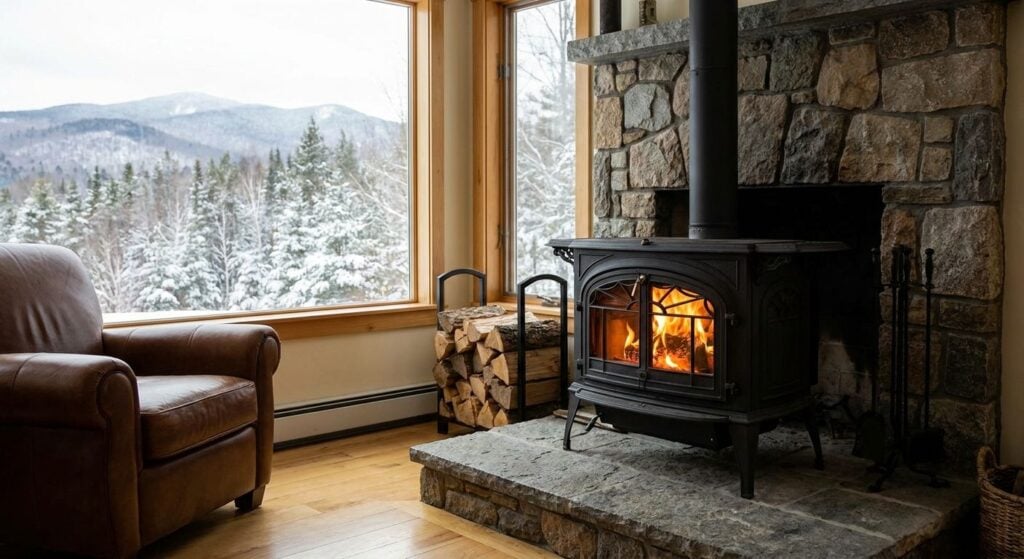
A wood stove cuts your heating bill through a New Hampshire winter, but it also changes how a carrier underwrites, prices, and sometimes declines your home insurance. Here's what to check before you renew or switch home insurance wood stove NH coverage in 2026.
- A wood stove endorsement is the standard fix for home insurance wood stove NH policies – Buy for a permitted, inspected install.
- Insurers usually want proof of professional installation and a chimney inspection dated within the last 12 months.
- Camps and seasonal properties need a vacation home policy, not a standard HO-3 – Consider before you bind.
- Pairing home and auto with one NH carrier keeps underwriting flexible when a single-line insurer hesitates on wood heat.
Why this matters
Wood and pellet stoves heat a large share of rural New Hampshire homes, especially off the gas line in towns around Amherst, Milford, and the Monadnock region. Mello Agency writes home insurance for Amherst NH homeowners who heat with wood, and the underwriting questions look nothing like a standard furnace-heated house.
Carriers treat a wood stove as an elevated fire risk the moment it shows up on an application. NFPA 211 calls for at least 36 inches of clearance between an unlisted stove and combustible material, less for a UL-listed unit with proper shielding. The Chimney Safety Institute of America recommends a chimney sweep and inspection once a year for regular wood burners.
Skip either requirement and a carrier can non-renew the policy or deny a fire claim outright, even with the premium paid in full. That's the gap this guide closes before renewal season hits in 2026.
Who this is for
This guide is built for New Hampshire homeowners who heat all or part of a house with cordwood or pellets – primary residences off natural gas, older farmhouses with an existing but undocumented stove, and anyone shopping for a policy who also runs a wood stove through the winter. Camp and seasonal property owners fit here too, since a stove running November through March changes how a policy needs to be written and priced.
What to look for in home insurance for a wood stove home
Proof of installation and inspection
Carriers want documentation, not a verbal description of the setup. A permit from the town, an installation certificate from a licensed installer, and a chimney inspection dated within the past 12 months cover most underwriting requests in 2026. Without that paperwork, expect a request for an inspection before binding, or a flat decline on the application.
Wood stove liability and rebuild coverage
Fire is the costliest peril a homeowner's policy pays out on, and a wood stove raises that exposure directly. Confirm the dwelling coverage limit reflects current rebuild cost in your NH town, not the purchase price of the home – rebuild cost runs higher than resale value in most 2026 New Hampshire markets, and a stove fire is exactly the claim that tests this number.
Replacement cost on the stove and chimney liner
A stove and its liner are expensive to replace and often excluded or capped under a basic policy. Ask whether the policy pays replacement cost or actual cash value on the stove itself. Actual cash value on a 10-year-old stove pays out a fraction of what a new comparable unit costs installed.
How the policy treats seasonal or vacation properties
A camp that runs a wood stove three or four months a year isn't underwritten the same way as a year-round primary residence. Vacation home insurance for Amherst NH properties accounts for extended vacancy periods, which matters because an unattended stove and an unattended home are two separate risk factors a carrier prices for separately.
Underwriting flexibility
Some carriers simply won't write a policy with an active wood stove, full stop. Others write it with an endorsement and a short requirement list. Ask directly whether the carrier declines wood heat before spending time on paperwork – this single question saves the most time in the shopping process.
Bundling stability
Pairing home and auto under one carrier often keeps a wood-stove home insurable when a standalone home policy gets more scrutiny at renewal. Auto insurance for Amherst NH drivers written with the same carrier as the home policy gives an underwriter more reason to keep the account than to decline one piece of it.
Coverage options worth comparing
Mello Agency's home insurance team in NH sees the same four scenarios come up on almost every wood stove renewal.
The safe pick: standard HO-3 with a wood stove endorsement. Requires an installation certificate and a chimney inspection dated within the past year – most 2026 NH carriers ask for both before binding. This is the right fit for a year-round primary residence with a permitted, code-compliant stove. Verdict: Buy.
The wildcard: a seasonal or camp policy for a stove-heated vacation property. Seasonal occupancy under six months a year still carries the same documentation requirement in most cases, plus a vacancy clause the standard HO-3 doesn't have. Verdict: Consider if the stove is the only heat source on the property.
The bundle play: home and auto with the same carrier. No single spec defines this one – it's about underwriting leverage. A carrier hesitant to write standalone wood-stove risk often stays in when the account includes a paying auto policy too. Verdict: Consider if your current carrier flags the stove at renewal.
The overlooked one: ordinance or law coverage for an older install. Town fire codes have tightened since many older NH stoves went in, sometimes decades before 2026. If a stove predates the current code, ordinance or law coverage pays the gap between what a standard policy rebuilds and what code now requires. Verdict: Buy if the home or the stove is older than 15 years.
Get your wood stove policy reviewed
A quick review confirms your coverage matches your stove before renewal season.
What to avoid
- Skipping the installation certificate to save a step. No paperwork means a carrier can deny a fire claim even with a valid policy in force.
- Assuming a pellet stove underwrites identically to a wood stove. Some carriers price and document them differently – ask which category your unit falls under before you bind.
- Letting a seasonal camp sit vacant without telling the carrier. An unoccupied wood-stove property for weeks at a time can trigger a vacancy clause that limits or voids coverage.
Quick comparison
| Coverage option | Best for | Key requirement | Verdict |
|---|---|---|---|
| HO-3 with wood stove endorsement | Year-round primary residence | Install certificate + inspection within 12 months | Buy |
| Seasonal/camp policy | Stove-heated vacation property | Same documentation, plus vacancy clause | Consider |
| Home + auto bundle | Homes flagged at renewal | Multi-policy account with one carrier | Consider |
| Ordinance or law add-on | Stove or home older than 15 years | Confirms rebuild meets current code | Buy |
FAQ
Does home insurance cover wood stove damage in New Hampshire?
Most NH home insurance policies cover fire damage from a properly installed and documented wood stove. Coverage narrows or disappears if the stove lacks an installation certificate or a chimney inspection dated within the past year.
Is home insurance more expensive with a wood stove in NH?
A wood stove can raise underwriting scrutiny more than it raises premium on its own in 2026. The bigger cost driver is whether the carrier requires an inspection, an endorsement, or declines the risk outright.
How much clearance does a wood stove need for insurance approval?
NFPA 211 calls for at least 36 inches of clearance from combustible material for an unlisted stove, less for a UL-listed unit with proper shielding. Carriers typically want this documented on the installation certificate.
Do I need a chimney inspection before insuring a wood stove?
Most carriers ask for a chimney inspection dated within the past 12 months before binding a policy with an active wood stove. The Chimney Safety Institute of America recommends this inspection annually regardless of insurance.
Can an insurer deny coverage for a wood stove home in NH?
Yes, some carriers decline to write any home with an active wood stove regardless of documentation. Others write it with an endorsement, so ask directly before starting paperwork.
Is a pellet stove treated the same as a wood stove for insurance?
Not always. Some NH carriers document and price pellet stoves differently than cordwood stoves, so confirm which category applies to your unit.
Does a vacation home with a wood stove need a different policy?
A camp or seasonal property running a wood stove usually needs a vacation home policy rather than a standard HO-3, mainly because of the vacancy clause. The documentation requirements for the stove itself stay similar.
What happens if my wood stove installation predates current fire code?
An older stove install that predates current town fire code can leave a rebuild-cost gap after a claim. Ordinance or law coverage closes that gap by paying the difference between the old install and what code now requires.
One last thing
Most wood-stove insurance claims in NH don't start with the stove itself – they start with the ash. Ash disposed of in a cardboard box or plastic bucket before it's fully cooled is a documented cause of house fires, and fire marshal guidance is to hold ash in a covered metal container for at least 72 hours before disposal. That single habit shows up in claim denials more often than a bad install does. Call or text Mello Agency for a quick review of your wood stove home insurance before your 2026 renewal date.
Related guides