

Best overall: National Flood Insurance Program (NFIP). Best for coverage above NFIP limits: Neptune Flood. Best for NFIP coverage through an independent agent: Wright National Flood Insurance Company. Best budget option for qualifying lower-risk properties: NFIP Preferred Risk Policy. Themelloagency’s 2026 guide compares these options for New Hampshire homeowners, renters, lake-property owners, and businesses.
- NFIP is the best overall option among the best flood insurance companies in New Hampshire for homes in mapped flood zones.
- Neptune Flood is best for homes requiring building coverage above NFIP’s $250,000 residential limit.
- Wright National Flood Insurance Company is best for buyers who want an NFIP policy serviced by a participating insurer.
- NFIP Preferred Risk Policy is the budget pick for qualifying properties in lower-risk flood zones.
- Standard homeowners insurance excludes flooding, so New Hampshire property owners need separate flood coverage.
Why this matters in 2026
Standard homeowners insurance does not cover flooding caused by rising water. New Hampshire homeowners need a separate flood policy through NFIP or a private flood insurer, while renters need contents coverage for their belongings.
A lender generally requires flood insurance when a home in a Special Flood Hazard Area secures a federally backed mortgage. Outside those mapped areas, coverage is usually optional. Optional does not mean unnecessary: a flood map determines the lending requirement, not whether water can reach your property.
Before choosing a company, review how much flood insurance costs in New Hampshire. In 2026, the useful comparison is not a statewide average; it is the coverage, exclusions, waiting period, and quote for your address.
Themelloagency’s flood insurance review is best suited to New Hampshire residents who want a direct comparison between federal and private coverage.
What makes the best flood insurance in New Hampshire
Use these criteria to compare every 2026 flood insurance quote:
- Building limit: The maximum available payment for covered damage to the insured structure.
- Contents limit: The separate maximum for covered belongings inside the property.
- Basement treatment: Policies sharply restrict what they cover below ground level.
- Waiting period: Coverage generally does not begin immediately after purchase.
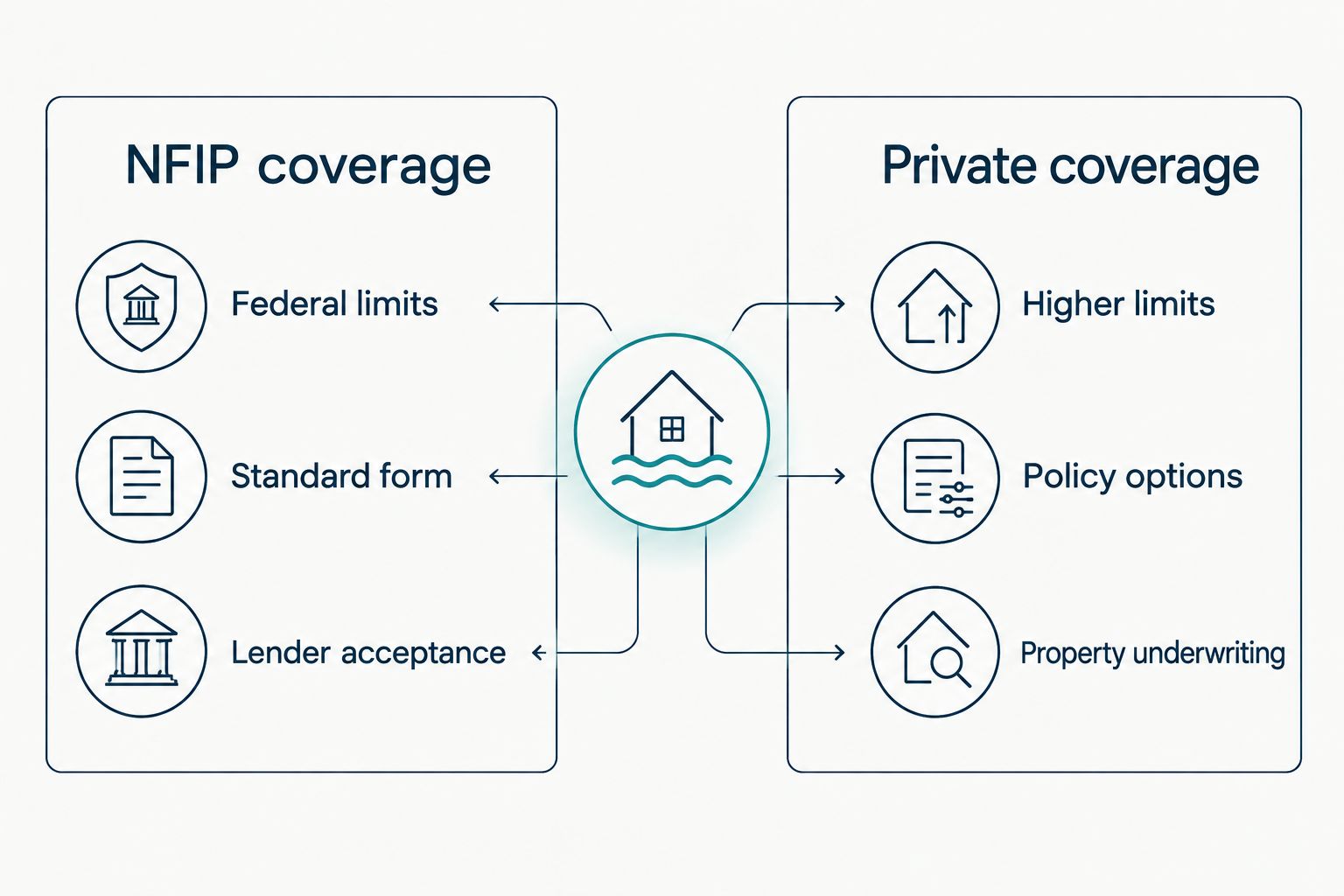
- Lender acceptance: A private policy must satisfy the mortgage company’s requirements.
- Claims service: Confirm who receives the claim, documents the loss, and communicates decisions.
Do not compare flood policies by company name alone. Two NFIP policies sold by different insurers use the same federal coverage form, limits, and exclusions; the servicing company and agent experience are the primary differences.
Best flood insurance companies in New Hampshire at a glance
| Rank | Company or program | Best for | Standout feature | Key limitation |
|---|---|---|---|---|
| 1 | National Flood Insurance Program | Homes in mapped flood zones | Federal program available in participating communities | $250,000 residential building limit |
| 2 | Neptune Flood | Homes needing higher limits | Private coverage above NFIP residential limits | Terms and eligibility depend on the property |
| 3 | Wright National Flood Insurance Company | NFIP buyers wanting insurer servicing | Participates in FEMA’s Write Your Own program | Uses the same NFIP limits and coverage form |
| 4 | NFIP Preferred Risk Policy | Qualifying lower-risk properties | NFIP option for eligible properties | Eligibility depends on flood zone and loss history |
1. National Flood Insurance Program: best overall for mapped flood zones
The National Flood Insurance Program is administered by FEMA and provides flood coverage in participating communities. Homeowners can purchase an NFIP policy through an insurer or insurance agent, but the federal program establishes the policy form and residential limits.
In 2026, NFIP remains the default comparison point because lenders recognize it and its terms are standardized. A single-family residential policy can provide up to $250,000 in building coverage and $100,000 in contents coverage.
NFIP pros:
- Available in New Hampshire communities participating in NFIP
- Federally defined policy terms make quotes easier to compare
- Accepted for applicable federal mortgage requirements
- Building and contents coverage can be selected separately
NFIP cons:
- The $250,000 building limit can leave higher-value homes underinsured
- The $100,000 contents limit can be restrictive for some households
- Basement coverage is limited, especially for finishes and personal property
- A standard 30-day waiting period applies in many situations
Finished lower levels require particular attention. NFIP generally limits basement protection to specified building systems, appliances, and structural items rather than treating a basement like an above-grade living room. Review flood insurance for finished basements in New Hampshire before selecting limits.
NFIP best for: New Hampshire homeowners in mapped high-risk zones, borrowers satisfying a lender requirement, and buyers who prioritize standardized federal coverage.
Verdict: Buy when you need dependable lender acceptance and the federal limits adequately protect the property.
2. Neptune Flood: best for coverage above NFIP limits
Neptune Flood offers private flood insurance rather than an NFIP policy. Its central advantage is the ability to insure residential buildings and belongings beyond the federal program’s maximum limits, subject to underwriting and policy terms.
Private coverage deserves a close look when the cost to rebuild your home is higher than $250,000. Compare the deductible, loss-settlement terms, basement restrictions, temporary-living-expense provisions, and lender requirements instead of focusing only on the higher headline limit.
Neptune Flood pros:
- Building coverage can exceed NFIP’s residential maximum
- Contents coverage can exceed NFIP’s $100,000 maximum
- Private underwriting can produce a different result from an NFIP quote
- May include coverage options not found in the standard NFIP form
Neptune Flood cons:
- Eligibility and terms depend on the individual property
- A mortgage servicer must confirm that the policy satisfies its requirements
- Private-policy provisions are not identical to the NFIP form
- Renewal terms can change based on the insurer’s underwriting rules
Neptune Flood best for: higher-value New Hampshire homes, households needing larger contents limits, and owners who want to compare private terms against NFIP in 2026.
Verdict: Buy when NFIP limits would leave a clear gap and the private policy satisfies your lender.
3. Wright National Flood Insurance Company: best for NFIP servicing
Wright National Flood Insurance Company participates in FEMA’s Write Your Own program. It issues and services NFIP policies, but the federal government sets the underlying coverage form, maximum limits, and major exclusions.
Choosing Wright does not increase the NFIP building or contents limit. The reason to select a Write Your Own carrier is the servicing relationship: how you purchase the policy, receive documents, make payments, and begin a claim.
Wright Flood pros:
- Provides access to the standardized NFIP policy
- Works within FEMA’s Write Your Own structure
- Lets buyers obtain federal flood insurance through an insurer and agent
- Uses NFIP coverage accepted for applicable mortgage requirements
Wright Flood cons:
- The $250,000 residential building limit still applies
- The $100,000 residential contents limit still applies
- NFIP basement restrictions remain unchanged
- Choosing a servicing carrier does not change the federal policy form
Wright Flood best for: New Hampshire buyers who want an NFIP policy and prefer insurer-based policy servicing rather than treating FEMA as their primary point of reference.
Verdict: Hold until you compare the service process with other companies offering the same NFIP form.
4. NFIP Preferred Risk Policy: best budget option
The NFIP Preferred Risk Policy is designed for eligible properties in lower-to-moderate-risk flood zones. It is not a separate insurance company; it is an NFIP policy option with qualification rules tied to the property’s flood designation and loss history.
This option can fit homeowners who want flood protection even though a lender does not require it. Renters can also consider contents-only flood coverage because a landlord’s building policy does not insure a tenant’s furniture, electronics, clothing, or other belongings.
Preferred Risk Policy pros:
- Provides NFIP coverage for eligible lower-risk properties
- Supports building-and-contents or contents-only coverage, depending on occupancy
- Uses the same federal program backing as other NFIP policies
- Gives property owners outside high-risk zones a clear coverage option
Preferred Risk Policy cons:
- Not every property qualifies
- NFIP building and contents limits still apply
- Basement restrictions do not disappear
- A property’s eligibility can change after remapping or qualifying losses
Preferred Risk Policy best for: eligible homeowners outside high-risk zones and renters who need contents protection in 2026.
Verdict: Buy if the property qualifies and the federal limits match the amount you need to protect.
Review your flood coverage
Compare federal and private flood insurance for your New Hampshire property.
How this 2026 ranking works
The ranking gives the top position to the option that fits the broadest group of New Hampshire property owners. NFIP ranks first for availability, standardized terms, and lender familiarity. Neptune Flood ranks second because higher limits solve a major NFIP weakness, but eligibility and policy terms vary by address.
Wright ranks third because it services NFIP coverage rather than replacing the federal product with different limits. The Preferred Risk Policy ranks fourth because it is useful but restricted to qualifying properties.
The right order changes when your needs change. A higher-value home should move private insurance to the top, while an eligible renter can skip building coverage and focus on contents.
Which flood insurance company should you choose?
Choose NFIP if you want the safest default in 2026. It is the strongest starting point for a home in a mapped flood zone, a property subject to lender requirements, or a household whose coverage needs fit within federal limits.
Choose Neptune Flood when $250,000 of building coverage or $100,000 of contents coverage is not enough. Ask the mortgage servicer to approve the private policy before replacing an existing NFIP policy.
Choose Wright National Flood Insurance Company when you want an NFIP policy serviced through a participating insurer. Choose the Preferred Risk Policy when the property qualifies and you want federal flood protection outside a high-risk zone.
Themelloagency can help you review flood insurance alongside home, condo, landlord, or business coverage. Keep the decision practical: insure the structure for an appropriate amount, protect the belongings you would need to replace, and read the basement restrictions before binding coverage.
FAQ
What’s the best flood insurance company in New Hampshire in 2026?
NFIP is the best overall flood insurance option for most New Hampshire properties in 2026 because it offers standardized federal coverage in participating communities. Neptune Flood is the stronger comparison for homes needing limits above NFIP’s maximums.
Is flood insurance required in New Hampshire?
Flood insurance is generally required when a federally backed mortgage covers a building in a Special Flood Hazard Area. Property owners outside those areas can usually purchase coverage voluntarily.
Does New Hampshire homeowners insurance cover floods?
No, standard homeowners insurance excludes damage caused by flooding from rising water. You need a separate NFIP or private flood policy for that risk.
How much does flood insurance cost in New Hampshire?
Flood insurance cost depends on the property, flood risk, selected limits, deductible, and policy type. Compare an address-specific NFIP quote with available private quotes rather than relying on a statewide average.
Is private flood insurance better than NFIP?
Private flood insurance is better when you need higher limits or policy features unavailable through NFIP. NFIP is better when standardized federal terms and straightforward lender acceptance are the priorities.
Does flood insurance cover a finished basement?
NFIP provides limited basement coverage and generally excludes finished walls, floors, and most personal property kept below ground level. Private-policy basement terms vary and must be checked in the coverage form.
Can renters buy flood insurance in New Hampshire?
Yes, New Hampshire renters can buy contents-only flood coverage for eligible belongings. A landlord’s building policy does not protect a tenant’s personal property.
How long does flood insurance take to start?
A standard NFIP policy commonly has a 30-day waiting period, although specific exceptions apply. Private flood insurers set their own effective-date rules, so confirm the start date before cancelling existing coverage.
One last thing
Flood insurance is not coverage you should wait to buy until heavy rain enters the forecast. NFIP commonly applies a 30-day waiting period, and private policies have their own effective-date rules.
The practical move for 2026 is to review flood coverage before a lender, closing deadline, spring thaw, or major storm forces a rushed decision. Themelloagency’s direct approach fits this review: confirm the flood zone, calculate the coverage needed, compare NFIP with private insurance, and document the effective date.
Related guides
- Flood insurance for New Hampshire lake homes
- Flood insurance for renters in New Hampshire
- How to appeal a high flood insurance premium in New Hampshire