
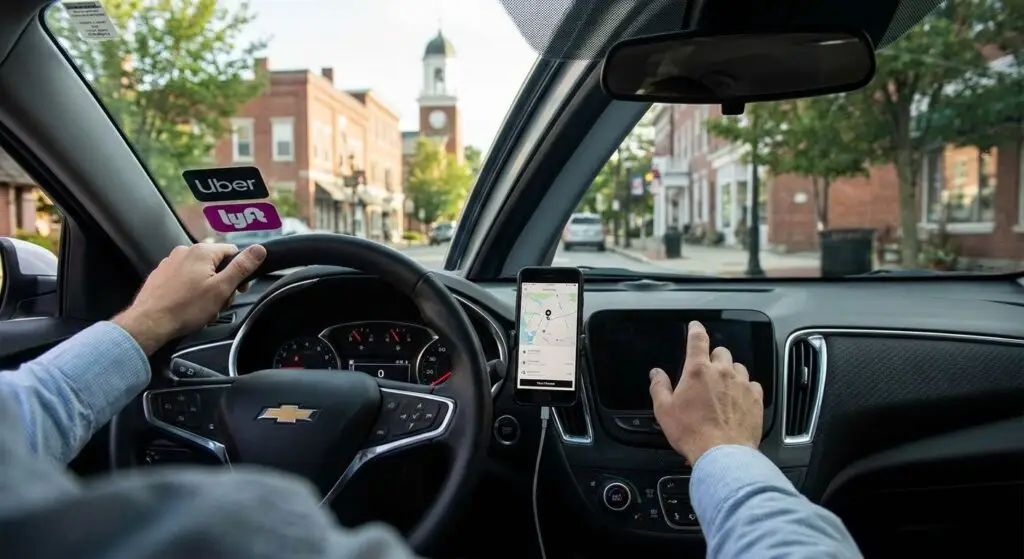
If you drive for Uber or Lyft in New Hampshire, your personal auto policy stops covering you the moment you turn the app on — and that gap is exactly where most rideshare drivers get burned in 2026.
- Rideshare insurance NH drivers need starts with a TNC endorsement — a bare personal policy leaves you exposed the second the app is on. Buy it.
- Period 1 (app on, no ride matched) is the coverage gap that wrecks claims in New Hampshire in 2026 — most personal policies exclude it entirely.
- Full-time drivers logging 30+ hours a week should price a commercial or hybrid TNC policy, not stack endorsements on a personal plan.
- Low-mileage personal miles plus rideshare hours can still qualify for a low-mileage discount in New Hampshire if you report accurately.
- Skip any policy that says nothing about Period 1, Period 2, or Period 3 — that silence means you’re not covered during the gap.
Who this is for
This is for anyone in New Hampshire driving under a TNC — Uber, Lyft, or a similar app — using a personal vehicle they also drive for errands, commuting, or family use. It's built for the driver logging anywhere from 5 to 40 hours a week, not for a licensed livery or taxi operation running a commercial fleet. If you're deciding whether your current auto policy actually protects you once the app goes on, or you're shopping because a claim got denied, this guide is for you.
Why this matters in 2026
Uber and Lyft carry contingent liability coverage, but it only activates once you're matched with a rider or already carrying one. Between those moments — app on, waiting for a ping — you're in what insurers call Period 1, and most personal auto policies in New Hampshire exclude commercial use outright. That means a fender-bender while you're idling and waiting for a fare can get denied by both your personal insurer and the rideshare company's coverage. Meeting New Hampshire's minimum auto insurance requirements is the floor, not the fix — rideshare driving needs a layer on top of that floor.
What to look for in rideshare insurance for NH drivers
Period 1 gap coverage
This is the single most important line item. A TNC endorsement should explicitly name Period 1 — app on, no ride accepted — and state a liability limit for that window, typically in the range of $50,000 per person and $100,000 per accident in New Hampshire filings. If the policy document doesn't mention Period 1 by name, assume it's not covered.
Liability limits during Periods 2 and 3
Once you accept a ride (Period 2) and once a passenger is in the car (Period 3), Uber and Lyft's own contingent liability typically steps up to $1 million. Your endorsement needs to bridge cleanly into that coverage without a lapse, and your deductible should match what you'd pay on your personal comprehensive and collision.
Collision and comprehensive continuation
Rideshare companies' $1 million liability coverage does not include collision or comprehensive damage to your own car during Periods 2 and 3 unless you already carry those coverages personally. A rideshare endorsement should extend your existing collision and comprehensive into all three periods — otherwise a totaled vehicle mid-trip comes out of your pocket.
Endorsement cost versus a standalone commercial policy
A TNC endorsement in New Hampshire generally runs $10 to $30 a month added to a personal policy. A standalone commercial or hybrid rideshare policy costs more — often $150 to $300 a month — but makes sense once you're driving 30-plus hours a week and the endorsement premium starts closing in on commercial pricing.
Occupation and mileage discounts that stack
Some New Hampshire insurers let you stack a rideshare endorsement with unrelated discounts — mileage banding, safe-driver history, or occupation-based pricing similar to what's available through occupation-based auto insurance discounts for nurses in New Hampshire. Ask specifically whether rideshare hours count against your reported annual mileage; underreporting it voids claims.
Claims coordination with Uber and Lyft
A policy is only as good as how fast it responds after an accident. Ask any insurer point-blank: do they have a documented process for coordinating a claim with Uber or Lyft's contingent carrier, or does the driver have to manage that handoff alone? In 2026, slow coordination is the top complaint drivers report after rideshare accidents.
Top picks for NH rideshare drivers
Personal auto plus TNC endorsement — the safe pick. Added to an existing personal policy, this covers all three periods for roughly $10 to $30 a month in New Hampshire and keeps your existing collision and comprehensive intact. Verdict: Buy — this is the right move for anyone driving fewer than 30 hours a week. If you're also weighing whether meeting the bare state minimum is enough before you add this layer, check New Hampshire's minimum auto insurance requirements first.
Hybrid commercial/TNC policy — for full-time drivers. Built for drivers logging 30+ hours a week, this replaces the personal policy entirely with a blended commercial structure, typically $150 to $300 a month. Verdict: Consider if rideshare is your primary income; Skip if it's supplemental.
Bare personal policy, no endorsement — the one to avoid. Technically legal to drive with in New Hampshire until an accident happens, but every major insurer reserves the right to deny a claim tied to commercial use once they see rideshare activity on your account. Verdict: Skip — this is the policy structure behind most denied claims in 2026.
Low-mileage personal policy paired with an endorsement — the wildcard. If your non-rideshare driving is genuinely light, pairing a low-mileage discount with a TNC endorsement can undercut a standard personal-plus-endorsement quote by a meaningful margin, since the base premium starts lower. Verdict: Consider if your annual personal mileage is under 7,500 miles.
Local agent review for Amherst-area drivers — worth the 15 minutes. Drivers based around Amherst NH auto insurance markets often qualify for carrier-specific rideshare add-ons that aren't advertised online and only surface in a direct quote conversation. Verdict: Buy the review, even if you end up keeping your current carrier.
Get your rideshare coverage checked
A quick review shows exactly where your app-on gap sits.
What to avoid
- A policy that never mentions "Period 1" — if the document is silent on app-on-no-ride coverage, you're not covered during it, no matter what the agent implies verbally.
- Assuming Uber or Lyft's coverage is a substitute for your own — their $1 million liability only applies during Periods 2 and 3, and it doesn't touch your own vehicle's collision damage unless you carry that coverage yourself.
- Under-reporting rideshare hours to keep premiums low — insurers cross-check mileage and app activity, and a claim filed after under-reporting gets denied on misrepresentation grounds, not just reduced.
Verdict comparison table
| Option | Period 1 covered | Monthly cost (2026) | Best for | Verdict |
|---|---|---|---|---|
| Personal auto + TNC endorsement | Yes | $10–$30 | Part-time drivers, under 30 hrs/week | Buy |
| Hybrid commercial/TNC policy | Yes | $150–$300 | Full-time drivers | Consider |
| Bare personal policy, no endorsement | No | $0 added | No one | Skip |
| Low-mileage policy + endorsement | Yes | $10–$25 | Drivers under 7,500 personal miles/year | Consider |
FAQ
Does my personal auto policy cover me while driving for Uber or Lyft in NH?
No, a standard personal auto policy in New Hampshire excludes commercial use, which includes rideshare driving. You need a TNC endorsement or a commercial policy to close that gap, especially during Period 1 when the app is on but no ride is matched.
What is Period 1 in rideshare insurance?
Period 1 is the time between turning on the Uber or Lyft app and being matched with a rider. Most personal policies exclude this window entirely, which is why a rideshare endorsement matters even if you rarely drive without a passenger.
How much does rideshare insurance cost in New Hampshire in 2026?
A TNC endorsement added to a personal policy typically runs $10 to $30 a month in New Hampshire. A standalone commercial or hybrid rideshare policy costs more, generally $150 to $300 a month, and fits full-time drivers better.
Is rideshare insurance required by law in New Hampshire?
New Hampshire doesn’t mandate a specific rideshare endorsement by name, but driving for Uber or Lyft without one risks a denied claim if your insurer determines you were engaged in commercial use at the time of an accident.
Can Uber or Lyft’s insurance replace my personal policy?
No. Uber and Lyft’s contingent liability coverage only applies during Periods 2 and 3, once a ride is accepted or a passenger is in the car, and it doesn’t cover your own vehicle’s damage unless you already carry collision and comprehensive.
Do I need commercial auto insurance to drive for Uber in NH?
Only if you’re driving full-time, generally 30 or more hours a week. Most part-time and moderate-hours drivers are better served by a TNC endorsement added to their existing personal policy.
Will driving for Uber affect my low-mileage discount in New Hampshire?
It can, since rideshare miles count toward your total reported mileage. If your non-rideshare driving stays under roughly 7,500 miles a year, you may still qualify for a reduced rate even with rideshare hours added.
What happens if I get in an accident during Period 1 without an endorsement?
Your personal insurer can deny the claim on commercial-use grounds, and Uber or Lyft’s coverage doesn’t activate until a ride is matched. This leaves the driver responsible for damages out of pocket, which is the exact scenario a TNC endorsement is built to prevent.
One last thing
Most rideshare drivers in New Hampshire don't get denied for lacking any coverage at all — they get denied because their policy technically has a rideshare endorsement, but it was written before they started driving full-time, and the limits never got updated to match. A five-minute call to confirm your current hours against your endorsement's assumptions catches this before a claim does.
Related guides