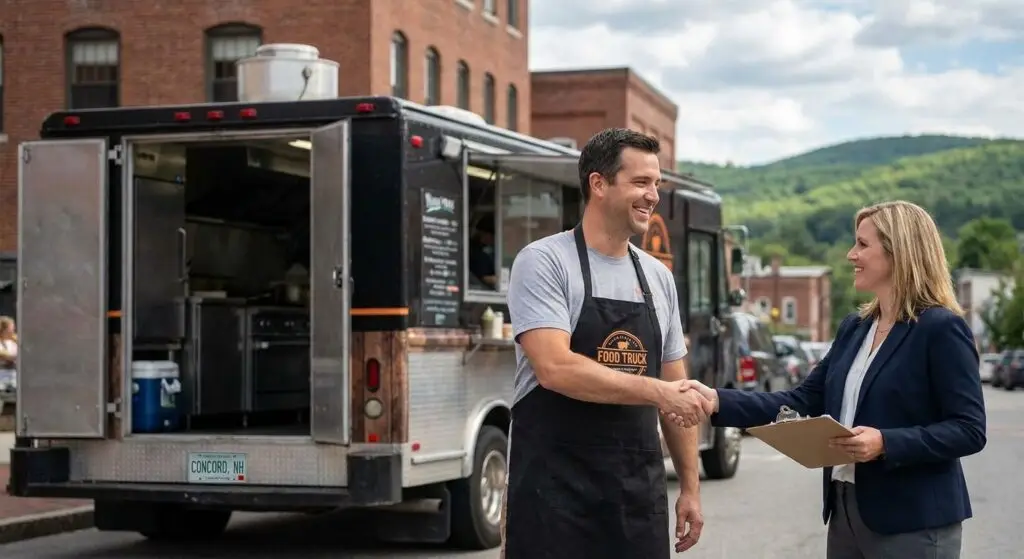
Run a food truck in New Hampshire and one bad grease fire, one slip-and-fall at a festival, or one fender-bender on Route 101 can wipe out a season's profit — the right insurance policy is what keeps the truck rolling instead of parked in a lawyer's parking lot.
- General liability with a $1M/$2M limit is the baseline most NH event organizers and commissaries require before you can set up.
- Food truck insurance in New Hampshire needs a commercial auto policy, not a personal one, once the vehicle is used for business.
- Workers’ compensation is mandatory in NH the day you hire your first employee, even part-time.
- Equipment coverage for fryers, generators, and propane systems is often sold separately from the auto policy — check before you assume it’s included.
- Bundling general liability, commercial auto, and equipment coverage with one carrier usually beats buying each piece separately.
Why this matters
New Hampshire has no state law forcing a food truck to carry insurance, but that doesn't mean you can skip it. Every fairground, brewery, and farmers market that books trucks in Manchester, Nashua, Concord, or Portsmouth requires a certificate of insurance before you're allowed to plug in a generator. Commissary kitchens want the same proof before they'll rent you space. Skip the coverage and you don't lose a discount — you lose the booking entirely.
The real risk math is simple: a single foodborne illness claim, a customer burn from hot oil, or a collision while driving between events can run into six figures in New Hampshire. General liability insurance for New Hampshire small businesses is the policy that absorbs those claims instead of your bank account.
Who this is for
This guide is built for operators running a single truck or a small fleet across New Hampshire — whether you're parked at the same lot in Amherst five days a week or chasing festival circuits from the Seacoast to the Lakes Region in 2026. It applies whether you own the truck outright, lease it, or work out of a shared commissary kitchen between events.
What to look for in food truck insurance for New Hampshire
General liability with a real limit
Most venues in New Hampshire won't hand you a permit without proof of at least $1,000,000 per occurrence and $2,000,000 aggregate in general liability. This covers slip-and-falls, foodborne illness claims, and property damage at the event site — the exposures that actually happen at a crowded fairground or brewery lot.
Commercial auto, not a personal policy
A personal auto policy typically excludes business use the moment you start serving food from the vehicle. New Hampshire is the only state without a mandatory personal auto insurance law, but that exemption does not extend to a vehicle used commercially. Commercial auto insurance for New Hampshire business fleets is the coverage that actually responds after a crash between gigs.
Equipment and spoilage coverage
Fryers, flat-tops, generators, and refrigeration units represent a real chunk of your capital investment. A power failure or a break-in that ruins a walk-in cooler's worth of inventory is a common claim — confirm the policy covers both the equipment itself and the food spoilage that follows.
Workers' compensation once you hire
New Hampshire requires workers' compensation the day you bring on your first employee, part-time or full-time, no exceptions for small crews. Workers' compensation insurance for New Hampshire small businesses covers medical bills and lost wages if a line cook gets burned or a server twists an ankle on uneven festival ground.
Liquor liability if you're pouring anything
Trucks that serve beer, wine, or cocktails at licensed events need liquor liability added on — general liability policies typically carve this out entirely. Confirm this before signing on for any brewery or wedding gig in 2026.
Additional insured endorsements
Event organizers and property owners routinely require the truck to name them as an additional insured on the certificate of insurance. A policy that can't produce this endorsement quickly, same-day in some cases, will cost you bookings during peak season.
Top picks: the coverage stack that actually protects a food truck
The non-negotiable — general liability
This is the policy every commissary, fairground, and city permit office in New Hampshire will ask for first. A $1,000,000/$2,000,000 limit satisfies nearly every venue requirement across the state. Skip it and you can't legally set up at most sanctioned events in 2026. Buy.
The one drivers forget — commercial auto
Swapping a personal auto policy for commercial auto insurance for New Hampshire business fleets closes the gap that opens the moment the truck starts hauling equipment and serving customers. A single at-fault accident on a personal policy used for business can get the claim denied outright. Buy.
The mandatory one you can't wait on — workers' compensation
Hire even one part-time employee and New Hampshire law requires workers' comp immediately — there's no grace period and no minimum hours threshold. Operators who delay this after their first hire are the most common compliance gap seen across NH small businesses. Buy the day you post the job listing.
The one that pairs with a fixed location — restaurant-style business coverage
Trucks that also run a brick-and-mortar stand, a seasonal window, or a shared kitchen space benefit from reviewing business insurance for restaurants in New Hampshire alongside the mobile policy — the exposures overlap but the limits often don't match. Consider if you split time between a truck and a fixed spot.
The one for garage-based operators — home-based business coverage
If the truck is stored, prepped, or dispatched from a residential garage between events, a homeowners policy almost never covers the commercial equipment or liability. Insuring a home-based business in New Hampshire closes that gap for operators running out of a home base rather than a commissary. Consider if your truck lives at your house.
What to avoid
- A personal umbrella policy as a substitute for commercial liability. It looks like extra protection but excludes business activity entirely — it won't respond to a claim from a festival customer.
- Skipping equipment coverage because "the auto policy covers the truck." Auto coverage protects the vehicle body and collision damage, not the fryer inside it or the food that spoils when the generator dies.
- Assuming a single-event certificate covers the whole season. Some carriers issue per-event certificates that lapse the moment the gig ends — confirm the policy runs year-round before booking a full 2026 festival circuit.
Get your food truck covered before the next booking
A quick review shows exactly what New Hampshire venues will require.
Verdict comparison
| Coverage | Who needs it | Typical requirement | Verdict |
|---|---|---|---|
| General liability | Every operator | $1M/$2M limit | Buy |
| Commercial auto | Anyone driving the truck for business | State financial responsibility limits, higher for commercial use | Buy |
| Workers' compensation | Anyone with one or more employees | Mandatory in NH, no threshold | Buy |
| Equipment/spoilage | Trucks with fryers, generators, coolers | Scheduled equipment value | Buy |
| Liquor liability | Trucks serving alcohol | Per-event or annual endorsement | Consider |
| Home-based business rider | Trucks stored/prepped at a residence | Add-on to homeowners or standalone policy | Consider |
FAQ
What is the minimum food truck insurance new hampshire venues require?
Most New Hampshire fairgrounds, breweries, and farmers markets require $1,000,000 per occurrence and $2,000,000 aggregate in general liability before issuing a permit. Some larger festivals in 2026 ask for higher limits, so confirm requirements before booking.
Does New Hampshire require workers’ compensation for food truck employees?
Yes. New Hampshire law requires workers’ compensation the moment an employer hires one or more employees, part-time or full-time. There is no minimum hours or payroll threshold that exempts a small crew.
Can I use my personal auto policy for a food truck?
No, a personal auto policy typically excludes business use, which means a claim after an accident while driving to or from an event can be denied. A commercial auto policy is built for vehicles used to generate income.
Is liquor liability included in general liability for a food truck?
No, general liability policies almost always exclude alcohol-related claims. Trucks pouring beer, wine, or cocktails at licensed New Hampshire events need a separate liquor liability endorsement.
How much does food truck insurance cost in New Hampshire?
Cost depends on revenue, equipment value, driving radius, and whether you have employees. A quick review of your operation against New Hampshire’s venue and commissary requirements is the fastest way to get an accurate number for 2026.
Do I need separate coverage for equipment like fryers and generators?
Yes, most auto and general liability policies exclude the value of onboard kitchen equipment. A scheduled equipment endorsement or inland marine policy covers fryers, flat-tops, generators, and refrigeration separately.
What happens if I don’t have an additional insured endorsement?
Many New Hampshire event organizers and property owners will not allow setup without being named as an additional insured on your certificate of insurance. Without it, you can be turned away at the gate even with an active policy.
Is food truck insurance different from restaurant insurance in New Hampshire?
Yes, food truck policies add commercial auto and mobile equipment coverage that a fixed restaurant location doesn’t need. Operators running both a truck and a storefront should compare the two policies side by side to avoid coverage gaps.
One last thing
The operators who get bounced from festival bookings in New Hampshire almost never lack coverage entirely — they lack a same-day certificate naming the event organizer as an additional insured. Confirm your carrier can turn that document around fast, because a two-day delay in 2026 can cost you the weekend's biggest gig.
Related guides
- General liability insurance for New Hampshire small businesses
- Commercial auto insurance for New Hampshire business fleets
- Workers' compensation insurance for New Hampshire small businesses
- Business insurance for restaurants in New Hampshire
- How to insure a home-based business in New Hampshire