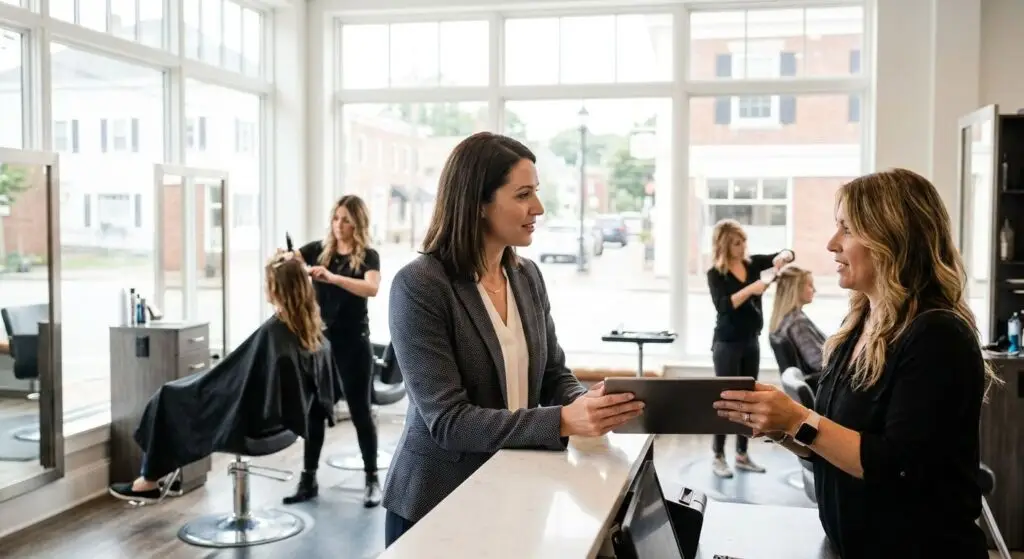
Business insurance for hair salons and spas in New Hampshire covers the property, liability, and employee risks specific to running a salon chair or treatment room, with the goal of keeping a single slip-and-fall claim or product reaction from wiping out a season's revenue. Salons carry risks that a typical retail shop doesn't: chemical treatments, sharp tools, wet floors, and clients who sit still while you work near their face and scalp.
- General liability plus professional liability is the baseline for business insurance for hair salons and spas in NH — most owners need both, not one or the other.
- NH requires workers’ compensation the moment you have one employee, even part-time.
- Booth renters and solo estheticians still need their own policy — the salon’s coverage rarely extends to independent contractors.
- A business owner’s policy (BOP) bundles property and liability at a lower combined cost than buying each separately.
Why business insurance matters for hair salons and spas
A salon or spa in New Hampshire deals with claims other small businesses rarely see: chemical burns from color or keratin treatments, allergic reactions to facials or waxing, slip-and-falls on wet tile near shampoo bowls, and equipment damage from steamers, autoclaves, or hydraulic chairs. Each of those is a separate exposure, and homeowners or personal umbrella policies never cover business activity — a claim tied to a service you performed for money gets denied outright without a commercial policy in place.
Salons also run on foot traffic and word of mouth. One bad outcome — a client with a chemical burn posting about it, or a lawsuit over a botched keratin treatment — does more damage to a small shop than it would to a larger chain with legal resources behind it. Coverage isn't about avoiding every claim; it's about making sure one claim doesn't become the reason the business closes in 2026.
Cover the basics with general liability
General liability is the floor, not the ceiling, for any salon or spa. It responds to third-party bodily injury and property damage — the classic slip-and-fall in the reception area or a client's coat ruined by dye.
- Confirm the policy covers premises liability for walk-in clients and scheduled appointments alike
- Check that product liability is included if you sell retail hair or skin products in the shop
- Ask whether completed operations coverage applies after the client leaves (a reaction that shows up hours later)
- Verify limits match your foot traffic — a busy downtown Manchester salon needs higher limits than a two-chair shop in a small town
General liability insurance for New Hampshire small businesses is the starting point most salons build the rest of their policy around.
Add professional liability for the services you actually perform
General liability doesn't cover claims that the service itself caused harm — a chemical burn from a perm, an allergic reaction to a facial product, or a client who says a keratin treatment damaged their hair. That's professional liability, sometimes called errors and omissions for service businesses.
- List every service offered (cuts, color, extensions, waxing, facials, massage, lash/brow tinting) and confirm each is named on the policy
- Ask if the policy covers licensed staff, unlicensed apprentices, and booth renters separately
- Check the claim process for allegations that don't involve visible injury (client dissatisfaction claims still cost money to defend)
- Confirm coverage extends to mobile services if stylists travel to weddings or events
Professional liability insurance for New Hampshire consultants applies the same structure service businesses like salons and spas need, even though the page name reads generically.
Get workers' compensation in place before you hire
New Hampshire requires workers' compensation coverage the moment a business has even one employee, part-time or full-time. This isn't optional and it isn't tied to payroll size — one shampoo assistant working ten hours a week triggers the requirement.
- Confirm classification codes match actual job duties (stylist vs. receptionist vs. massage therapist carry different rates)
- Ask how the policy treats booth renters — most are independent contractors, not employees, and need their own coverage
- Check whether the policy covers repetitive stress injuries common in styling work (wrist and shoulder strain)
- Review annual payroll audits so premiums stay accurate as staffing changes
Workers' compensation insurance for New Hampshire small businesses covers this requirement and it applies to salons the same way it applies to any other employer in the state.
Protect the physical space and equipment
A salon's equipment — chairs, dryers, sterilization units, retail inventory — represents real capital that a fire, pipe burst, or theft can wipe out in one incident. Commercial property coverage (usually bundled into a BOP) handles this.
- Inventory equipment and retail stock with replacement cost, not purchase price, since styling chairs and equipment hold value
- Confirm business interruption coverage is included so rent and payroll get paid if the shop closes for repairs
- Check theft coverage for retail products displayed near the entrance
- Ask about coverage for leased space improvements (built-in shampoo bowls, custom lighting) if you don't own the building
Cover client data and booking systems
Most salons and spas now run booking, payment, and client history through software — Vagaro, Square, Mindbody, or similar platforms. A data breach or ransomware attack that locks up appointment records and payment info is a real cost, not a hypothetical one.
- Confirm the policy covers costs to notify clients after a data breach
- Check whether ransomware payments and system restoration are included
- Ask about coverage for stolen point-of-sale terminals or tablets
- Review whether third-party liability applies if a vendor's software (not yours) causes the breach
Cyber liability insurance for New Hampshire small businesses is worth a real look for any salon running client payment data through an app or point-of-sale system.
Insure the vehicle if you offer mobile or event services
Salons that send stylists to weddings, photo shoots, or clients' homes need commercial auto coverage — a personal auto policy typically excludes business use, and a claim during a paid job gets denied.
- Confirm whether the vehicle is titled to the business or an employee's personal car used for work
- Check liability limits match the value of equipment transported (styling kits, portable chairs)
- Ask if hired and non-owned auto coverage applies when employees use their own cars for supply runs
Commercial auto insurance for New Hampshire business fleets covers this even for a single vehicle used occasionally for business errands.
Bundle coverage into a business owner's policy
Most salons combine general liability and commercial property into a single business owner's policy (BOP), which usually costs less than buying each separately and simplifies renewal. Professional liability, workers' comp, and cyber coverage are typically added as endorsements or separate policies layered on top.
Get a quick coverage review
Call, text, or start your quote — no pressure, just a plain answer on what you need.
Coverage comparison for salons and spas
| Coverage type | Best for | Key limitation |
|---|---|---|
| General liability | Any salon or spa with walk-in foot traffic | Doesn't cover claims tied to the service itself |
| Professional liability | Chemical services, facials, waxing, massage | Must be endorsed for every service offered |
| Workers' compensation | Any shop with even one employee | Required by NH law once you have staff |
| Commercial property / BOP | Owned or leased shop space with equipment | Booth renters usually need separate coverage |
| Cyber liability | Shops using online booking or POS systems | Doesn't cover third-party software vendor failures automatically |
| Commercial auto | Mobile stylists, event or wedding services | Personal auto policies exclude business use entirely |
A salon running color services, employing at least one stylist, and taking online bookings needs general liability, professional liability, workers' comp, and cyber coverage together — skipping any one leaves a real gap.
Common mistakes salons and spas make in NH
- Treating booth renters as covered under the salon's policy. Independent contractors almost always need their own general liability and professional liability, not a share of the owner's.
- Skipping workers' comp because staff is part-time. New Hampshire's requirement doesn't scale down for hours worked — one employee triggers it.
- Leaving new services off the professional liability list. Adding lash extensions or microblading without notifying the carrier means those claims may not be covered.
- Assuming a homeowners policy covers a home-based salon. A stylist working out of a converted garage or spare room needs commercial coverage, not a homeowner's rider.
- Underinsuring equipment at purchase price instead of replacement cost. Styling chairs, sterilizers, and steamers cost more to replace in 2026 than they did when purchased years earlier.
Salons operating out of a house or converted space should also check how to insure a home-based business in New Hampshire before assuming a homeowners policy fills the gap.
FAQ
What insurance does a hair salon need in New Hampshire?
A hair salon in New Hampshire typically needs general liability, professional liability, workers’ compensation if it has employees, and commercial property coverage for the shop and equipment. Salons offering mobile or event services also need commercial auto coverage.
Is workers’ compensation required for a one-person salon?
No, a sole proprietor with no employees isn’t required to carry workers’ comp in New Hampshire. The requirement triggers the moment the business hires even one part-time employee.
Do booth renters need their own insurance?
Yes, booth renters are usually independent contractors and need their own general liability and professional liability policy. The salon owner’s policy typically doesn’t extend to cover them.
Does a homeowners policy cover a home-based salon?
No, homeowners insurance excludes business activity conducted for money, including salon services run out of a home. A separate business policy or home-based business endorsement is required.
What does professional liability cover for a spa?
Professional liability covers claims that a service itself caused harm, such as a chemical burn from a facial product or an allergic reaction to a treatment. It’s separate from general liability, which covers slip-and-falls and property damage.
Do spas need cyber liability insurance?
Spas using online booking, client payment processing, or stored client records benefit from cyber liability coverage. It covers breach notification costs and ransomware recovery if booking or payment systems get compromised.
Can a salon combine coverages into one policy?
Yes, most salons combine general liability and commercial property into a business owner’s policy (BOP), then add professional liability, workers’ comp, and cyber coverage as separate policies or endorsements.
One last thing
The claim that catches most NH salon owners off guard isn't the slip-and-fall — it's the chemical reaction that shows up hours or days after the appointment, once the client is home and no longer under direct observation. That's exactly the gap professional liability closes and general liability doesn't, so check that specific coverage line before renewal, not after a claim shows up.
Related guides
- Workers' compensation insurance for New Hampshire small businesses
- Professional liability insurance for New Hampshire consultants
- Cyber liability insurance for New Hampshire small businesses
- How to insure a home-based business in New Hampshire
- Commercial auto insurance for New Hampshire business fleets