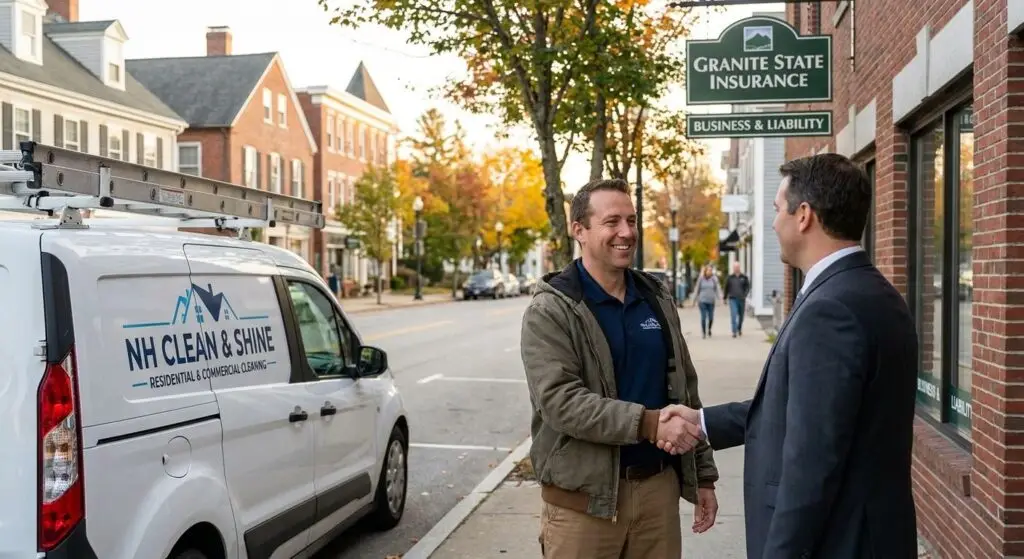
Business insurance for cleaning companies in New Hampshire is a package of general liability, workers' compensation, and commercial auto coverage built to protect your crew, your equipment, and the client relationships that keep the business running. Cleaning crews work inside other people's homes and offices every day, which means a single breakage claim, slip-and-fall, or missing-key incident can turn into a lawsuit fast if the right policy isn't in place.
- Business insurance for cleaning companies in NH starts with general liability and workers’ comp – both are non-negotiable once you hire staff.
- NH law requires workers’ compensation for any business with one or more employees, including part-time cleaners.
- Bonding covers employee theft claims – many commercial clients require proof before signing a contract.
- Bundling general liability, commercial auto, and workers’ comp with one NH agency cuts admin time as much as cost.
- Skip cyber liability only if your crew never handles client alarm codes, keys, or digital payment info.
Why business insurance matters for cleaning companies in NH
Cleaning companies carry a different risk profile than most small businesses because the work happens inside someone else's property, not your own. A vacuum knocks over a lamp, a chemical stains a hardwood floor, or a part-time employee slips on a wet tile – each of those is a claim against your business, not the client's.
General liability insurance for New Hampshire small businesses is the baseline most commercial clients and property managers require before they'll sign a cleaning contract. Without a certificate of insurance on hand, you lose the bid before you even quote the job.
Staffing adds a second layer. Whether you run a two-person residential crew or a 15-person commercial janitorial team, New Hampshire law requires workers' compensation coverage once you have one or more employees – full-time, part-time, or seasonal.
Update your general liability coverage first
General liability is the policy every cleaning company needs before taking on a single client. It covers property damage, bodily injury, and completed-operations claims – the ones that show up weeks after the job, like a floor finish that reacted badly with a client's flooring material.
- Confirm your policy covers both residential and commercial job sites if you serve both
- Check that your limits meet what commercial property managers require (many ask for $1 million per occurrence)
- Add products-completed operations if you use specialty chemicals or floor treatments
- Request a certificate of insurance template you can send to new clients same-day
- Review the exclusions list for mold, asbestos, or water damage before you take on restoration-adjacent work
A local review of your general liability insurance for New Hampshire small businesses catches gaps before a claim finds them for you.
Add workers' compensation once you hire
The moment you bring on your first employee – even a part-time weekend cleaner – New Hampshire requires workers' comp coverage. Skipping it isn't a gray area; it's a compliance risk that can shut down a growing cleaning business fast.
- Classify each role correctly (residential cleaner vs. commercial janitorial vs. supervisor) since rates differ by class code
- Track payroll accurately – premiums are based on it, and misreporting causes audit penalties
- Include 1099 subcontractors in your review even if you think they're exempt
- Ask about experience modification factors if you've had prior claims
- Confirm the policy covers injuries at client sites, not just your own office
Workers' compensation insurance for New Hampshire small businesses walks through classification and payroll reporting in more detail.
Cover your equipment and vehicles
Cleaning companies run through vacuums, floor buffers, pressure washers, and vans faster than most service businesses, and personal auto policies don't cover business use.
- Insure commercial vehicles under a business auto policy, not a personal one
- Add inland marine or equipment coverage for portable machines that travel between job sites
- Confirm hired and non-owned auto coverage if employees use their own cars between clients
- Check that stolen equipment from a locked van is actually covered, not excluded
A fleet of two vans or twenty, commercial auto insurance for New Hampshire business fleets is the fix once personal auto stops cutting it.
Get bonded before a client asks
Janitorial and residential clients increasingly ask for proof of bonding before they'll hand over keys or alarm codes. A fidelity bond covers theft by an employee – something general liability doesn't touch.
- Start with a $10,000-$25,000 bond for small residential crews and scale up for commercial contracts
- Bond every employee who enters client property unsupervised, not just supervisors
- Keep bond documentation on file to hand over during a bid process
- Re-bond after major staff turnover so coverage stays current
Add cyber and professional liability if you touch client data
Most cleaning companies don't think of themselves as a data risk, but scheduling apps, digital payment systems, and stored alarm codes create exposure the moment a client's information sits on your phone or laptop.
- Cyber liability covers costs if client payment data or access codes are exposed in a breach
- Professional liability matters more for commercial janitorial contracts with service-level guarantees
- Review what your point-of-sale or scheduling software vendor already covers before duplicating it
Cyber liability insurance for New Hampshire small businesses is worth a quick review if your crew books jobs or takes payments through an app.
Bundle policies to control cost and paperwork
Running general liability, workers' comp, commercial auto, and bonding through separate carriers means separate renewal dates, separate certificates, and separate calls when a client asks for updated proof of coverage.
- Ask whether a business owner's policy (BOP) can combine general liability and property coverage
- Line up renewal dates across policies so you're not juggling paperwork four times a year
- Request one point of contact for all certificates of insurance instead of chasing multiple carriers
- Compare bundled pricing against standalone policies at least once during 2026
If your cleaning business runs out of your home before scaling to a storefront or warehouse, how to insure a home-based business in New Hampshire covers what a homeowners policy won't.
Review coverage annually as you grow
A two-person residential crew in 2024 that's now a ten-person commercial operation in 2026 has outgrown its original policy limits. Growth without a coverage review is the most common gap agencies see.
- Reassess liability limits every time you add a commercial contract
- Update vehicle schedules the day you buy or sell a van
- Re-check payroll numbers annually so workers' comp premiums stay accurate
- Revisit bonding amounts as contract sizes increase
Get your NH cleaning business covered
A quick review shows exactly where your current coverage falls short.
Comparison: coverage options for NH cleaning companies
| Coverage type | Best for | Required in NH? | Key limitation |
|---|---|---|---|
| General liability | Any cleaning company taking on clients | Not state-mandated, but required by most contracts | Doesn't cover employee injuries |
| Workers' compensation | Any business with one or more employees | Yes, by NH law | Doesn't cover clients or bystanders |
| Commercial auto | Companies using vans or company vehicles | Yes, for registered business vehicles | Personal auto policies exclude business use |
| Fidelity bond | Crews entering homes or offices unsupervised | Not required by law, often required by clients | Doesn't cover accidental damage |
| Cyber liability | Companies using scheduling or payment apps | Not required by law | Doesn't cover physical property damage |
Verdict: general liability and workers' compensation are the two policies no NH cleaning company should operate without in 2026 – everything else layers on top based on client size and how much digital data your crew handles.
“If a client asks for proof of bonding before signing a contract, get bonded before you lose the job.”
Common mistakes cleaning companies make in NH
- Treating 1099 cleaners as exempt from workers' comp – misclassification is one of the top reasons NH audits flag small cleaning businesses.
- Using personal auto insurance for a company van – a claim gets denied the moment the insurer sees commercial use.
- Skipping bonding until a commercial client demands it – by then you've already lost the bid or delayed the contract.
- Letting policy limits stay flat while revenue grows – a $500,000 limit that made sense in 2022 rarely covers a commercial contract signed in 2026.
- Not updating certificates of insurance when adding new vehicles or staff – clients and property managers check these more often than owners expect.
FAQ
What is the best business insurance for cleaning companies in NH?
General liability paired with workers’ compensation is the baseline for cleaning companies in New Hampshire in 2026. Commercial auto and bonding get added as the business takes on vehicles, employees, and commercial contracts.
Is workers’ compensation required for cleaning businesses in New Hampshire?
Yes. New Hampshire law requires workers’ compensation coverage for any business with one or more employees, including part-time or seasonal cleaners.
Do I need bonding as a cleaning company in NH?
Bonding isn’t required by law, but most commercial clients and many residential clients ask for proof of it before granting access to keys or alarm codes.
Does general liability cover employee injuries?
No. General liability covers property damage and third-party bodily injury; employee injuries are covered separately by workers’ compensation.
Can I use my personal car insurance for a cleaning business van?
No. Personal auto policies exclude business use, so a cleaning company van needs a commercial auto policy to avoid a denied claim.
How much liability coverage do commercial clients expect?
Many property managers and commercial clients in NH require at least $1 million per occurrence in general liability before signing a janitorial contract.
Does cyber liability matter for a small cleaning business?
It matters if your crew books jobs, stores alarm codes, or takes payments through an app – otherwise it’s a lower priority than general liability or workers’ comp.
Should I bundle my cleaning company’s insurance policies?
Bundling general liability, commercial auto, and workers’ comp with one NH agency usually simplifies renewals and certificate requests without sacrificing coverage quality.
One last thing
The fastest way to lose a commercial cleaning contract in 2026 isn't a bad quote – it's showing up without a certificate of insurance the client can verify on the spot. Keep one on file, updated every time a policy renews, and you'll close bids faster than competitors still scrambling to fax paperwork.
Related guides
- General liability insurance for New Hampshire small businesses
- Workers' compensation insurance for New Hampshire small businesses
- Commercial auto insurance for New Hampshire business fleets
- Cyber liability insurance for New Hampshire small businesses
- How to insure a home-based business in New Hampshire