
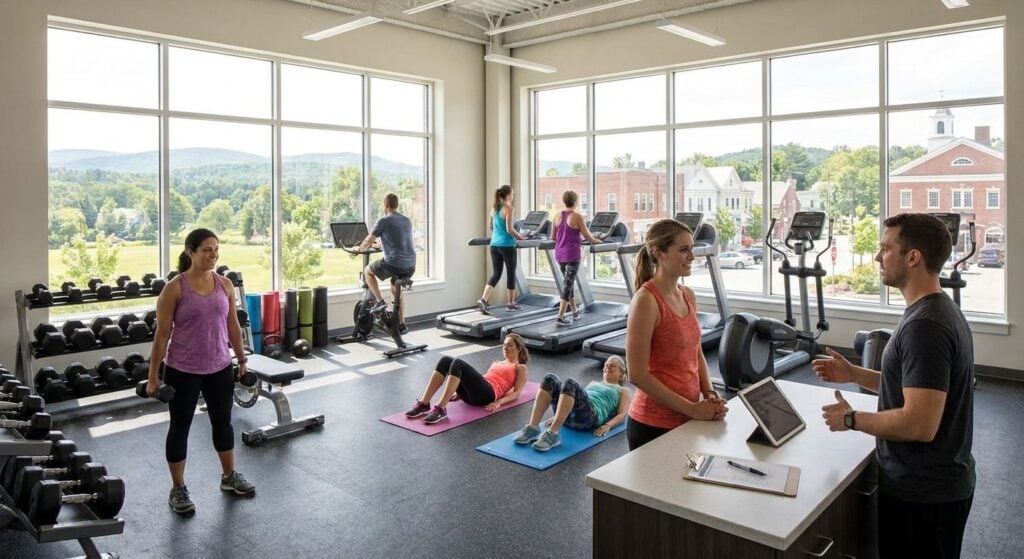
Business insurance for gyms and fitness studios in New Hampshire covers the risks a generic small-business policy skips: a member's shoulder injury mid-class, a treadmill fire, or a trainer's program advice that ends in a lawsuit. Gyms carry more physical risk per square foot than a typical retail shop, and NH's mix of independent studios, franchise locations, and one-person training businesses each need the coverage built around movement, not just walls.
- Business insurance for gyms and fitness studios in NH starts with general liability plus workers’ comp in 2026 — both are non-negotiable.
- General liability for fitness businesses typically carries $1 million per-occurrence / $2 million aggregate limits.
- New Hampshire requires workers’ comp once you hire your first employee, including a part-time instructor.
- Professional liability covers bad program advice — general liability alone doesn’t.
- A single annual review catches coverage gaps before a claim does, not after.
Why business insurance matters for New Hampshire gyms and studios
A gym isn't a desk job with a storefront. Classes involve fast movement, free weights, group cycling bikes, and sometimes saunas or climbing walls — all of it under one roof with paying members moving through it daily.
Most commercial leases in NH require proof of general liability insurance before a landlord hands over studio keys. Equipment financing companies attach their own coverage requirements to loans on racks, bikes, and treadmills. And the moment a studio hires its first employee — even a single part-time instructor teaching one class a week — New Hampshire's workers' comp rules apply, no exceptions for size.
Waivers help in court, but they don't replace coverage. NH judges still hear negligence claims against gyms that had signed waivers on file, because a waiver limits some claims, not all of them.
Build the coverage step by step
1. Confirm workers' compensation before you hire anyone
New Hampshire requires workers' comp once a business has one employee, full-time or part-time. This catches studio owners off guard because they assume a single weekly class instructor doesn't count — they do.
- Cover every instructor on payroll, even ones teaching a single class per week.
- Verify independent contractor trainers carry their own policy in writing — don't assume it.
- Confirm coverage applies to injuries during classes, not just desk-based front office work.
- Check workers' compensation insurance for New Hampshire small businesses requirements before your first hire, not after.
- Update the policy every time headcount changes, including seasonal summer instructors.
2. Add general liability for member and guest injuries
General liability is the policy that responds when a member slips near the water fountain, a dropped dumbbell hits a guest's foot, or someone falls off a treadmill during an open house.
- Covers legal defense costs if a member sues over an injury during a class.
- Matches the limits most landlords require before signing a lease, often $1 million per occurrence / $2 million aggregate.
- Extends to guests brought in for a free trial class, not just paying members.
- Applies whether the injury happens on the gym floor or in the parking lot.
- Pair it with waivers as a second layer, not a replacement.
3. Cover the equipment and the space itself
A studio's biggest hard-dollar investment usually isn't the lease — it's the bikes, racks, mirrors, and sound system installed inside it.
- Insure owned equipment against theft, fire, and water damage.
- Ask about improvements-and-betterments coverage for flooring, mirrors, and sound systems installed in a leased space.
- Add business personal property coverage so gear damaged during an outdoor class still counts.
- Get business interruption coverage to replace lost income if a burst pipe shuts the studio for weeks.
- Confirm your financing company's required limits in writing before signing an equipment loan.
4. Add professional liability if staff give fitness or nutrition advice
General liability covers physical injury. It does not cover a claim that a trainer's program design or nutrition guidance caused harm — that's a different exposure entirely.
- Professional liability (errors and omissions) responds to claims tied to advice, not accidents.
- Certified personal trainers, nutrition coaches, and physical therapists on staff raise this exposure the most.
- Review each trainer's certifications and scope of practice so advice stays inside their training.
- Document intake forms and health screenings — they matter if a claim ever gets filed.
- Carry professional liability alongside general liability, not instead of it.
5. Insure any vehicle the business actually uses
A van used to shuttle clients to an outdoor bootcamp, or a car used to haul equipment between two studio locations, needs commercial auto coverage.
- Personal auto policies typically exclude business use and can deny a claim during a client pickup.
- Cover any vehicle titled to the studio, even a single cargo van.
- Add hired and non-owned auto coverage if staff use personal cars for studio errands.
- Confirm coverage extends to off-site classes held at parks or outdoor lots.
- Review vehicle use annually as class formats change.
6. Add cyber liability if you store payment or health data
Membership software holds payment cards, addresses, and sometimes health screening forms filled out at sign-up.
- Covers notification costs and credit monitoring after a data breach.
- Applies whether the breach happens through the studio's own system or a third-party membership platform.
- Confirm what encryption and breach protocols your point-of-sale provider already carries — don't assume it's covered.
- Add coverage before a breach happens, not after member data is already exposed.
- Review this annually alongside your other policies, since membership software changes often.
7. Review the whole package once a year, not once at signup
Coverage that fit a 1,200-square-foot studio in 2022 rarely fits a 4,000-square-foot facility with a sauna and kids' room added by 2026.
- New class formats — climbing walls, boxing, hot yoga — change the risk profile and should trigger a review.
- New hires, new equipment purchases, and lease renewals are natural review checkpoints.
- A single annual review catches gaps across liability, workers' comp, and property before a claim finds them.
- Update limits any time square footage or headcount grows meaningfully.
Get your gym’s coverage reviewed
One quick review covers liability, workers’ comp, and equipment in a single quote.
Comparison: coverage options for NH gyms and fitness studios
| Option | Best for | Key limitation |
|---|---|---|
| General liability | Every gym, day one | Doesn't cover employee injuries or professional advice claims |
| Workers' compensation | Any studio with even one part-time instructor | Legally required in NH once you hire — no exceptions |
| Commercial property / BOP | Studios that own equipment or improved a leased space | Doesn't cover vehicles or advice-related claims |
| Professional liability | Studios with certified trainers, nutrition coaches, PTs | Doesn't cover physical injury claims — pair with general liability |
| Commercial auto | Studios running shuttle vans or mobile bootcamps | Personal auto policies typically exclude business use |
| Cyber liability | Studios storing payment or health data digitally | Doesn't cover physical damage or injury claims |
A gym in New Hampshire that skips workers' comp because "it's just one instructor" is already out of compliance the day that instructor teaches a single class.
Common mistakes NH gyms and studios make
- Relying on liability waivers alone instead of general liability — NH courts still allow negligence claims against gyms with signed waivers on file.
- Treating instructors as contractors without a written agreement, then discovering the studio owes workers' comp anyway.
- Insuring the building but forgetting equipment that's leased or financed separately, from bikes to sound systems.
- Skipping commercial auto because "it's just my personal car" for a shuttle van or mobile class run.
- Buying one policy at launch and never reviewing it again as the studio adds classes, staff, or square footage by 2026.
FAQ
What insurance does a gym need in New Hampshire?
A New Hampshire gym needs general liability and workers’ compensation at minimum, plus property coverage for equipment. Studios with certified trainers or nutrition coaches should add professional liability, and any studio storing payment data should add cyber liability.
Is workers’ comp required for a one-person fitness studio?
Workers’ comp isn’t required if the owner has zero employees, but it applies the moment a studio hires even one part-time instructor. A sole proprietor training clients alone typically doesn’t need it until staff are added.
Does general liability cover a personal trainer’s advice?
No, general liability covers physical injury claims, not claims tied to program design or nutrition advice. Professional liability (errors and omissions) covers advice-related claims separately.
How much does business insurance cost for a small gym?
Cost depends on square footage, class types, staff count, and equipment value, so it varies by studio. Getting a specific quote is more accurate than estimating a flat rate.
Do I need commercial auto for a mobile fitness business?
Yes, any vehicle titled to the business or used to shuttle clients needs commercial auto coverage. Personal auto policies typically exclude business use and can deny a claim.
What happens if a member signs a waiver and still gets hurt?
A waiver can limit some claims but New Hampshire courts still allow negligence claims against gyms with signed waivers on file. General liability coverage responds to those claims regardless of the waiver.
Does my landlord require proof of insurance for a studio lease?
Most commercial leases in New Hampshire require proof of general liability coverage before handing over keys. Check your specific lease terms, since required limits vary by landlord.
Is cyber liability worth it for a small fitness studio?
Cyber liability is worth adding if the studio stores member payment cards or health screening forms digitally. It covers notification and credit monitoring costs after a breach, which general liability does not.
One last thing
The gap that shows up most often in a quick review isn't a big line item — it's the sauna, tanning bed, or climbing wall added after the original policy was written. If your studio added an amenity in the last year, say so before renewal, not after a claim forces the conversation in 2026.
Related guides
- Professional liability insurance for New Hampshire consultants
- Commercial auto insurance for New Hampshire business fleets
- Cyber liability insurance for New Hampshire small businesses