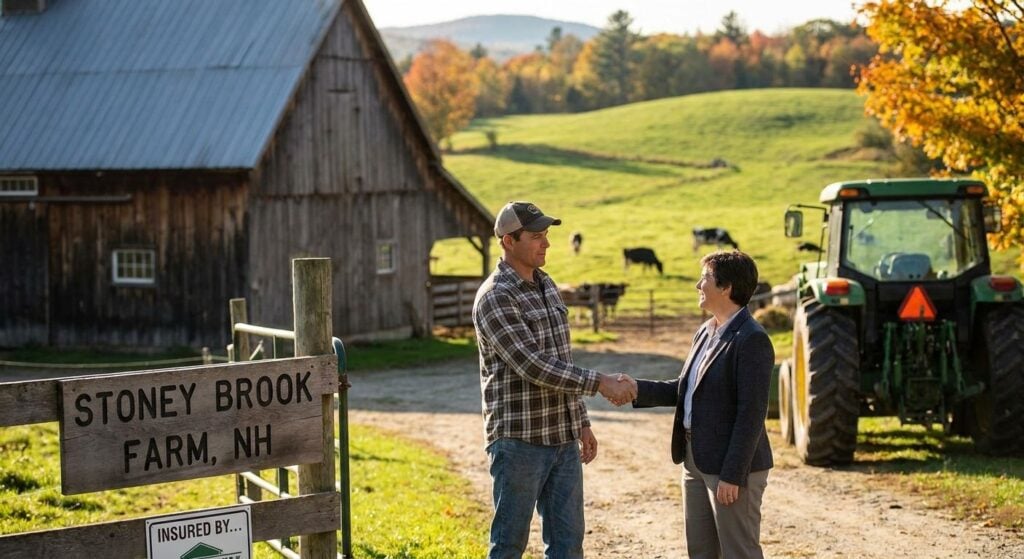
New Hampshire farm business insurance is coverage built around barns, livestock, farm equipment, and roadside stands, protecting a farm's income when weather, a fallen visitor, or an injured seasonal hire turns into a claim. A hobby farm selling eggs at the end of the driveway and a 200-acre dairy operation running a corn maze in October carry different risks, and a generic small-business policy usually misses both.
- Business insurance for farms NH needs pairs a farm liability endorsement with a Business Owner’s Policy for barns, equipment, and farm stands.
- Workers’ compensation is required in New Hampshire once you have even one employee, including seasonal help during harvest.
- Agritourism activities like corn mazes, hayrides, and pick-your-own events usually need a specific liability endorsement, not just a homeowners policy.
- Commercial auto or farm vehicle coverage is separate from your personal car policy the moment a truck or trailer is used for farm business.
- A quick coverage review with Themello Agency catches gaps before a claim does, not after.
Why business insurance matters for New Hampshire farms
New Hampshire farms deal with ice-loaded roof collapses, frozen pipes in outbuildings, and equipment left exposed through a Concord winter that a standard homeowners policy was never written to cover. Add a farm stand, a wedding barn rental, or a fall festival with paying visitors, and the liability exposure jumps from "neighbors visiting" to "strangers on the property with money changing hands."
Many farms in the state still run on a homeowners policy stretched to cover business activity, which works fine until an adjuster reads the fine print after a claim. Business insurance for farms in NH exists specifically to close that gap between what a homeowners policy assumes (a private residence) and what a working farm actually does (commerce).
Cover your farm structures and outbuildings
Barns, equipment sheds, greenhouses, and storage buildings need coverage separate from the farmhouse itself, especially if they're older wood-frame structures.
- Get replacement cost coverage, not actual cash value, on barns and outbuildings
- List every structure individually rather than lumping them under "other structures"
- Photograph roof condition each fall before snow load season
- Check whether hay and feed stored inside are covered for fire and water damage
- Ask about coverage for solar panels or generators mounted on outbuildings
Add general liability for the farm stand and agritourism activities
If people other than family step onto the property to buy, tour, or attend an event, general liability insurance for New Hampshire small businesses becomes the backbone of your coverage.
- Confirm the policy names farm stand sales, not just general premises liability
- Add a specific endorsement for hayrides, corn mazes, or pick-your-own events if you run them
- Check product liability coverage if you sell anything processed on-site, like jams or cider
- Review coverage for petting-zoo animals if visitors interact with livestock
- Set liability limits based on peak-season foot traffic, not average daily visitors
Get workers' compensation if you hire any help
New Hampshire requires workers' compensation the moment a farm has one employee, and that includes a teenager hired for six weeks during hay season.
- Confirm seasonal and part-time workers are classified correctly, not treated as contractors by default
- Check whether the policy covers injuries from farm machinery specifically
- Ask how family members working the farm are classified
- Review workers' compensation insurance for New Hampshire small businesses if payroll changes seasonally
- Keep payroll records current since premiums are often based on actual wages paid
Insure farm vehicles and trailers correctly
A truck registered to the farm and used to haul equipment or deliver produce isn't covered the same way a personal vehicle is.
- Separate personal auto policies from vehicles titled to the farm business
- Add trailer coverage for livestock or equipment trailers, which are often excluded by default
- Check commercial auto insurance for New Hampshire business fleets if you run more than one farm truck
- Confirm coverage applies when equipment is hauled off-property to another field or a farmers market
- Ask about coverage gaps for ATVs or utility vehicles used daily on the property
Cover farm equipment and machinery
Tractors, balers, irrigation systems, and processing equipment represent some of the largest single investments on a farm, and a fire or theft loss without proper coverage can end a season.
- Get an inland marine or equipment floater for machinery that moves between fields or off-site
- Confirm coverage applies to equipment left in fields overnight during harvest
- Check whether mechanical breakdown is covered or only fire and theft
- List equipment by value, not by a single blanket estimate
- Update the schedule every time equipment is bought, sold, or upgraded
Add flood and water protection for low-lying land
New Hampshire's river valleys and lake-adjacent farmland flood during spring runoff and heavy fall storms, and standard business policies generally exclude flood damage outright.
- Check flood zone status for every structure on the property, not just the farmhouse
- Get a separate flood policy if barns or equipment sheds sit near a river or wetland
- Confirm drainage and sump equipment failures are addressed somewhere in the policy stack
- Review coverage timing, since flood policies often carry a waiting period before taking effect
Layer on umbrella coverage as the farm grows
Once a farm runs events, hires staff, and sells retail products, the liability exposure often outgrows a standalone general liability limit.
- Add umbrella coverage once annual visitor events or retail sales expand past a small stand
- Confirm the umbrella policy sits above both farm liability and commercial auto limits
- Review limits annually if the farm adds a new revenue stream like weddings or agritourism
- A quick coverage review with Themello Agency can confirm whether current limits still match the farm's size
Comparison: coverage options for New Hampshire farms
| Option | Best For | Key Limitation |
|---|---|---|
| Farm liability endorsement | Small farms with a stand or occasional visitors | Doesn't cover employees or vehicles |
| Business Owner's Policy (BOP) | Farms combining a building, liability, and equipment need | May need separate flood or auto add-ons |
| Workers' compensation | Any farm with paid help, seasonal or full-time | Mandatory once one employee is on payroll |
| Commercial auto / farm vehicle policy | Farms hauling equipment or delivering goods off-property | Personal auto policies typically exclude business use |
| Umbrella policy | Larger operations running events, retail, or agritourism | Sits above other policies, doesn't replace them |
The verdict for most working New Hampshire farms is a Business Owner's Policy paired with workers' comp and a commercial auto policy, with an umbrella added once agritourism or event revenue grows past a side income.
Get a farm coverage review
Call, text, or start a quote to check gaps before claim season.
Common mistakes New Hampshire farms make
- Running agritourism on a homeowners policy — a corn maze or hayride with paying visitors falls outside personal home coverage almost every time.
- Treating seasonal hires as contractors — New Hampshire's workers' comp rules apply to part-time and seasonal farm labor, not just year-round employees.
- Underinsuring equipment left in fields — a scheduled equipment floater matters more once machinery sits outside overnight during harvest.
- Skipping flood coverage near rivers and lakes — standard business policies exclude flood damage, and low-lying NH farmland floods during spring runoff.
- Forgetting trailers and ATVs on the auto policy — these are commonly excluded from personal auto and left off commercial policies by mistake.
FAQ
What does business insurance for farms NH cover?
It typically covers farm structures, equipment, general liability for visitors and farm stand sales, workers’ compensation for employees, and commercial auto for farm vehicles. Coverage is usually built from several policies layered together rather than one single farm policy.
Do I need workers’ comp for seasonal farm help in New Hampshire?
Yes, New Hampshire requires workers’ compensation coverage once a farm has even one employee, including short-term or seasonal hires. Family members working the farm may be classified differently, which is worth confirming during a policy review.
Is agritourism covered under a standard farm liability policy?
Not automatically. Activities like corn mazes, hayrides, and pick-your-own events usually need a specific agritourism or event liability endorsement added to the base policy.
How much does farm business insurance cost in New Hampshire in 2026?
Cost depends on acreage, building count, equipment value, payroll, and whether the farm runs agritourism events, so figures vary widely between operations. A coverage review gives an accurate number based on the specific farm.
Do I need flood insurance for a farm in NH?
If barns, equipment sheds, or fields sit near a river, wetland, or lake, flood insurance is worth adding since standard business policies exclude flood damage. Spring runoff and fall storms are the two periods that cause the most farm flood claims in the state.
Can I insure farm equipment separately from the barn it’s stored in?
Yes, an equipment floater or inland marine policy covers tractors, balers, and machinery separately from the structure, including when equipment is out in the field. This matters because building coverage alone often doesn’t extend to machinery left outside overnight.
What’s the difference between a homeowners policy and a farm business policy?
A homeowners policy covers the residence and personal liability; it generally excludes commercial activity like farm stand sales, paid events, or employees. A farm business policy adds coverage for those commercial exposures specifically.
Does farm insurance cover injury to a customer at a farm stand?
General liability coverage with a farm stand or retail endorsement typically covers customer injuries on the property. Without that endorsement, a standard homeowners or basic liability policy may deny the claim.
One last thing
The farms that get burned hardest aren't the ones without insurance — they're the ones running a growing agritourism side business on a policy written for a quiet residential property five years ago. Review coverage every time the farm adds a new revenue stream, not just at renewal, since a new corn maze or wedding venue changes the risk picture faster than most policies update on their own.
Related guides
- Business insurance for landscaping companies in New Hampshire
- Cyber liability insurance for New Hampshire small businesses