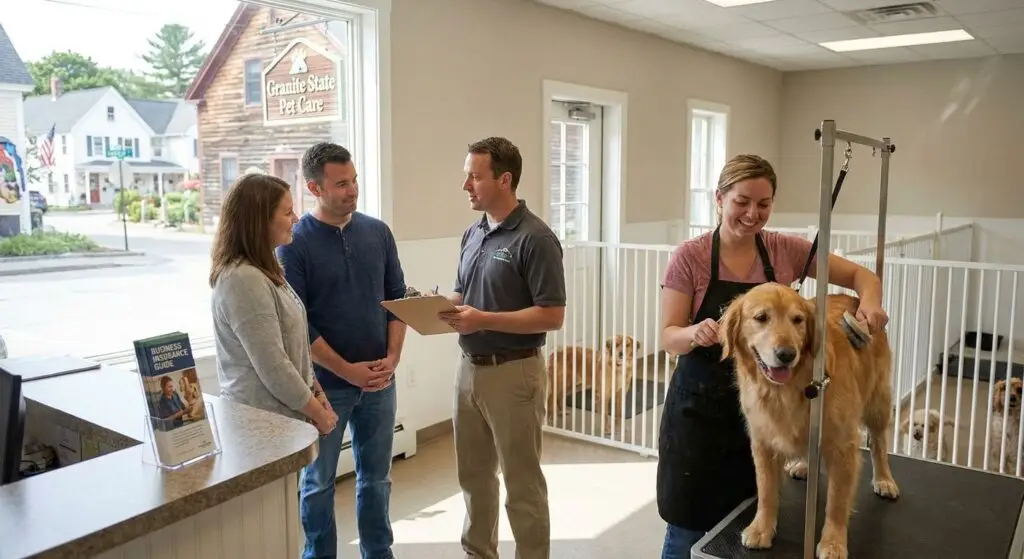
Pet groomers and boarding operators in New Hampshire need business insurance built around bite claims, escaped-animal incidents, and the reality of caring for other people's pets inside a commercial space — a standard storefront policy skips all three. Grooming and boarding businesses carry a mix of general liability, workers' compensation, bailee's coverage, and often commercial auto that a retail shop never needs, because the "product" here is a live animal that can bite, bolt, or get sick on your watch.
- Business insurance for pet groomers and boarding in NH must include care, custody, and control coverage — standard general liability excludes damage to animals in your care.
- Workers’ compensation is required in New Hampshire the moment you have one employee, even part-time.
- Mobile groomers need commercial auto, not a personal auto policy, once the van carries clippers, tables, and client pets.
- A single dog bite or escaped-pet claim can trigger both liability and bailee’s coverage — carry both, not one.
- Bundling general liability, property, and bailee’s coverage into a business owner’s policy is usually cheaper than buying each separately.
Why this matters for groomers and boarding kennels
A groomer's biggest exposure isn't a slip-and-fall — it's the animal itself. Clippers nick skin, dryers overheat, dogs fight in shared runs, and boarded pets escape through a gate a client forgot to latch. Every one of those events is a claim against the business, not the pet owner, because the animal was in your care, custody, and control at the time.
New Hampshire doesn't require general liability insurance by state law, but landlords who lease commercial space to groomers almost always require it in the lease, and boarding facilities that operate under town zoning permits frequently need proof of coverage to keep the permit active. If you employ even one part-time bather or kennel attendant, New Hampshire law requires workers' compensation — there's no owner-only exemption once payroll starts.
Update your liability coverage for animal-specific risk
A generic general liability insurance for New Hampshire small businesses policy covers slip-and-fall and third-party property damage, but it typically excludes damage to property "in your care, custody, or control" — which is exactly where a boarded dog or groomed cat sits all day.
- Confirm your policy includes a bailee's coverage or care, custody, and control endorsement — this is the piece that pays if a dog you're grooming is injured or a boarded cat gets sick in your kennel
- Set a limit high enough to cover a veterinary bill for a large-breed dog, not just a cat or small dog
- Ask whether dog bites to staff or other pets are covered under the same limit or carved out separately
- Check if the policy excludes "aggressive breeds" — some carriers list breed restrictions that can leave a claim uncovered
- Get the endorsement in writing before your first day with new inventory of dogs on-site, not after an incident
Carry workers' compensation for every employee, including part-time
New Hampshire requires workers' compensation insurance as soon as a business has one employee — full-time, part-time, or seasonal help during peak boarding months over the holidays all count.
- Confirm your policy classification code matches "pet grooming" or "animal boarding," not general retail, since misclassification can void a claim
- Cover bite and scratch injuries to staff the same way you'd cover a slip on wet floors
- Add seasonal staff to the policy before the holiday boarding rush, not after they've already clocked hours
- Review the experience modification rate annually — a clean claims history over 2026 lowers next year's premium
- Bundle workers' compensation insurance for New Hampshire small businesses with your liability policy through the same carrier when possible to simplify audits
Insure the building, equipment, and inventory
Whether you rent a storefront or own the building, the physical space needs its own coverage separate from liability.
- Cover grooming tables, clippers, dryers, and tubs at replacement cost, not depreciated value
- Include boarding kennels, runs, and fencing under the property section, especially if they're outdoor structures
- Add business income coverage so a fire or flood that shuts you down for weeks still pays payroll and rent
- Confirm HVAC and climate-control equipment for boarding rooms is scheduled, since a failed system in July can be a covered loss if pets are harmed
- Check that any leased equipment (financed grooming tables, for example) is covered under your policy, not just the lessor's
Add commercial auto if you groom mobile or transport pets
A mobile grooming van or a boarding shuttle that picks up pets from clients' homes is a commercial vehicle the moment it's used for business, and a personal auto policy will deny a claim tied to work use.
- Confirm the van is titled and insured as a commercial vehicle, not under a personal policy
- Add coverage for equipment bolted into the van — generators, water tanks, grooming tables
- Cover pets while in transit separately, since standard auto liability often excludes cargo-type coverage for live animals
- List every employee who drives the van on the policy, including seasonal drivers
- Review commercial auto insurance for New Hampshire business fleets if you run more than one vehicle, since fleet policies can simplify renewals
Consider professional liability for grooming-related injury claims
General liability covers most incidents, but a claim alleging negligent technique — a cut too deep, a dryer left on too long — sometimes falls under professional liability instead, depending on the carrier's wording.
- Ask your agent directly whether grooming injury claims are covered under general liability or require a separate professional liability endorsement
- Document every incident with photos and a written report the same day it happens
- Keep signed intake forms noting any pre-existing conditions disclosed by the owner
- Review the policy annually as service offerings expand — nail trims and de-shedding treatments carry different risk profiles than full grooms
Review cyber and payment-data exposure
Most groomers and boarding facilities now book appointments and store payment cards online, which creates a data exposure a 2016-era policy never anticipated.
- Add a cyber liability endorsement if you store client credit card numbers or pet medical history in a booking system
- Confirm the endorsement covers notification costs if client data is breached, not just direct financial loss
- Review cyber liability insurance for New Hampshire small businesses if your booking software is cloud-based and outside your direct control
Get a quick coverage review
Call, text, or start your quote for pet grooming and boarding coverage in NH.
Comparing coverage options for groomers and boarding operators
| Coverage | Best for | Key limitation |
|---|---|---|
| General liability | Bite claims, client slip-and-fall, third-party property damage | Excludes damage to animals in your direct care without an endorsement |
| Bailee's / care, custody, control | Injury or illness to a pet while boarded or groomed | Limits are often lower than general liability — confirm the cap fits your average pet value |
| Workers' compensation | Any business with one or more employees | Mandatory in NH once payroll starts — no owner-only exemption |
| Business owner's policy (BOP) | Combining property, liability, and business income in one bundle | Not every carrier offers a BOP tailored to animal-care businesses |
| Commercial auto | Mobile grooming vans and pickup/dropoff shuttles | Personal auto policies exclude business use entirely |
Verdict: a standalone general liability policy is not enough for a New Hampshire groomer or boarding kennel — pair it with a bailee's endorsement and workers' compensation before you take on your first boarded pet in 2026.
Common mistakes groomers and boarding operators make
- Assuming general liability covers injured pets — it usually doesn't without a care, custody, and control endorsement, and that gap surfaces during the worst possible moment: a claim
- Skipping workers' comp for part-time bathers — New Hampshire doesn't scale the requirement by hours worked, just by having an employee at all
- Insuring a mobile van under a personal auto policy — carriers routinely deny claims once they learn the vehicle was used for grooming appointments
- Underinsuring kennel structures — outdoor runs and fencing get overlooked in property schedules until storm damage exposes the gap
- Waiting until after an incident to check breed restrictions — some general liability carriers exclude specific breeds from bite coverage, and that's not something to discover during a claim
FAQ
What’s the best business insurance for pet groomers in New Hampshire?
A business owner’s policy that bundles general liability with a care, custody, and control endorsement is the best starting point for most NH groomers in 2026. Add workers’ compensation the moment you hire any staff, even part-time.
Is workers’ compensation required for a one-person grooming business in NH?
No — New Hampshire only requires workers’ compensation once you have at least one employee. A sole owner working alone isn’t required to carry it, though many choose to for their own injury protection.
Does general liability cover a dog bite at a boarding facility?
Yes, general liability typically covers a dog bite to a third party like a customer or visitor, but injuries to the boarded pet itself usually require a separate bailee’s or care, custody, and control endorsement.
How much does business insurance cost for a mobile pet groomer?
Cost depends on payroll, vehicle count, and coverage limits, so get a direct quote rather than relying on a general estimate. A licensed agent can price the exact combination of commercial auto and liability your van needs.
Can I use my personal auto policy for a mobile grooming van?
No, personal auto policies exclude business use, and a claim tied to a grooming appointment will likely be denied. Mobile groomers need a commercial auto policy that names the van’s business use explicitly.
What does bailee’s coverage mean for a boarding kennel?
Bailee’s coverage pays for damage or injury to a pet that’s in your custody, like a boarded dog that gets sick or hurt in a kennel run. It’s separate from general liability, which covers injuries to people, not the animals themselves.
Do I need cyber liability insurance for a small grooming business?
If you store client payment cards or pet medical records in an online booking system, cyber liability is worth adding in 2026. It covers notification costs and related expenses if that data is breached.
One last thing
The most overlooked gap isn't liability or workers' comp — it's the breed exclusion buried in some general liability policies. A groomer who takes on large or restricted breeds without checking the fine print can end up with a bite claim that's simply not covered, no matter how solid the rest of the policy looks. Read the breed list before you take the appointment, not after the claim is filed.
Related guides
- General liability insurance for New Hampshire small businesses
- Workers' compensation insurance for New Hampshire small businesses
- Business insurance for hair salons and spas in New Hampshire
- How to insure a home-based business in New Hampshire
- Dog liability coverage for New Hampshire homeowners