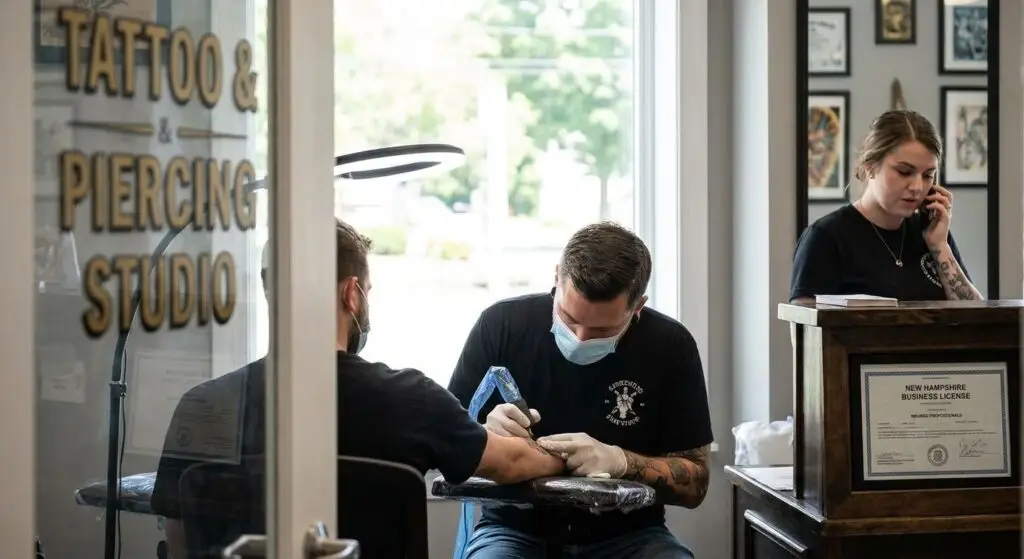
Tattoo and piercing studio insurance in New Hampshire is coverage built around bodily injury and infection-related claims, not just the slip-and-fall risk every retail shop carries. A studio's biggest exposure isn't a customer tripping on the doorstep — it's a claim tied to an allergic reaction, an infection, or a procedure a client says went wrong, and that's a different coverage problem than the one a boutique or bookstore has.
- General liability alone won’t cover a botched-procedure claim at a tattoo or piercing studio in New Hampshire in 2026 — pair it with professional liability.
- New Hampshire requires workers’ compensation the moment a studio has one W-2 employee, no exceptions for small shops.
- Booth renters need their own liability policy — a studio’s coverage doesn’t automatically extend to independent contractors working the chair.
- Cyber liability matters if the studio stores digital consent forms, ID scans, or card payment data on a booking system.
Why this matters for tattoo and piercing studios
A tattoo or piercing studio in New Hampshire deals with needles, ink, jewelry, and skin — every one of those carries a bodily injury or infection angle a standard small-business policy wasn't written for. Landlords and lenders in NH commercial districts routinely ask for a certificate of insurance before signing a lease, and most require both general liability and workers' compensation limits spelled out before handing over keys.
Studios also run on a mix of employees and independent booth renters, which changes how workers' compensation and general liability need to be structured. Get the classification wrong and a claim from a renter's client can land back on the studio's own policy instead of the renter's.
Build the right coverage stack
Start with general liability insurance
General liability is the base layer for any storefront business in New Hampshire — it responds to third-party bodily injury and property damage claims, like a customer slipping in the lobby or a fire spreading from a piece of equipment. General liability insurance for New Hampshire small businesses is the starting point most landlords ask to see on a certificate of insurance before a lease gets signed.
- Confirm the policy covers premises liability, not just products liability
- Check the per-occurrence and aggregate limits against your landlord's lease requirements
- Ask whether piercing and tattooing are listed as covered operations, not excluded activities
- Get a certificate of insurance ready before your lease renewal date
Add professional liability for the procedure itself
General liability stops at slip-and-fall and property damage — it typically won't respond to a claim that a specific tattoo or piercing caused an infection, scarring, or an allergic reaction to ink or jewelry. That gap is what professional liability (sometimes called errors and omissions) is built to close, and studios that skip it are betting the shop on the idea that no client ever reacts badly to a procedure.
- Confirm the policy names tattooing and body piercing as covered professional services
- Check whether the exclusion list mentions bloodborne pathogen exposure
- Ask if the coverage extends to apprentices working under supervision
- Verify the policy responds even if the client signed a waiver — waivers reduce risk, they don't eliminate it
Professional liability insurance for New Hampshire consultants outlines how this coverage type works even though the page is written for a different service business — the underlying mechanics of a professional liability claim are the same.
Carry workers' compensation the moment you hire
New Hampshire law requires workers' compensation coverage as soon as a business has a single employee — there's no small-business exemption based on headcount or payroll size. A studio with one piercer on payroll needs this in place before that person's first shift, not after an injury happens.
- Classify booth renters correctly — most are independent contractors, not employees, and need their own coverage
- Confirm needle-stick and bloodborne pathogen exposure incidents are covered under the state's workers' comp rules
- Review payroll numbers annually since premium is tied to actual wages paid
- Keep proof of coverage posted, since NH labor inspectors can request it on-site
Workers' compensation insurance for New Hampshire small businesses walks through what counts as an employee versus a contractor, which is the exact distinction that trips up multi-artist studios.
Require booth renters to carry their own policy
Most tattoo studios in New Hampshire run on a booth-rental model where individual artists lease chair space and operate as their own business. A studio's general liability policy usually doesn't extend to a renter's clients unless the renter is added as an additional insured or carries independent coverage.
- Ask every renter for a certificate of insurance naming the studio as additional insured
- Put the insurance requirement in the written booth-rental agreement, not just a verbal understanding
- Re-verify coverage annually — renter policies lapse more often than owner policies
- Keep copies on file in case a claim comes in and the studio needs to show the renter carried their own coverage
Cover equipment, ink, and leasehold improvements
Autoclaves, tattoo machines, jewelry inventory, and leasehold improvements to a rented space represent real replacement cost if a pipe bursts or a fire damages the studio. Property coverage — either standalone or bundled into a business owners policy — handles this instead of leaving it to the studio's out-of-pocket budget.
- Get an updated inventory of equipment and ink stock at least once a year
- Confirm leasehold improvements (built-in stations, lighting, flooring) are scheduled on the policy
- Ask whether business income coverage is included if the studio has to close for repairs
- Check that sterilization equipment is specifically listed, since autoclaves aren't cheap to replace
Add cyber liability if client data lives online
Most studios now run booking software that stores names, ID scans for age verification, health screening answers, and payment card numbers. A breach of that data — through a hacked booking platform or a lost device — creates notification costs and liability exposure that general liability doesn't touch.
- Confirm the policy covers notification costs if client records are exposed
- Check whether payment card data breaches are specifically covered, not just general data loss
- Ask if the coverage extends to a third-party booking platform, not just in-house systems
- Review the policy annually as booking software and payment processors change
Cyber liability insurance for New Hampshire small businesses breaks down what a notification-cost claim actually looks like for a small retail-facing business.
“A studio’s general liability policy doesn’t automatically cover a booth renter’s client claim – get proof of the renter’s own policy before they touch a chair.”
Comparing coverage options for NH studios
| Option | Best for | Key limitation |
|---|---|---|
| General liability only | Solo artist renting a single chair with no employees | Won't respond to a claim tied to the procedure itself, only slip-and-fall type incidents |
| General liability + professional liability | Any licensed tattoo or piercing business, owner or renter | Doesn't cover a staff member's own on-the-job injury |
| Workers' compensation | Any studio with even one W-2 employee | Required by New Hampshire law once staff is hired, not optional |
| Cyber liability | Studios storing digital consent forms, ID scans, or card data | Doesn't replace liability coverage for a botched procedure claim |
| Business owners policy bundle | Studios that own equipment and lease long-term | Professional liability often isn't included by default and needs a separate endorsement |
Review your studio’s coverage
Call, text, or start a quote to see what’s actually covered right now.
Common mistakes tattoo and piercing studios make
- Treating general liability as complete coverage. It handles the lobby slip-and-fall, not the claim tied to the tattoo or piercing itself — that requires professional liability layered on top.
- Skipping workers' compensation because the studio feels small. New Hampshire's requirement kicks in at one employee, and a needle-stick injury without coverage in place becomes an out-of-pocket problem fast.
- Assuming booth renters are automatically covered. Renters operating as independent artists need their own policy — a studio's certificate doesn't extend to their clients unless it's structured that way in writing.
- Not updating the policy when the studio adds piercing to a tattoo-only shop, or vice versa. Insurers price and underwrite these services differently, and an unlisted operation can mean a denied claim.
- Letting apprentice coverage fall through the cracks. An apprentice working under a licensed artist still creates exposure, and not every professional liability policy automatically extends to unlicensed apprentices.
FAQ
What insurance does a tattoo studio need in New Hampshire?
A tattoo studio in New Hampshire generally needs general liability, professional liability for the procedure itself, and workers’ compensation once any employee is on payroll. Studios running a booth-rental model also need each renter to carry their own liability policy.
Is workers’ compensation required for a one-person tattoo studio?
If the studio has zero employees and the owner is the only person working, New Hampshire doesn’t require workers’ compensation. The moment a single W-2 employee is hired, the requirement applies regardless of studio size.
Does general liability cover a bad tattoo or piercing reaction?
No, general liability typically responds to slip-and-fall and property damage claims, not to a client’s allergic reaction or infection tied to the procedure itself. That gap is what professional liability is written to cover.
Do booth renters need their own insurance in a New Hampshire tattoo studio?
Yes, most booth renters operate as independent businesses and need their own liability policy since a studio’s coverage doesn’t automatically extend to a renter’s clients. Studios should require a certificate of insurance naming the studio as additional insured.
What’s the difference between general liability and professional liability for a piercing studio?
General liability covers third-party bodily injury and property damage unrelated to the service performed, like a customer tripping in the shop. Professional liability covers claims tied to the piercing procedure itself, such as an infection or reaction.
Does a tattoo studio need cyber liability insurance?
A studio that stores client ID scans, health screening answers, or payment card data through booking software benefits from cyber liability coverage. It handles notification costs and liability if that data is exposed in a breach.
Can a studio add professional liability to an existing general liability policy?
In many cases professional liability is written as a separate policy or endorsement rather than bundled automatically into general liability. Check with the carrier directly since coverage structures vary by insurer.
One last thing
The detail most NH studios miss isn't the coverage itself — it's the certificate of insurance paperwork. Landlords and even some city licensing offices in New Hampshire require an active certificate on file before a studio can operate, and a lapsed policy that hasn't been caught yet can quietly put a lease or a license at risk in 2026.
Related guides
- Professional liability insurance for New Hampshire consultants
- Commercial auto insurance for New Hampshire business fleets