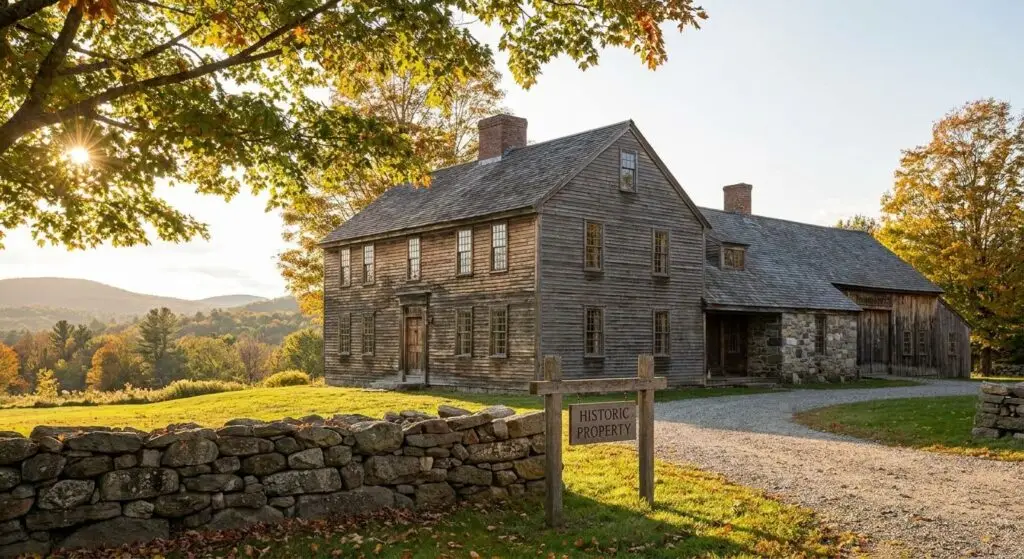
Historic and older home insurance in New Hampshire covers dwellings typically built before 1950 with the aim of matching coverage to period construction costs, not a generic rebuild estimate. Knob-and-tube wiring, plaster walls, fieldstone foundations, and wood-fired heat change how an insurer prices risk and what a standard policy will and won't pay to restore.
- Home insurance for historic homes in New Hampshire needs a replacement cost estimate based on period materials, not market value.
- Ordinance or law coverage matters more here than in newer construction because code upgrades on an old house get expensive fast.
- Wood stoves and knob-and-tube wiring often trigger inspection requirements or coverage limits from carriers in 2026.
- Renovation work on a historic property needs its own policy layer while the house is under construction.
- Working with an agent who understands New Hampshire’s older housing stock beats shopping rate alone.
Why home insurance for historic homes matters in New Hampshire
New Hampshire's housing stock skews old. Towns like Portsmouth, Exeter, Keene, and Concord carry entire neighborhoods of homes built well before modern building codes existed, and a standard actual cash value or market-value policy underestimates what it actually costs to rebuild with matching materials, trim, and craftsmanship.
A generic policy written for a 2020s build assumes drywall, PEX plumbing, and code-compliant panels. A house with original plaster, cast iron radiators, or a fieldstone foundation costs more per square foot to restore, and most homeowners find that out only after a claim. Determining your actual coverage needs before a loss happens is the single biggest lever an older-home owner has.
Steps to get home insurance right for a historic New Hampshire home
Get an accurate replacement cost estimate
Market value and replacement cost are not the same number, and the gap widens with age. A 1920s farmhouse might sell for $350,000 but cost $500,000 to rebuild with comparable materials once labor and specialty trim are factored in.
- Ask for a replacement cost estimate specific to the home's construction type, not a square-footage average
- Request an itemized breakdown for custom millwork, plaster, or original flooring
- Re-run the estimate after any renovation over $10,000
- Confirm whether the carrier uses actual cash value or replacement cost for the roof specifically
- Check that outbuildings (barns, carriage houses) are scheduled, not assumed
Inspect and update outdated electrical and heating systems
Knob-and-tube wiring, common in homes built before 1950, and older 60-amp fuse panels are two of the fastest ways to get a policy declined or non-renewed in New Hampshire. Wood stoves add a second layer of scrutiny.
- Get a licensed electrician's inspection report before applying, not after a quote comes back with exclusions
- Budget for panel upgrades from fuse boxes to breaker panels if the home hasn't been rewired
- Have wood stove chimneys inspected annually, in line with NFPA guidance, and keep the certificate on file
- Ask whether the carrier requires a WETT or chimney sweep certification for homes with wood stoves
- Document any oil tank age and location, since underground tanks are a common exclusion trigger
Add ordinance or law coverage
When an older home takes a major loss, local building codes usually require bringing the whole structure up to current standards, not just repairing the damaged section. Standard policies rarely cover that gap on their own.
- Ask specifically about ordinance or law coverage as a separate endorsement
- Look at increments of 10%, 25%, or 50% of the dwelling limit depending on how much of the home is original
- Confirm the endorsement covers demolition and debris removal for non-compliant portions
- Check if the endorsement extends to increased construction costs from code-required materials
- Review this coverage every few years as NH building codes get updated
Document architectural details and materials
An adjuster who doesn't know the home has hand-carved trim, original hardware, or plaster crown molding will price a claim like it's drywall and vinyl. Documentation before a loss changes that conversation.
- Photograph or video every room, including trim, flooring, and built-ins
- Keep receipts and contractor names for any restoration work already completed
- Note the age and type of roofing material, since slate and wood shingle cost more to replace than asphalt
- Save any historical society or National Register documentation if the home carries that designation
- Store copies of this documentation off-site or in cloud storage, not just in the house
Increase liability and umbrella limits
Older homes often have features that raise liability exposure: uneven floors, narrow stairwells, older railings, or a barn used for storage or hobby space. Standard liability limits of $100,000 to $300,000 may not be enough.
- Push dwelling liability to at least $300,000 if the home has stairs, a pool, or outbuildings
- Layer on umbrella coverage for an extra $1 million or more in protection
- Confirm outbuildings used for anything other than storage are disclosed and covered
- Ask how the policy treats guests injured on original, non-code-compliant staircases
- Review limits any time the home is used for events, rentals, or a home-based business
Cover renovation projects separately
A historic home mid-renovation is a different risk than a finished, occupied one. Standard homeowners policies often exclude or limit coverage while walls are open, scaffolding is up, or the home sits partially vacant during work.
- Get a builders risk policy for any renovation project over a few weeks
- Confirm coverage for materials and fixtures stored on-site before installation
- Ask whether the existing homeowners policy stays active or gets suspended during major work
- Check contractor liability requirements before signing a renovation contract
- Re-quote the standing homeowners policy once work wraps, since the replacement cost figure will have changed
Comparing coverage options for older and historic New Hampshire homes
| Option | Best for | Key limitation |
|---|---|---|
| Standard HO-3 policy | Homes with updated systems and no unique architectural features | Often undervalues period materials and custom trim |
| Replacement cost policy with historic endorsement | Homes with original woodwork, plaster, or specialty roofing | Requires detailed documentation to price accurately |
| Agreed value / guaranteed replacement cost | High-value or heavily restored historic homes | Usually costs more upfront in premium |
| Builders risk (renovation phase only) | Homes actively under renovation or restoration | Only covers the construction period, not ongoing occupancy |
The clearest verdict here: a standard HO-3 policy underprices a pre-1950 New Hampshire home almost every time, and a replacement cost endorsement built around the home's actual materials is the fix, not a bigger dwelling limit alone.
Common mistakes owners of historic New Hampshire homes make
- Insuring to market value instead of replacement cost — a home that sells for less than it costs to rebuild leaves the owner underinsured after a total loss
- Skipping the electrical inspection until a carrier flags it — this delays quotes and often forces a rushed, more expensive panel upgrade
- Treating the barn or carriage house as automatically covered — outbuildings frequently need to be scheduled separately with their own limit
- Renovating without a builders risk policy — a fire or storm loss mid-project can fall into a coverage gap between the homeowners policy and the contractor's liability
- Assuming wood stove use doesn't need to be disclosed — an undisclosed wood stove found during a claim investigation can delay or reduce a payout
Get your historic home reviewed
Call, text, or start a quote for a coverage check on your older New Hampshire home.
FAQ
What counts as a historic home for insurance purposes in New Hampshire?
Most carriers treat homes built before 1950 as older or historic risk, though some apply the label to anything over 50 years old regardless of National Register status. The exact cutoff varies by insurer, so ask directly when getting a quote.
Is home insurance more expensive for historic homes in New Hampshire?
Often yes, because replacement cost for period materials like slate roofing, plaster walls, and custom millwork runs higher than modern equivalents. Homes with outdated wiring or heating systems can also see higher rates until those systems are updated.
Do I need to rewire an old house to get home insurance in New Hampshire?
Many carriers will decline or limit coverage on homes with active knob-and-tube wiring or older fuse panels. An electrician’s inspection report showing the wiring is safe, or proof of a panel upgrade, resolves this in most cases.
Does home insurance cover a wood stove in an older New Hampshire home?
Wood stoves are typically covered but often require an annual chimney inspection certificate and sometimes a WETT or sweep certification. Skipping disclosure of a wood stove can create problems if a fire claim gets investigated.
What is ordinance or law coverage and do I need it for a historic home?
Ordinance or law coverage pays for code-required upgrades when repairing damage to an older home, since local codes usually require bringing the whole structure up to current standards. It’s one of the most commonly missed endorsements on pre-1950 New Hampshire homes.
Can I insure a historic home while it’s being renovated?
Yes, but it usually needs a separate builders risk policy layered on top of or in place of the standard homeowners policy during construction. Check with the carrier on whether the existing policy stays active or pauses during major work.
Should a historic home carry umbrella insurance?
Umbrella coverage makes sense for older homes with features like uneven stairs, ponds, barns, or outbuildings that raise liability exposure beyond standard limits. An extra $1 million in umbrella coverage is common for properties with these features.
What’s the difference between replacement cost and agreed value coverage for an old home?
Replacement cost pays to rebuild with similar materials up to the policy limit, while agreed value locks in a pre-set payout amount agreed on by the owner and insurer at the start of the policy. Agreed value removes the risk of underinsurance but usually costs more in premium.
One last thing
The fastest way to find out a historic home is underinsured is a partial loss, not a total one — a kitchen fire that requires matching 90-year-old plaster and trim exposes the gap between market value and true rebuild cost long before a full rebuild ever would. Get the replacement cost number checked in 2026 before that happens, not after.
Related guides