
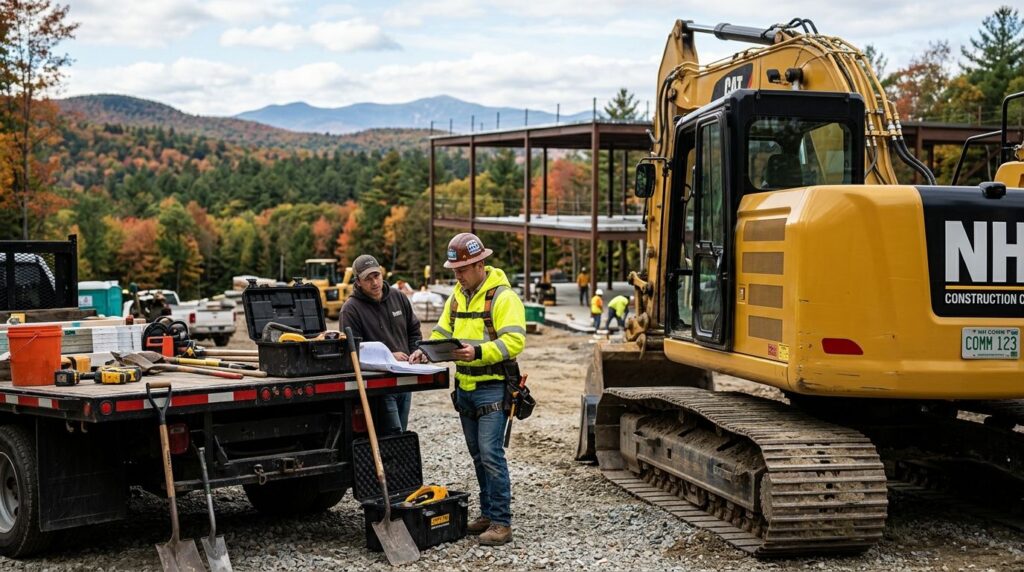
New Hampshire contractors carry tools, generators, and machinery that never sit still — inland marine insurance covers that mobile equipment against theft, damage, and loss wherever the job takes it, whether that's a driveway in Nashua or a job site off Route 16 near the White Mountains. Contractors in this state deal with harsh winters, remote job sites with spotty security, and equipment that spends more time on a trailer than in a locked shop. Standard commercial property insurance stops covering a table saw or skid steer the moment it leaves your business address — inland marine picks up where that policy ends.
- Inland marine insurance for contractors in New Hampshire covers tools and equipment away from your shop — property policies won’t.
- A contractors equipment floater is the most common inland marine form for NH trade businesses in 2026.
- Theft from job sites and trucks is the top claim driver for New Hampshire contractors, especially in winter months.
- Bundling inland marine with general liability and workers’ comp usually simplifies renewal and claims for small NH contracting operations.
Why inland marine coverage matters for New Hampshire contractors
A general liability policy protects you when someone else gets hurt or their property gets damaged. It does nothing for your own generator getting stolen off a Concord job site overnight, or a $6,000 compressor sliding out of an unsecured trailer on I-93. That gap is exactly what inland marine insurance closes.
New Hampshire's mix of rural job sites, seasonal construction slowdowns, and unattended equipment storage between November and March creates real exposure. Tools left in a truck bed or a half-built structure over a long weekend are an easy target, and a single stolen mini-excavator can stall a project for weeks while a replacement gets sourced. Contractors who skip inland marine coverage are self-insuring their most expensive tools — the ones that generate revenue every day they're on a job.
Steps to set up inland marine coverage the right way
Inventory your tools and equipment
Before buying anything, know what you own and what it's worth. Insurers price inland marine coverage off a schedule, and a vague list under-protects you.
- List every piece of equipment over $500 in value, with serial numbers
- Note original purchase price and current replacement cost, not depreciated value
- Separate owned equipment from rented or leased gear
- Photograph high-value items for claims documentation
- Update the list every time you buy or retire equipment
Match coverage to job-site risk
A contractor working mostly in suburban Manchester has a different theft profile than one running crews in Coos County backcountry. Match your limits and terms to where you actually work.
- Flag job sites without fencing or overnight security
- Note seasonal exposure — winter storage yards see more break-ins than active summer sites
- Check whether your policy covers equipment in transit between sites, not just parked equipment
- Review coverage for equipment stored at a subcontractor's location
Check theft and mysterious disappearance terms
Not every inland marine policy treats theft the same way. Some exclude "mysterious disappearance" — meaning equipment that vanishes with no witnesses and no forced-entry evidence — which is common on open job sites.
- Confirm the policy covers theft with no sign of forced entry
- Ask whether a police report is required for every claim, and how fast it must be filed
- Check if there's a per-item sublimit that caps payout below the item's actual value
- Review whether GPS-tracked equipment gets a premium credit
Coordinate inland marine with builders risk and general liability
Overlapping coverage wastes premium; gaps in coverage leave you exposed. Inland marine protects your tools and equipment; builders risk insurance protects the structure under construction; general liability handles third-party injury and property damage claims.
- Confirm builders risk covers the structure itself, not the contractor's own tools
- Confirm general liability insurance doesn't attempt to double as equipment coverage — it won't pay for a stolen generator
- Ask your agent to map out where each policy starts and stops before you sign anything
An independent agency that reviews all three policies side by side catches the overlap and the gaps faster than piecing coverage together policy by policy. That review is where a quick call to Themelloagency's contractor insurance page earns its keep — one review, three policies checked at once.
Set your equipment schedule and limits
Most inland marine policies for contractors run on a scheduled basis — each item listed with its own value — or a blanket basis covering a category up to a total limit.
- Schedule high-value single items (over $10,000) individually
- Use a blanket limit for smaller hand tools and portable equipment
- Set the blanket limit above your typical job-site tool load, not your average
- Review limits annually — equipment replacement costs have climbed steadily through 2026
Review off-premises and in-transit exposures
Equipment gets stolen from trucks and trailers more often than from job sites themselves. Confirm your policy actually follows the equipment, not just the location.
- Check coverage while equipment is on a trailer in transit
- Confirm coverage extends to a subcontractor's yard if you store gear there temporarily
- Ask about coverage for tools left in a locked vehicle overnight
- Review whether commercial auto and inland marine coordinate, so a stolen truck-and-tools loss isn't disputed between two carriers
If your crews run multiple trucks between job sites, pairing this with commercial auto insurance for your fleet closes the gap between vehicle coverage and equipment coverage.
Bundle with workers' compensation for full operational protection
Equipment coverage protects assets; workers' compensation insurance protects your crew. New Hampshire requires workers' comp for almost every business with employees, and a contractor missing it can't legally operate a jobsite with hired labor.
- Confirm workers' comp is active before crews start any 2026 project
- Bundle policies with one agency to simplify renewal dates and paperwork
- Ask whether bundling multiple lines reduces your total premium load
Get your equipment coverage reviewed
A quick call checks your tools, job sites, and liability gaps at once.
Comparison of inland marine coverage options for contractors
| Option | Best for | Key limitation |
|---|---|---|
| Scheduled inland marine | High-value single items like excavators or generators | Requires updating the schedule every time you buy new equipment |
| Blanket inland marine | Contractors with many small tools, hard to itemize | Per-item payout often capped below total blanket limit |
| Contractors equipment floater | Crews moving gear between multiple active job sites daily | Doesn't cover the structure being built — pair with builders risk |
| Rental reimbursement endorsement | Contractors who rent replacement gear during a claim | Only pays while original equipment is being repaired or replaced |
Verdict: a scheduled contractors equipment floater with a rental reimbursement endorsement is the standard setup for most New Hampshire trade contractors in 2026 — it covers named high-value assets and keeps a crew working while a stolen or damaged item gets replaced.
Common mistakes New Hampshire contractors make
- Insuring equipment at purchase price instead of replacement cost. Prices on skid steers and compressors have moved since 2023, and a policy based on old numbers underpays on a claim.
- Forgetting winter storage exposure. Equipment parked in a yard from December through March in New Hampshire sees more theft attempts than gear in active summer use — confirm storage locations are listed on the policy.
- Assuming rented equipment is automatically covered. Many inland marine policies exclude rented or leased gear unless specifically added — check this before a rental company holds you liable for a stolen loader.
- Skipping the police report step. Insurers routinely deny theft claims without a filed report, even when the loss is obvious.
- Not updating the schedule after buying new tools. A truck full of unlisted tools is a truck full of uninsured tools the day it gets broken into.
FAQ
What does inland marine insurance cover for contractors in New Hampshire?
It covers tools, machinery, and equipment while they’re away from your business location — on a job site, in transit, or in storage. Standard commercial property insurance only covers items at a fixed address, so inland marine fills the gap for mobile contractor equipment.
Is inland marine insurance the same as builders risk insurance?
No. Inland marine covers your tools and equipment; builders risk covers the structure under construction itself. Most New Hampshire contractors carry both, since they protect different assets on the same job.
Do New Hampshire contractors legally need inland marine coverage?
New Hampshire doesn’t mandate inland marine coverage by law, but most contract agreements and equipment lenders require proof of coverage before releasing high-value machinery. Workers’ compensation, by contrast, is required for nearly every employer in the state.
Does inland marine cover stolen tools from a work truck?
Yes, if the policy includes in-transit and off-premises coverage, which most contractor equipment floaters do. Confirm whether the policy requires forced-entry evidence, since some plans exclude theft with no visible break-in.
Can I add rented equipment to an inland marine policy?
Yes, most carriers let you add rented or leased equipment as an endorsement. Without it, you may be personally liable to the rental company if the equipment is stolen or damaged on your job site.
How is inland marine different from general liability insurance?
General liability covers injury or property damage you cause to someone else. Inland marine covers your own equipment against theft, damage, and loss — the two don’t overlap.
Should small contractors bundle inland marine with other policies?
Bundling inland marine with general liability and workers’ compensation through one agency usually simplifies renewals and claims coordination, since all three policies get reviewed together instead of separately.
One last thing
The claim that gets denied most often isn't the big theft — it's the small one. A stolen $800 nail gun left off an equipment schedule gets no payout at all, while a $40,000 excavator listed by serial number gets paid without argument. The schedule is the policy — if it's not listed, it's not covered, no matter how obvious the loss.
Related guides
- Business insurance for contractors in New Hampshire
- Builders risk insurance for home renovation projects in NH
- Workers' compensation insurance for New Hampshire small businesses
- General liability insurance for New Hampshire small businesses
- Commercial auto insurance for New Hampshire business fleets