Product liability insurance for New Hampshire manufacturers pays legal defense and settlement costs when a product you made, assembled, or private-labeled injures someone or damages their property, with the goal of keeping one defect claim from draining company cash. Manufacturers carry a different exposure than a retailer or a contractor: the claim can surface years after the part left your shop, and it can name every business in the supply chain, not just the one that sold the finished item.
- Product liability insurance new hampshire manufacturers policies usually attach to a general liability form as products-completed operations coverage, not a standalone policy.
- A $1 million per-occurrence limit is common for small NH shops, but supply contracts with big OEMs often require $2 million or more.
- Manufacturers selling into multiple states need coverage that follows the product wherever a lawsuit gets filed, not just New Hampshire courts.
- Umbrella coverage sits on top of the primary policy and is the cheapest way to raise limits once a single claim exceeds the base policy.
- The Mello Agency reviews contract language and supply chain exposure before recommending limits, not after a claim shows up.
Why product liability insurance matters for New Hampshire manufacturers
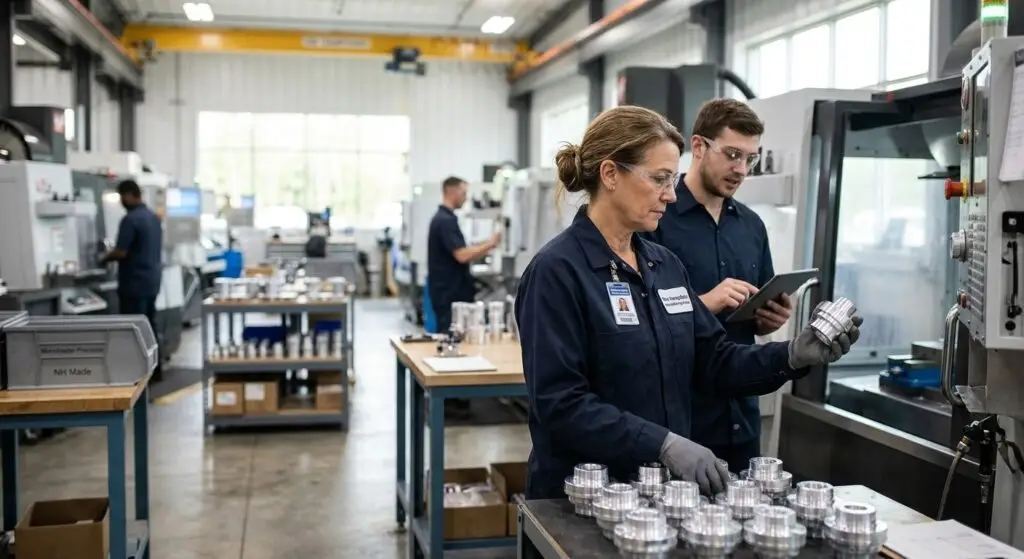
A manufacturer's exposure doesn't end when the product ships. If a component fails in a customer's facility in Ohio, or a consumer product ends up on a store shelf in another state, the lawsuit can land wherever the injury happened, not where the part was built. New Hampshire's manufacturing base runs heavy on precision machining, plastics, electronics, and food production, and every one of those categories carries its own version of the same risk: a defect claim that names the manufacturer regardless of who assembled the final product.
Most NH manufacturers already carry general liability insurance, but the products-completed operations piece inside that policy is where product liability protection actually lives. Buying a policy without checking that section is the single most common gap this office sees among shop owners in 2026.
Confirm your products-completed operations coverage
Before anything else, find out whether your current policy even covers claims tied to products you've already sold and shipped. This is the free step and it takes fifteen minutes with your policy declarations page.
- Pull your current general liability policy and locate the products-completed operations limit, which is often separate from the general aggregate
- Check whether the limit is per-occurrence, aggregate, or both
- Confirm the policy covers claims filed after the product has left your possession, not just while it's on-site
- Ask whether any product categories are excluded (food, medical devices, and certain chemical compounds are common carve-outs)
- Note the retroactive date if the policy was recently rewritten
Match your policy limits to your supply chain exposure
Limits should reflect who buys from you, not just your revenue. A shop selling direct to consumers has a different exposure profile than a subcontractor supplying parts to an automotive OEM.
- List every customer contract that specifies a minimum liability limit
- Check purchase orders and master supply agreements for indemnification language
- Estimate the worst-case unit exposure if a full production run gets recalled
- Compare your current per-occurrence limit against the highest limit any single customer requires
- Flag any customer requiring limits above $2 million, since that usually forces an umbrella conversation
A $1 million per-occurrence limit covers most small NH shops selling regionally, but any manufacturer supplying a Tier 1 automotive or aerospace buyer should expect a $2 million to $5 million requirement written into the contract.
Document your quality control process
Insurers price product liability partly on how tight your quality control is, and courts weigh it heavily when a claim goes to litigation. This step is manual and it's the one shops skip most often.
- Write down your inspection process for incoming raw materials
- Log final inspection results by batch or serial number, not just pass/fail
- Keep supplier certificates of compliance on file for at least the life of the product plus several years
- Record any corrective action taken after a customer complaint
- Save shipping and lot records so a recall can be traced to a specific run, not the entire product line
When this documentation exists and is organized, underwriters price the risk lower and defense counsel has a much easier time closing a claim before it reaches a jury.
Add contractual liability coverage for OEM relationships
Manufacturers supplying larger buyers almost always sign a supply agreement with an indemnification clause. That clause can shift liability back to you even for claims that aren't strictly your fault.
- Read every supply agreement for indemnification and hold-harmless language before signing
- Confirm your policy includes contractual liability coverage, since it's not automatic on every form
- Ask whether the buyer requires you to name them as an additional insured
- Check whether a waiver of subrogation is required and whether your carrier allows it
- Get any unusual contract language reviewed before the next renewal, not after a claim arrives
This is the point where a generic policy stops being enough and a broker who reads the actual contract earns their fee. The Mello Agency reviews supply and distribution contracts as part of setting product liability insurance for New Hampshire manufacturers, because the contract language often drives the required limit more than the product itself does.
Layer an umbrella policy over your primary limits
Once your primary general liability limit is set, an umbrella policy is the least expensive way to add another $1 million to $5 million in protection above it.
- Confirm the umbrella policy follows form over your general liability, auto, and employers liability
- Check for any gaps between the primary policy's aggregate and the umbrella's attachment point
- Ask whether the umbrella covers products-completed operations specifically, since some forms exclude it
- Compare the added premium against the added limit — this coverage is usually cheap per dollar of protection
- Revisit the umbrella limit every time a new large contract or new product line gets added
Manufacturers with export customers or products headed into consumer retail should treat umbrella coverage as standard, not optional, since a single class-action-style claim can exceed a $1 million primary limit fast.
Review coverage before new product launches
A new product line changes your risk profile even if your revenue doesn't move much. This step gets skipped constantly because launch timelines don't leave room for an insurance review.
- Notify your broker before a new product category goes into production, not after the first shipment
- Ask whether the new product falls under an existing exclusion (certain electronics, coatings, and food additives commonly do)
- Confirm the policy's product description on file matches what you're actually shipping in 2026
- Check whether a new distribution channel (export, big-box retail, e-commerce) changes the required limit
- Update your certificate of insurance templates so new customers get accurate proof of coverage immediately
Bundle with workers' comp and commercial auto for full protection
Product liability rarely stands alone on a manufacturing risk. Shop floor injuries and delivery exposure sit right next to it.
- Confirm workers' compensation coverage matches your current headcount and payroll classification codes
- Check that any company-owned delivery vehicles are covered under commercial auto insurance, not a personal policy
- Ask about package discounts when general liability, workers' comp, and commercial auto sit with the same carrier
- Review employee driving records annually if delivery is part of daily operations
- Confirm equipment and machinery are scheduled correctly, since a gap here often surfaces during a claim, not before
Get a product liability quote reviewed
Call or text for a quick review of your current limits and contracts.
Coverage options for New Hampshire manufacturers compared
| Option | Best for | Key limitation |
|---|---|---|
| General liability with products-completed operations | Small to mid-size shops selling regionally | Limit is shared with all other liability claims on the aggregate |
| Standalone product liability endorsement | Manufacturers in higher-hazard categories (food, chemicals, medical) | Underwriting is stricter and takes longer to bind |
| Umbrella / excess liability | Manufacturers with OEM or export contracts requiring high limits | Only pays after the primary policy's limit is exhausted |
| Manufacturers errors and omissions | Companies designing custom or engineered products, not just fabricating | Doesn't cover bodily injury or property damage on its own |
Verdict: a general liability policy with a solid products-completed operations limit is the right starting point for most New Hampshire manufacturers, and an umbrella layer becomes necessary the moment a customer contract requires more than $1 million.
Common mistakes New Hampshire manufacturers make
- Assuming general liability automatically covers products after they ship. Some cheaper policies cap products-completed operations far below the general aggregate, and shop owners don't find out until a claim hits.
- Setting limits based on revenue instead of contract requirements. A small shop supplying one large OEM can face a $2 million limit requirement despite modest annual sales.
- Skipping the umbrella conversation because the primary policy "feels like enough." A single injury claim tied to a defective part can exceed $1 million in medical costs and lost wages alone.
- Not updating coverage before a new product launch. New materials, new suppliers, or a new distribution channel can trigger an exclusion nobody checked for.
- Letting quality control documentation lapse. Underwriters and defense attorneys both rely on batch records and inspection logs, and missing paperwork weakens a defense even when the product wasn't actually defective.
FAQ
What does product liability insurance cover for New Hampshire manufacturers?
It covers legal defense and settlement costs when a product a manufacturer made, assembled, or private-labeled causes bodily injury or property damage after it leaves the shop. Coverage usually sits inside a general liability policy’s products-completed operations section rather than as a separate policy.
Is product liability insurance required by law in New Hampshire?
New Hampshire does not mandate product liability insurance by statute, but nearly every supply contract with a distributor, retailer, or OEM buyer requires proof of coverage and a minimum limit before they’ll place an order. Skipping coverage effectively locks a manufacturer out of larger contracts.
How much product liability insurance does a small NH manufacturer need?
Most small shops selling regionally carry a $1 million per-occurrence limit, while manufacturers supplying automotive, aerospace, or large retail buyers are often contractually required to carry $2 million to $5 million. The right number comes from the buyer’s contract, not a general rule of thumb.
Does product liability insurance cover claims filed years after the product shipped?
Yes, as long as the policy was active with the correct retroactive date and the products-completed operations coverage wasn’t excluded or capped. This is why continuous coverage without lapses matters more for manufacturers than for most other business types.
Is umbrella insurance the same as product liability insurance?
No. Umbrella insurance adds extra limits on top of an existing general liability policy once the primary limit is used up; it doesn’t replace the underlying products-completed operations coverage. Manufacturers typically need both, not one or the other.
Do New Hampshire manufacturers need separate coverage for products sold out of state?
The policy needs to cover claims wherever they’re filed, not just in New Hampshire, since a defect claim follows the product to wherever the injury happened. Confirm with your broker that the policy has no territorial restriction before shipping outside New England.
What’s the difference between product liability and manufacturers errors and omissions coverage?
Product liability covers bodily injury and property damage caused by a physical defect, while errors and omissions covers financial loss from a design or specification mistake that doesn’t necessarily injure anyone. Manufacturers who design custom or engineered products often need both.
Can a small manufacturing shop bundle product liability with other business coverage?
Yes, most carriers package general liability, workers’ compensation, and commercial auto together for manufacturers, often at a lower combined rate than buying each separately. Bundling also simplifies certificate of insurance requests from customers.
One last thing
The claim that actually sinks a small manufacturer isn't usually the injury itself, it's the defense cost racked up before the case even reaches settlement. Check your products-completed operations limit today, not at renewal, because that's the number that determines whether a defect claim is an annoyance or a business-ending event in 2026.
Related guides
- General liability insurance for New Hampshire small businesses
- Workers' compensation insurance for New Hampshire small businesses
- Commercial auto insurance for New Hampshire business fleets
- Umbrella insurance for New Hampshire business owners
- Best business insurance policies for New Hampshire startups