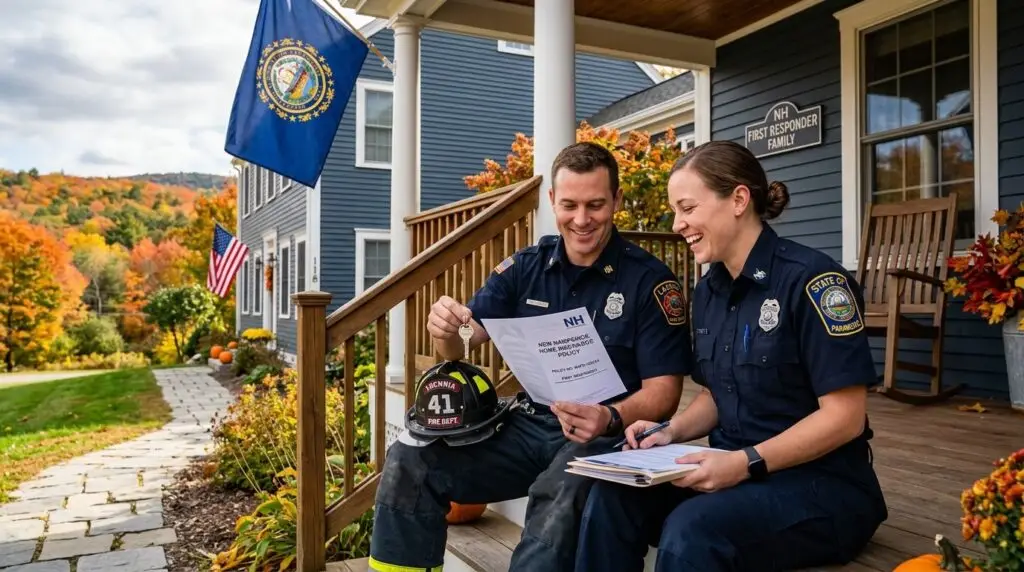
First responders in New Hampshire need home insurance that accounts for 24-hour shifts, homes sitting empty during long tours, and the liability exposure that comes with a public-safety career — coverage built on the same HO-3 framework as any other NH homeowners policy, with a handful of details that matter more for this group than for a typical buyer. Firefighters, police officers, paramedics, and EMTs also tend to carry duty gear, firearms, and sometimes a second income (overtime details, volunteer department stipends, part-time EMS work) that a standard policy doesn't automatically account for.
- Home insurance for first responders NH runs on a standard HO-3 policy — the fixes are in the endorsements, not a separate product.
- Shift work means your home sits unoccupied for 24-48 hours at a stretch; disclose that pattern so a claim isn’t questioned later.
- Duty gear, firearms, and tools kept at home usually need a scheduled personal property endorsement — base coverage caps out fast.
- Umbrella coverage matters more for public-facing roles with dogs, side businesses, or higher community visibility.
- Bundling home and auto with New Hampshire homeowners insurance for first responders is the fastest lever for lowering premium.
Why home insurance matters for New Hampshire first responders
New Hampshire doesn't legally require homeowners insurance — it's the only state with no mandatory auto insurance requirement either — but every mortgage lender in the state requires dwelling coverage, and most first responders are still paying a mortgage while working odd, unpredictable hours. That combination changes how you should think about coverage.
A firefighter working a 24-on/48-off schedule leaves a house unoccupied for a full day at a time, several times a week. A patrol officer on a rotating night shift is asleep during the exact hours a break-in is more likely to happen at home. None of that voids a policy, but it does mean underwriters weigh vacancy and theft risk differently, and it means you should know your actual coverage needs before you assume the policy you signed five years ago still fits.
Many New Hampshire first responders are also veterans — a large share of fire and police departments in the state recruit from military service — which sometimes opens up separate discount paths worth checking alongside your homeowners review.
Update your dwelling coverage to match rebuild cost
Market value and rebuild cost are two different numbers, and 2026 construction costs in New Hampshire have moved fast enough that a policy written in 2020 or 2021 is likely underinsured today.
- Ask your carrier for a current replacement cost estimate, not the number from your last renewal
- Confirm the policy includes extended or guaranteed replacement cost, not just "actual cash value"
- Check the dwelling limit against recent local rebuild quotes if you've had any home renovation done
- Flag any additions — finished basements, garages, in-law space — that may not be reflected in the file
- Re-run the number every two to three years, not just at renewal reminders
Schedule your duty gear and personal equipment
Standard homeowners policies cap personal property coverage at a flat percentage of dwelling coverage, and they sub-limit categories like firearms, tools, and business-use equipment well below what most first responders keep at home. A scheduled personal property endorsement is the manual fix; it's a line-item add-on most carriers offer without switching your whole policy.
- Inventory duty gear, firearms, ballistic vests, and specialty tools kept at the house
- Get appraisals or receipts for anything over a few hundred dollars
- Ask specifically about the firearms sub-limit — most base policies cap it in the low thousands
- Separate personally owned gear from anything issued by your department, since issued equipment is usually covered by the department, not your homeowners policy
- Update the schedule any time you add or replace major equipment
Disclose side income, volunteer work, and vehicles kept on the property
Volunteer fire departments, part-time EMS shifts, and side businesses are common among first responders in New Hampshire, especially in smaller towns that rely on volunteer coverage. Insurers need to know about this activity because undisclosed business use on a residential policy is one of the most common reasons a claim gets denied.
- Tell your agent about any volunteer department vehicle, radio equipment, or gear stored at the house
- Disclose part-time EMS or security work run partly from home
- Ask whether a side business needs its own home-based business coverage or fits under an endorsement
- If you're a veteran transitioning into a first-responder role, check whether your existing coverage was set up under military and veteran insurance guidance that no longer matches your current situation
- Confirm any trailer, ATV, or department-adjacent vehicle parked at the property is either excluded correctly or added as scheduled property
Increase your liability limits for public-facing exposure
First responders live visibly in their communities — neighbors, callers, and coworkers often know exactly where you live. That visibility, combined with common household risks like dogs or trampolines, pushes liability exposure above what a base $100,000-$300,000 policy limit realistically covers.
- Raise personal liability limits to at least $300,000-$500,000 if your base policy sits lower
- Add an umbrella policy once your home and auto liability limits are maxed out, which most first responders reach faster than average due to dual-vehicle households
- Check dog liability coverage separately if you own a breed your carrier flags
- Review pool or trampoline liability if either is on the property
- Ask your agent whether an umbrella policy makes more financial sense than stacking higher limits on the base policy alone
“If your homeowners policy caps firearms and duty gear at a few thousand dollars, it wasn’t written for a first responder’s household.”
Cover extended vacancy during long shifts
A house sitting empty for 24 hours isn't the same underwriting risk as a house vacant for 60 days, but insurers still track occupancy patterns. Most standard policies don't penalize normal shift-based absences — the risk shows up when a home sits fully unoccupied for weeks, which happens more often with first responders who also work seasonal camps, deployments, or travel assignments.
- Confirm your policy's vacancy clause and how many consecutive days trigger reduced coverage
- Ask a neighbor or family member to check the house during multi-day stretches when possible
- Set up basic monitoring (cameras, water sensors) if the house is regularly empty for long blocks
- Tell your carrier in advance if you're heading into an extended absence, like a long training assignment
- Review coverage again if the home becomes a rental or second property during a duty-station change
Bundle and re-shop annually as pay and schedule change
First responder pay structures shift with overtime, promotions, and stipends, and premiums should get revisited on the same schedule — not just left on autopilot at renewal.
- Bundle home and auto with one carrier for a multi-policy discount
- Ask specifically about public-service or first-responder discounts, since some carriers offer them and many agents don't lead with it
- Re-shop every 12-18 months, especially after a rate increase notice
- Review ways to lower home insurance premiums in New Hampshire any time your household income or schedule changes
- Raise your deductible if you've built enough savings to self-insure smaller claims
Get your policy reviewed today
Quick review of your current coverage — call, text, or start a quote.
Comparing coverage options for New Hampshire first responders
| Option | Best for | Key limitation | Verdict |
|---|---|---|---|
| Standard HO-3 policy | First responders with typical schedules and no specialty equipment at home | Sub-limits on firearms, tools, and business property fill up fast | Hold — fine as a base, not sufficient alone |
| HO-3 + scheduled personal property endorsement | Anyone storing duty gear, firearms, or tools at home | Requires an itemized list and receipts or appraisals | Buy — the single most useful add-on for this group |
| HO-3 + umbrella policy | First responders with dogs, side businesses, or high community visibility | Needs underlying home and auto limits raised before it kicks in | Buy — cheap protection against a lawsuit that could outlast a career |
| Landlord/dwelling fire policy | First responders renting out a second property or relocating for a duty assignment | Doesn't cover owner-occupied risk; needs separate tenant liability | Skip unless you're actually renting the property out |
Common mistakes first responders make with home insurance
- Assuming duty gear is automatically covered — most policies sub-limit firearms and tools well below what's actually kept in a garage or gun safe
- Not disclosing volunteer department vehicles or equipment stored on the property, which can complicate a claim involving that vehicle
- Insuring to market value instead of rebuild cost, which leaves a real coverage gap after a total loss in 2026's construction market
- Skipping a liability increase despite public-facing exposure, dog ownership, or a side business run partly from home
- Letting a policy sit unreviewed for years while pay, overtime, and household risk keep changing
FAQ
Does home insurance cost more for firefighters and police officers in New Hampshire?
Home insurance for first responders in NH is priced on the same factors as any homeowner — location, dwelling value, claims history, and credit-based insurance score. Occupation alone isn’t a standard rating factor, though some carriers offer public-service discounts worth asking about.
Do I need to tell my insurer I’m a volunteer firefighter?
Yes, disclose volunteer fire or EMS work, especially if department equipment, a radio, or a vehicle is kept at your home. Undisclosed business or volunteer-related activity is a common reason claims get delayed or denied.
Is duty gear covered under a standard homeowners policy?
Personal duty gear kept at home is covered up to your personal property limit, but firearms, tools, and specialty equipment usually fall under lower sub-limits. A scheduled personal property endorsement raises those limits for specific, itemized items.
Does my homeowners policy cover the house during a 24-hour shift when no one’s home?
Yes, normal shift-based absences don’t trigger vacancy clauses, which typically apply after 30-60 consecutive days of full vacancy. Regular 24-on/48-off schedules are treated as occupied housing.
Should first responders carry umbrella insurance?
An umbrella policy is worth carrying once your home and auto liability limits are maxed, particularly for first responders with dogs, side businesses, or higher public visibility. It adds liability protection above the base policy at a relatively low added cost.
Are firearms kept at home covered under homeowners insurance?
Firearms are covered under personal property, but most base policies cap firearm coverage in the low thousands regardless of your total personal property limit. A scheduled endorsement is the fix for anyone with a collection or duty-issued firearms kept at home.
Does New Hampshire require homeowners insurance?
New Hampshire has no state law requiring homeowners insurance, but virtually every mortgage lender requires dwelling coverage as a loan condition. Most first responders carrying a mortgage need coverage regardless of state law.
Can I bundle home and auto insurance as a first responder in NH?
Yes, bundling home and auto with one carrier is one of the fastest ways to lower total premium, and it’s worth checking specifically for public-service discounts at the same time. Re-shopping the bundle every 12-18 months keeps it competitive.
One last thing
The detail most first responders miss isn't the big-ticket item — it's the firearms and tool sub-limit buried in the base policy. A $2,000 cap on firearms coverage doesn't matter to most homeowners, but it matters a great deal to someone with duty-issued or personally owned weapons stored at home, and it's a five-minute fix through a scheduled personal property endorsement.
Related guides
- How to lower home insurance premiums in New Hampshire
- Home insurance for homes with in-law apartments in New Hampshire