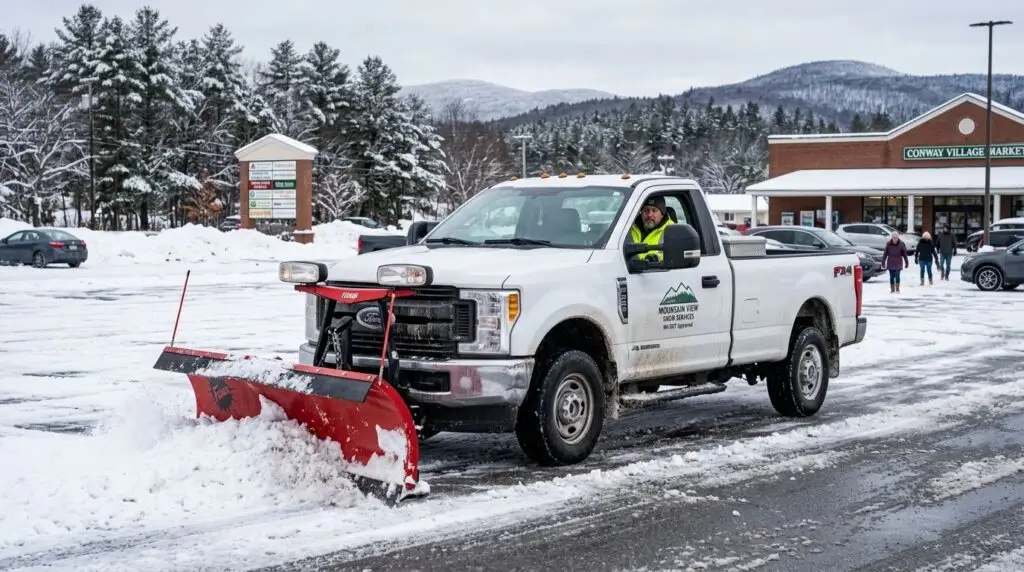
Business insurance for New Hampshire snow removal companies means pairing commercial auto, workers' compensation, and general liability coverage so a slide-off, a slip-and-fall, or a damaged mailbox doesn't wipe out a season's revenue. Plow operators carry risk that a typical landscaper doesn't: heavy trucks moving in the dark, ice, and low visibility, plus crews working on someone else's property at 4 a.m. Themello Agency structures snow removal policies around the specific exposures of plowing, not a generic contractor template.
- Business insurance for New Hampshire snow removal companies starts with commercial auto, workers’ comp, and general liability layered together.
- New Hampshire requires workers’ comp under RSA 281-A once you have even one employee, seasonal or not.
- Plow trucks used for business almost never qualify for a personal auto policy, even if the truck also hauls firewood on weekends.
- Snow removal general liability should include slip-and-fall and property damage from plowing, not just a generic contractor form.
- Themello Agency reviews snow removal coverage against actual routes, crew size, and equipment before the season starts, not after a claim.
Why business insurance matters for snow removal companies
A single plow route runs through dozens of driveways and parking lots in one shift, each one a separate liability exposure. Hit a car, clip a fence, or leave a patch of ice that causes a fall, and the claim lands on whichever policy is actually in force at the time — not the one you meant to buy in October.
New Hampshire winters push plow operators into pre-dawn and late-night hours when visibility is worst and traffic incidents spike. Seasonal crews, rented equipment, and subcontracted routes add layers most snow removal owners don't think about until a certificate of insurance request lands in their inbox from a commercial client who won't sign a contract without proof of coverage.
Set up commercial auto coverage for plow trucks
A truck fitted with a plow blade and used to service clients is a commercial vehicle in the eyes of most insurers, even if it's titled personally. Personal auto policies routinely exclude business use, which means a claim during a plow run can get denied outright.
- Insure every truck that touches a paying route, not just the ones with company logos on the door
- List plow attachments and salt spreaders as scheduled equipment, since they're often excluded from standard auto physical damage
- Confirm hired and non-owned auto coverage if crew members ever use their own trucks for routes
- Check that liability limits match what commercial clients require in their service contracts
- Ask about coverage for equipment left attached to the truck between shifts
Commercial auto insurance for New Hampshire business fleets covers multi-truck operations under one policy, which simplifies renewals when you're adding or retiring trucks mid-season.
Get workers' compensation in place before the first storm
New Hampshire law (RSA 281-A:5) requires workers' compensation coverage for any business with employees, full-time, part-time, or seasonal. Snow removal crews work in conditions with real injury risk: falls on ice, muscle strain from shoveling, and vehicle accidents during routes.
- Cover every crew member on payroll, including seasonal hires brought on just for winter
- Confirm classification codes match plowing and shoveling work, not general landscaping, since misclassification can trigger audits and back premiums
- Review payroll estimates before the season starts so the audit at season's end doesn't produce a surprise bill
- Ask whether subcontracted plow operators need their own coverage or fall under your policy
Workers' compensation insurance for New Hampshire small businesses walks through how classification codes affect premium for seasonal crews specifically.
Build general liability around slip-and-fall and property damage
The single most common claim against a snow removal company is a slip-and-fall on a lot the company just serviced. The second most common is property damage from a plow blade catching a curb, a sprinkler head, or a parked car.
- Carry general liability limits that match what commercial property managers and HOAs require in service contracts
- Confirm the policy covers completed operations, since a fall can happen hours after the truck leaves
- Check for exclusions on damage to underground utilities or landscaping features hit by plow blades
- Get certificates of insurance ready to send before the season starts, since large clients often won't sign without one on file
General liability insurance for New Hampshire small businesses is the base layer most plowing contracts require before a company can bid on commercial lots.
Add inland marine coverage for plows, spreaders, and equipment
Plow blades, salt spreaders, and skid steers used for snow removal are expensive equipment that moves between job sites and often sits unattended overnight in a truck bed or trailer. Standard commercial property policies frequently exclude equipment away from a fixed location.
- Schedule high-value attachments and spreaders individually rather than relying on a blanket limit
- Confirm coverage applies while equipment sits on a trailer between routes, not just at the shop
- Check theft coverage specifically, since plow equipment theft is a known target during winter months
- Review replacement cost versus actual cash value, since older equipment depreciates fast on paper
Layer umbrella coverage once base limits are set
A single serious accident, a multi-vehicle pileup during a storm or a fall that results in a long-term injury, can exceed general liability or auto limits fast. Umbrella coverage adds a layer on top of existing policies rather than replacing anything.
- Confirm the umbrella sits above both auto and general liability, not just one
- Match the umbrella limit to the size of contracts being bid, since large commercial clients often require higher combined limits
- Ask whether the umbrella follows the business as it adds trucks or crew mid-season
Umbrella insurance for New Hampshire business owners is worth reviewing once a snow removal operation moves past a handful of residential driveways into commercial contracts.
Review contracts and certificates before signing new routes
Most commercial and HOA snow removal contracts specify minimum liability limits, additional insured status, and certificate requirements before work can start. Missing a requirement can mean losing the contract or, worse, working uninsured on a technicality.
- Read the insurance requirements section of every contract before agreeing to terms
- Confirm the policy can add the client as an additional insured when required
- Keep certificates of insurance current and ready to send without a scramble
Comparison: coverage options for New Hampshire snow removal companies
| Coverage | Best for | Key limitation |
|---|---|---|
| Commercial auto | Any business using a truck with a plow attachment | Personal auto policies typically exclude business use entirely |
| Workers' compensation | Any operation with employees, including seasonal crews | Required by RSA 281-A regardless of company size once staff are hired |
| General liability | Slip-and-fall and property damage on client lots | Completed operations gaps can leave post-service falls uncovered |
| Inland marine | Plows, spreaders, skid steers moved between sites | Standard property policies often exclude equipment off-premises |
| Umbrella | Operations bidding larger commercial contracts | Only extends existing limits, doesn't replace a missing base policy |
Get your snow removal policy reviewed
Call, text, or start a quote before the first storm hits.
Common mistakes snow removal companies make
- Insuring the truck personally. A plow truck used for paying routes needs commercial auto coverage, not a personal policy with a business-use exclusion buried in the fine print.
- Skipping workers' comp for seasonal crews. New Hampshire law doesn't carve out an exception for part-time or short-season employees.
- Underestimating equipment theft risk. Plow attachments and spreaders left on trailers overnight are common theft targets during winter, and a standard property policy often won't cover them off-premises.
- Missing certificate requirements. Losing a commercial contract because a certificate wasn't on file before the bid deadline is avoidable with a policy reviewed ahead of the season, not after a client asks.
- Assuming general liability covers everything. Property damage from a plow blade and a slip-and-fall claim months later both need to be confirmed as covered, not assumed.
FAQ
What insurance does a snow removal company need in New Hampshire?
A New Hampshire snow removal company needs commercial auto for plow trucks, workers’ compensation for any employees, and general liability for slip-and-fall and property damage claims. Larger operations bidding commercial contracts typically add inland marine for equipment and an umbrella policy for extra liability limits.
Is workers’ comp required for seasonal plow crews in New Hampshire?
Yes. RSA 281-A:5 requires workers’ compensation coverage for any employer with employees in New Hampshire, and the law doesn’t exempt seasonal or part-time snow removal crews.
Can I use my personal auto policy for a plow truck?
No, most personal auto policies exclude business use, and a truck fitted with a plow and used to service paying clients counts as commercial use. A denied claim during a plow route is the most common result of relying on a personal policy.
Does general liability cover slip-and-fall claims after plowing?
General liability covers slip-and-fall claims tied to snow removal work, but confirm the policy includes completed operations coverage since falls often happen hours after a truck leaves the lot.
What’s the difference between general liability and inland marine for a plow business?
General liability covers injuries and property damage caused by your work, while inland marine covers your own equipment, plows, spreaders, and attachments, while it’s away from a fixed location.
Do commercial clients require a certificate of insurance for plowing contracts?
Most commercial and HOA snow removal contracts in New Hampshire require a certificate of insurance and often additional insured status before work can start. Missing this requirement can cost the contract even with adequate coverage in place.
How much liability coverage does a snow removal company need?
Required limits vary by contract, and larger commercial clients often specify minimums in the service agreement. Reviewing contract language before bidding, and layering umbrella coverage on top of base limits, is the standard approach for operations scaling past residential routes.
Is equipment theft covered under a standard business policy?
Standard commercial property policies often exclude equipment away from a fixed location, which is exactly where plow attachments and spreaders sit overnight. Inland marine coverage closes that gap for equipment that travels between job sites.
One last thing
The claim that catches most snow removal owners off guard isn't the fender-bender during a storm, it's the slip-and-fall reported weeks after the last visit to a lot, when the truck is long gone and the ice has melted. Confirm completed operations coverage sits inside the general liability policy before the 2026 season starts, not after the letter from a client's attorney arrives.
Related guides
- Business insurance for contractors in New Hampshire
- Business insurance for landscaping companies in New Hampshire