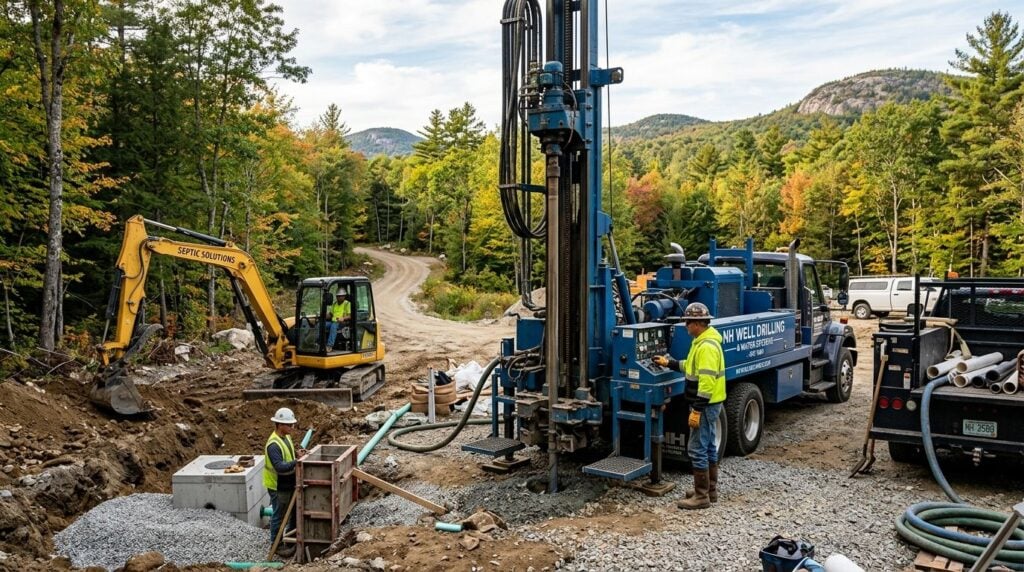
New Hampshire well drilling and septic companies need business insurance built around groundwater risk, heavy equipment, and crews working on other people's property, not a generic small-business package. A drilling rig hitting a gas line, a septic install that back-pressures into a neighbor's well, or a crew member injured under a 40-foot mast rig are the claims that actually happen in this trade, and they call for coverage most general contractors never think about.
- Business insurance for New Hampshire well drilling companies should combine general liability, commercial auto, inland marine, and workers’ comp at minimum.
- Pollution liability matters more here than in most trades because groundwater contamination claims are excluded from standard general liability.
- Workers’ compensation is required in New Hampshire once you have even one employee, including part-time crew.
- An umbrella policy adds liability limits above your base policies for a single well contamination or property-damage claim.
- Bundling rig, equipment, and vehicle coverage under one inland marine or commercial auto policy avoids gaps between what’s parked and what’s mounted.
Why business insurance matters for well drilling and septic companies in New Hampshire
A standard general liability policy covers a lot of contractor risk, but well drilling and septic work carries two exposures that push companies toward specialized add-ons: contamination liability and mobile heavy equipment. If a drilled well cross-contaminates a neighboring water supply, or a septic system fails and floods a basement, that's a pollution-adjacent claim, and most general liability forms carve pollution incidents out entirely.
New Hampshire's rural terrain and private well density (most of the state runs on private wells and on-site septic, not municipal water and sewer) means this isn't a rare edge case for local drillers and installers. It's a routine part of the job, which is why coverage built for this segment looks different from a policy written for a landscaper or an electrician.
Crews also run heavy, expensive equipment: drilling rigs, well casing, pumps, backhoes, and vacuum trucks. That equipment sits on trucks that move between job sites daily, which creates overlap between commercial auto and equipment coverage that needs to be closed deliberately, not left to chance.
The how-to spine: building coverage step by step
Cover your rig and mounted equipment correctly
A drilling rig bolted to a truck chassis isn't just "a truck." Standard commercial auto often caps coverage on permanently attached equipment, which is where inland marine coverage comes in for tools and machinery that travel between sites.
- Confirm your commercial auto policy actually lists the rig as scheduled equipment, not just the chassis
- Add inland marine coverage for portable tools, generators, and pumps that ride in the truck bed
- Insure trailers separately if they're not owned outright by the drilling company
- Get replacement cost valuation on rigs and casing, not actual cash value
- Review coverage every time you add or trade a piece of equipment
Carry general liability sized for property damage claims
General liability is the base layer for third-party injury and property damage. For well drilling and septic work, the property damage side matters more than most trades because a bad bore or a mis-sited leach field can damage a client's yard, driveway, or foundation.
- Set limits high enough to cover full driveway, landscaping, or foundation repair, not just a token amount
- Confirm completed operations coverage extends after the job is done, since septic failures often show up weeks later
- Check that the policy covers subcontracted excavation work if you sub that portion out
- Ask whether damage to underground utilities during boring is a covered peril or an exclusion
Add workers' compensation for drilling and installation crews
New Hampshire requires workers' compensation coverage once a business has even one employee, and drilling crews work around rotating machinery, trenches, and heavy casing sections daily. This isn't optional paperwork; it's the coverage that pays medical bills and lost wages when a crew member gets hurt on a rig.
- Classify employees correctly by job duty, since misclassifying a driller as office staff understates risk and can void a claim
- Include part-time or seasonal help, since NH's requirement doesn't scale down for smaller crews
- Confirm coverage extends to work performed off normal business hours for emergency septic calls
- Review payroll and job classifications annually as crew size changes
Address pollution and contamination exposure directly
This is the step most generic business policies skip. Standard general liability typically excludes pollution incidents, which leaves a real gap for a trade where the entire job touches groundwater and wastewater.
- Ask specifically whether your general liability policy excludes "pollution" or "contamination" claims, since most do
- Add a pollution liability endorsement or standalone policy if you drill wells, install septic systems, or handle fuel oil tank work
- Confirm the policy covers cleanup costs, not just third-party bodily injury from contamination
- Document well and septic siting decisions in case a contamination claim surfaces months or years later
Insure the vehicles that move crews and equipment between sites
Commercial auto is separate from personal auto coverage, and a policy written for a single pickup truck won't automatically extend to a fleet of drilling trucks, dump trucks, and service vans. If you run more than one vehicle, look at fleet-level coverage rather than insuring each truck individually.
- Confirm every vehicle used for business, even a crew member's personal truck hauling tools, is covered under a business policy
- Set liability limits based on the size and weight of the vehicles in the fleet, not a default minimum
- Add hired and non-owned auto coverage if crews occasionally rent equipment-hauling trucks
- Review the fleet list every time a vehicle is added, sold, or repurposed
Layer on umbrella coverage for large liability events
A single well contamination claim, a septic failure that damages multiple properties, or a serious injury on a job site can exceed the limits of a base general liability or auto policy fast. Umbrella coverage sits above those base policies and picks up where they stop.
- Set umbrella limits based on your largest realistic exposure, not an arbitrary round number
- Confirm the umbrella policy actually extends over pollution liability, since some umbrella forms exclude it by default
- Review umbrella limits any time contract requirements from municipalities or developers call for higher coverage
- Check that umbrella coverage follows all scheduled vehicles and equipment, not just the base liability policy
Review the whole package annually, not just at renewal
Well drilling and septic companies change equipment, add crew, and take on new contract types faster than most small businesses. A policy written three years ago for a two-truck operation doesn't fit a five-truck operation with a new backhoe and two new hires.
- Walk through every vehicle, rig, and piece of equipment added since the last review
- Confirm payroll figures match current crew size for workers' comp accuracy
- Re-check pollution liability limits against any new contract requirements from towns or developers
- Ask whether a business owners policy still makes sense or whether the company has outgrown it
Coverage comparison for well drilling and septic companies
| Coverage type | Best for | Key limitation |
|---|---|---|
| General liability | Third-party property damage and injury claims | Usually excludes pollution and contamination incidents |
| Workers' compensation | Crew injuries on drilling and installation jobs | Required in NH once you have even one employee |
| Commercial auto | Trucks and vehicles used for business travel | May cap coverage on permanently mounted equipment |
| Inland marine | Rigs, pumps, and tools that move between job sites | Doesn't cover liability, only the equipment itself |
| Pollution liability | Groundwater and septic contamination claims | Often sold as a separate policy, not bundled by default |
| Umbrella | Large claims exceeding base policy limits | Only pays after underlying policy limits are exhausted |
Common mistakes well drilling and septic companies make
- Assuming general liability covers contamination claims. Most policies exclude pollution incidents outright, leaving the business exposed on the exact claim type most likely to occur in this trade.
- Insuring the truck but not the mounted rig. A drilling rig bolted to a chassis needs to be scheduled as equipment, not assumed to ride along under basic auto coverage.
- Skipping workers' comp for part-time or seasonal crew. New Hampshire's requirement applies once you have any employee, not just full-time staff.
- Under-limiting property damage coverage. Driveway, landscaping, and foundation repair costs from a bad bore or misplaced leach field add up fast, and low limits get exhausted quickly.
- Never revisiting the policy after adding equipment. A rig, a new truck, or a hire that isn't added to the policy mid-year creates a gap right when it's needed most.
Get your coverage reviewed this week
Call or text for a quick review of your current business policy.
FAQ
What insurance does a well drilling company need in New Hampshire?
A well drilling company needs general liability, commercial auto, inland marine for rigs and tools, workers’ compensation, and typically pollution liability since standard general liability excludes contamination claims. Umbrella coverage adds protection above those base limits for larger claims.
Do septic installers need pollution liability insurance?
Yes, most standard general liability policies exclude contamination and pollution incidents, and septic system failures can trigger exactly that kind of claim. A separate pollution liability policy or endorsement closes that gap.
Is workers’ compensation required for well drilling crews in New Hampshire?
Yes, New Hampshire requires workers’ compensation coverage once a business has even one employee, including part-time or seasonal drilling crew. This applies regardless of how small the operation is.
Does commercial auto insurance cover a drilling rig mounted on a truck?
Not always fully. Standard commercial auto can cap coverage on permanently mounted equipment, which is why inland marine coverage is often added to protect the rig, pumps, and tools separately from the vehicle itself.
Do I need umbrella insurance if I already have general liability?
Umbrella coverage is worth adding once your business faces claims that could exceed your general liability limits, which is common in well contamination or multi-property septic failures. It sits above your base policies and picks up where they stop.
What happens if a septic install causes groundwater contamination?
That type of claim typically falls outside standard general liability coverage because most policies exclude pollution incidents. Without a pollution liability endorsement or standalone policy, the business would be responsible for cleanup and third-party costs directly.
Can one business owners policy cover both office staff and field crews?
A business owners policy can bundle general liability and property coverage for a small operation, but field crews running heavy equipment often need workers’ compensation, commercial auto, and inland marine added separately since a basic BOP isn’t built for mobile equipment risk.
How is business insurance priced for a well drilling company?
Pricing depends on factors like crew size, payroll, equipment value, and claims history rather than a flat rate, since drilling and septic work varies widely in risk from job to job. A coverage review is the fastest way to get an accurate number for your specific operation.
One last thing
The claim that catches most well drilling and septic companies off guard in New Hampshire isn't equipment damage or a vehicle accident, it's a contamination claim showing up months after the job is finished, once general liability's completed operations window has already closed on the wrong assumption that pollution was covered in the first place. Check that exclusion in writing before you need it.
Related guides
- Commercial auto insurance for New Hampshire business fleets
- Inland marine insurance for New Hampshire contractors
- Umbrella insurance for New Hampshire business owners