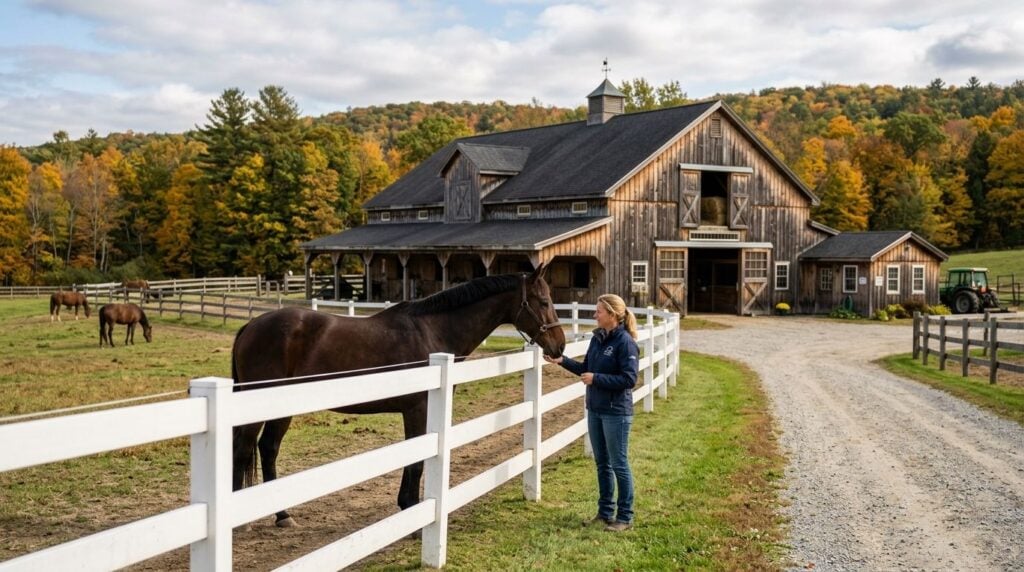
New Hampshire horse boarding insurance is a package of commercial coverages built to protect stables, arenas, and boarded horses so a barn fire, a kicked visitor, or an escaped horse doesn't end the business. Boarding facilities carry a different risk mix than a typical small business — animals, amateur riders, trailers, and part-time barn help all show up on the same policy, and a standard business owners policy usually misses at least one of them.
- Business insurance for New Hampshire horse boarding facilities requires general liability plus a care, custody, and control endorsement most standard policies exclude.
- New Hampshire’s equine activity liability law, RSA 508:19, limits inherent-risk claims but only when the exact statutory warning language is posted.
- Workers’ compensation is required the day a barn hires its first employee, even part-time, under New Hampshire law.
- A business owners policy bundles property and liability for straightforward barns, but doesn’t include workers’ comp or commercial auto.
- Umbrella coverage matters most for facilities running lessons or trail rides at volume, where a single claim can exceed a $1 million liability limit.
Why horse boarding insurance matters in New Hampshire
A boarding barn is a business the moment someone pays to keep a horse on your property, even if it's a converted family farm. New Hampshire farm insurance policies often don't extend to boarding, lessons, or trail rides without specific endorsements, which is where most gaps in coverage start.
The exposures stack up fast: a boarder's horse colics overnight, a lesson student gets kicked in the arena, a hay barn catches fire in January, or a part-time barn hand strains a back mucking stalls. Each of those is a different type of claim, and each needs a different coverage to respond. New Hampshire's equine activity liability statute (RSA 508:19) gives facilities some protection against inherent-risk claims tied to horseback riding, but it does not replace insurance — it limits one category of lawsuit, and only when the facility follows the posting and waiver requirements exactly.
A boarding facility that only carries a homeowner's policy or a generic small-business policy is uninsured for its actual risk, not just underinsured.
Building the coverage stack
The sections below walk through the coverages a New Hampshire boarding operation needs, starting with the most commonly missed gap: general liability that quietly excludes anything to do with horses.
Confirm your general liability policy actually covers equine activities
Many standard commercial general liability forms carry an animal or equine activity exclusion buried in the policy language, which means a facility can pay premiums for years without real coverage for its core business.
- Ask directly whether "equine activity" or animal-related injury is excluded from the general liability coverage
- Confirm the policy covers boarders, lesson students, and trail ride guests, not just employees and delivery drivers
- Check per-occurrence and aggregate limits — $1 million per occurrence and $2 million aggregate is the common commercial baseline
- Verify the barn's actual address and acreage are listed, not a home address that predates the business
Add care, custody, and control coverage for boarded horses
General liability almost always excludes injury, illness, or death to animals in a facility's care — that's what a care, custody, and control (CCC) endorsement is for, and boarding barns without it are exposed on every horse they hold.
- Request a per-horse or per-incident CCC limit tied to the actual value of boarders' horses, not a flat estimate
- Confirm the endorsement responds to colic, injury, theft, and fire — some versions only cover theft
- Put boarding contracts in writing that spell out who covers vet bills in a dispute
- Size the CCC aggregate to barn capacity — a 20-stall operation needs a materially higher limit than a 4-stall backyard barn
Insure the barn, arena, and equipment
Commercial property coverage protects the structures and equipment a boarding business can't run without: the barn, the indoor arena, run-in sheds, tack, and the tractor that drags the footing every week.
- Value the hay barn and indoor arena separately — replacement cost differs sharply between post-frame and stick-built construction
- List fencing, footing, and irrigation as scheduled property rather than lumping them into a blanket limit
- Confirm coverage includes loss of boarding income if a fire or storm shuts the barn down for weeks
- For a straightforward barn with modest property and liability needs, a business owners policy bundles both into a single binder and renewal date
Carry workers' compensation the day you hire anyone
New Hampshire law requires workers' compensation coverage as soon as a business has an employee, full-time or part-time — a single stall mucker or part-time trainer is enough to trigger the requirement in 2026.
- Classify barn staff correctly: "farm labor" and "equestrian instructor" carry different rates and different risk profiles
- Cover working students and interns if they perform labor in exchange for lessons or board credit — courts don't treat that arrangement as unpaid
- Confirm coverage responds to kicks, falls, and repetitive lifting injuries, the most common claims in a barn setting
- Don't wait for a claim to find out coverage was never bound — retroactive gaps are rarely fixable after an injury
Insure trailers, trucks, and farm equipment separately
A personal auto policy doesn't cover a trailer or truck titled to the business, and a boarder's personal insurance doesn't cover a facility-owned trailer used for hauling.
- Confirm the horse trailer is titled and insured under the business, not left on a personal policy by default
- Cover tractors, mowers, and arena drags under equipment or inland marine coverage, not property alone
- List trailer replacement value accurately — replacement often runs higher than resale value
- Add hired and non-owned auto coverage if instructors or staff use personal vehicles for lessons or shows
Post the required liability signage and use written waivers
RSA 508:19 limits — but does not eliminate — a facility's liability for the inherent risks of horseback riding, and the protection only applies when the exact statutory warning language is posted and repeated in every waiver.
- Post the statutory warning sign at the barn entrance and inside the riding ring, not just at the office
- Include the identical warning language in every boarding, lesson, and trail ride waiver signed on-site
- Keep signed waivers on file for every rider, including repeat boarders, not just first-time visitors
- Understand the statute covers inherent risk, not negligence — a broken fence board or unsafe cross-tie area isn't protected
Layer on umbrella coverage for catastrophic claims
A serious riding injury or wrongful death claim can exceed a $1 million general liability limit quickly, and umbrella coverage adds a layer above the base general liability and CCC limits once they're exhausted.
- Match umbrella limits to real exposure: boarder count, lesson volume, and trail ride traffic all factor in
- Confirm the umbrella insurance for business owners policy follows form over general liability and CCC, not auto only
- Review the limit every renewal as boarder numbers or lesson programs grow
- Bundle umbrella onto the same renewal date as the underlying business owners policy to avoid coverage gaps between carriers
Coverage comparison for New Hampshire boarding facilities
| Coverage type | Best for | Key limitation |
|---|---|---|
| General liability | Any barn with boarders, lesson clients, or visitor traffic | Usually excludes injury to animals in the facility's care |
| CCC endorsement | Boarding barns holding horses not owned by the business | Limits often too low for high-value boarders without a specific rider |
| Farm/ranch package | Facilities combining boarding, hay, and equipment on one property | May cap coverage for indoor arenas or event hosting |
| Business owners policy | Small barns with straightforward property and liability needs | Doesn't include workers' comp or commercial auto by default |
| Workers' compensation | Any facility with employees, even part-time | Legally required in New Hampshire once staff are hired |
| Umbrella | Barns running lessons or trail rides at higher volume | Only pays once the underlying limit is exhausted |
Get your boarding facility reviewed
A quick review shows where your current policy stops short.
Common mistakes New Hampshire boarding facilities make
- Assuming a homeowner's policy covers a barn business run from the family farm
- Letting boarders sign generic liability waivers that don't repeat the RSA 508:19 warning language
- Sizing CCC limits to an average horse value instead of the highest-value horse currently boarded
- Skipping workers' comp for a single part-time trainer, then facing a claim after a kick or fall
- Forgetting to update the property policy after adding or expanding an indoor arena
FAQ
What insurance do horse boarding facilities need in New Hampshire?
A New Hampshire boarding facility typically needs general liability with an equine activity endorsement, care custody and control coverage for boarded horses, commercial property, workers’ compensation if there’s any staff, and often an umbrella policy. Each covers a different type of claim and none fully substitutes for another.
Does homeowners insurance cover a horse boarding business?
No. Homeowners insurance is written for personal, non-business use of a property and typically excludes injury claims, boarding income loss, or animal-related liability tied to a business operation. Running boarders on the property without a commercial policy leaves the facility uninsured for its main risk.
Is workers’ compensation required for barn employees in New Hampshire?
Yes. New Hampshire requires workers’ compensation coverage once a business has any employee, including part-time barn help, trainers, or working students who perform labor for lesson or board credit. There’s no employee-count threshold to clear first.
What is New Hampshire’s equine activity liability law?
RSA 508:19 limits a facility’s liability for injuries arising from the inherent risks of horseback riding, provided the required warning language is posted at the facility and included in waivers. It does not protect against negligence, such as unsafe fencing or faulty equipment.
How much does business insurance cost for a horse boarding facility?
Cost depends on stall count, boarder horse values, whether lessons or trail rides are offered, and whether the facility carries employees requiring workers’ compensation. A quick coverage review is the fastest way to get an accurate number for a specific barn.
Does general liability cover injury to a boarded horse?
Generally no. Standard general liability excludes injury, illness, or death to animals in a facility’s care, custody, or control, which is why a separate CCC endorsement or farm mortality coverage is needed for boarded horses.
What’s the difference between a farm policy and a business owners policy for a horse facility?
A farm or ranch package is built around agricultural property and equipment with liability attached, while a business owners policy bundles standard commercial property and liability for a simpler operation. Boarding facilities with hay production or multiple structures often fit a farm package better.
Do small barns need umbrella insurance?
A small barn with a handful of boarders and no lesson program may not need it immediately, but any facility running lessons or trail rides should carry umbrella coverage since a single serious injury claim can exceed a standard $1 million general liability limit.
One last thing
The RSA 508:19 protection only holds up if the posted warning sign uses the statute's exact wording — a hand-lettered or paraphrased version has repeatedly failed to hold up when tested in equine liability disputes across states with similar laws. Confirm the sign at your barn entrance matches the statutory text word for word, not a summary of it, before 2026 boarding season starts.
Related guides
- Workers' compensation insurance for New Hampshire small businesses
- How to choose a business owners policy in New Hampshire