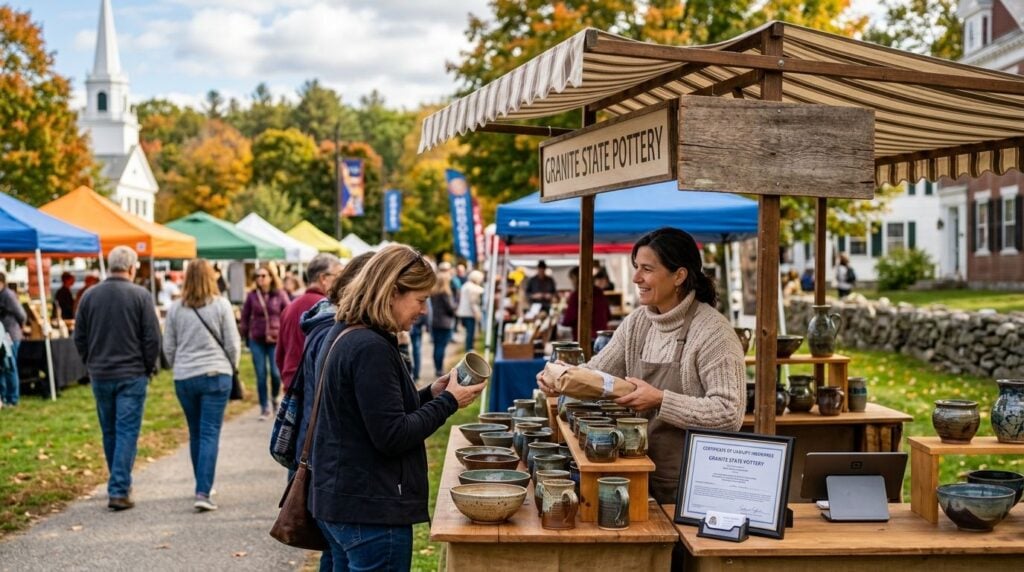
Craft fair vendor insurance in New Hampshire covers the gap between what your homeowners policy ignores and what a fairground organizer or market manager demands before you can set up a booth. Pop-up and seasonal sellers face a narrower set of risks than a storefront retailer, but those risks show up fast: a customer trips on your tent stake, a candle you sell causes a burn, or your inventory gets soaked in a parking lot downpour between shows.
- Most craft fair organizers in New Hampshire require $1 million per occurrence / $2 million aggregate general liability before you get a booth space.
- Craft fair vendor insurance NH options range from a standalone general liability policy to a full business owners policy (BOP) bundling property and liability.
- Home-based makers need a separate business rider or endorsement — a standard homeowners policy excludes commercial activity, even seasonal sales.
- Vendors selling food, cosmetics, or anything worn or ingested should add product liability, not just general liability.
- Mello Agency writes seasonal and year-round policies for New Hampshire craft vendors and can size coverage to what a specific fair or market requires.
Why craft fair vendor insurance matters for pop-up sellers in NH
Craft fair and farmers market organizers across New Hampshire increasingly ask for a certificate of insurance (COI) before confirming your table. A vendor without proof of coverage gets turned away at check-in, even after paying a booth fee — that's a lost weekend of sales, not just an inconvenience.
The exposure is real even at a two-day event. A folding table collapsing on a child's foot, a burn from a hot-glue display, or a customer's allergic reaction to a bath product you sell can all turn into a claim that a homeowners policy simply won't touch. New Hampshire homeowners and renters policies carry standard business-activity exclusions, so income-producing sales — even seasonal ones — fall outside that coverage the moment money changes hands.
2026 brings more juried craft shows and farmers markets requiring proof of insurance as a condition of entry, a trend that's been building across New England markets for several seasons. Vendors who show up with a COI in hand get booked faster and avoid the scramble of trying to bind coverage the week before an event.
Get a certificate of insurance before you apply for a booth
Most organizers want the COI attached to your application, not promised after acceptance.
- Ask the event organizer for their exact wording — some require the fair or market itself listed as "additional insured"
- Request the COI at least two weeks before the event's application deadline
- Keep a digital copy on your phone for pop-up markets that check at the gate
- Confirm the policy dates cover every show date on your 2026 calendar, not just one weekend
- If you sell at multiple venues, ask whether one annual policy covers all of them or whether each event needs its own endorsement
Buy general liability coverage sized to what organizers require
General liability is the baseline every craft fair vendor needs, and the general liability insurance for New Hampshire small businesses page breaks down how limits get set for a business your size.
- Confirm the per-occurrence and aggregate limits the organizer's contract specifies — $1 million/$2 million is common at juried shows
- Ask whether the policy covers "products-completed operations," which matters once a customer leaves your booth with your item
- Check whether the policy follows you to every venue or is tied to one address
- Bundle liability with property coverage if you're carrying $5,000+ in inventory to shows
- Renew before your first spring market, not after a fair rejects your paperwork
Add product liability coverage if you sell items people use, wear, or eat
General liability protects against slip-and-fall type claims at your booth. Product liability protects against claims that your product itself caused harm after the sale — a candle that starts a fire, jewelry with a metal allergy trigger, or a jarred sauce that spoils.
- Add product liability as an endorsement to your GL policy rather than buying it separately when possible
- Flag any product involving heat, ingestion, or skin contact — soaps, candles, food, cosmetics — for extra scrutiny from your carrier
- Keep ingredient or material lists for anything you sell in case a claim requires documentation
- Review coverage yearly as you add new product lines to your booth
Verdict: skip product liability only if every item you sell is purely decorative and has zero contact, ingestion, or fire risk — otherwise, add it.
Cover your inventory and equipment in transit and on-site
Your tent, folding tables, display racks, and unsold inventory ride in your vehicle to every show. A standard auto policy generally excludes commercial cargo, and a homeowners policy stops at your driveway.
- Ask about inland marine or a business personal property endorsement for gear that travels
- Get an itemized list of your booth equipment with replacement values before your first 2026 show
- Photograph your full setup each season for a fast claims record
- Check whether weather damage — a collapsed tent in wind, rain-soaked stock — is covered or excluded
Decide whether you need a business owners policy or a standalone GL policy
A business owners policy (BOP) bundles general liability with property coverage in one package, usually at a lower combined cost than buying each separately. The how to choose a business owners policy in New Hampshire guide walks through when a BOP makes sense versus a standalone GL policy.
- Choose a standalone GL policy if you carry minimal inventory and rent your booth equipment each time
- Choose a BOP if you own $2,000+ in equipment, inventory, or a dedicated workshop space
- Ask whether the BOP includes business interruption coverage if a fire or theft sidelines your workshop mid-season
- Compare renewal terms — some BOPs lock in 12-month terms even for seasonal sellers
Add workers' compensation if you hire help for the season
If you bring on a helper for peak craft fair season — even part-time, even a family member paid in cash — New Hampshire generally requires workers' compensation once you have employees. The workers' compensation insurance for New Hampshire small businesses page covers who counts as an employee under state rules.
- Confirm whether a seasonal or part-time helper triggers the requirement in your situation
- Document hours and pay for anyone assisting at booths, even informally
- Ask your carrier whether a single-person exemption applies if you're the sole seller
- Review the requirement each time your staffing changes, not just once a year
Review your home-based business setup if you make products at home
Most craft fair vendors build inventory at a kitchen table, garage, or spare room. That workshop space needs its own look, separate from booth-day coverage.
- Read the how to insure a home-based business in New Hampshire guide before assuming your homeowners policy has you covered
- Ask whether raw materials and finished inventory stored at home need a separate limit from booth-day coverage
- Flag any equipment — kilns, sewing machines, soap-making tools — that a standard homeowners policy may exclude or cap
- Confirm liability coverage extends to customers who visit your home studio directly, not just fairground booths
Renew and update coverage every season
Craft fair schedules shift year to year — more markets, bigger inventory, a new product line. A policy written for your 2025 season may not match your 2026 lineup.
- Update your event calendar with your agent before your first spring show
- Increase inventory limits if your product line grew over the winter
- Re-check organizer requirements each year — limits requested by fairs have been trending upward
- Confirm your COI reflects your current policy dates, not last year's
Get your craft fair COI sorted
Quick review of your booth insurance needs before your next show.
Comparing coverage options for NH craft fair vendors
| Option | Best for | Key limitation |
|---|---|---|
| Standalone general liability | Vendors with minimal owned equipment, renting booth setup each show | Doesn't cover your inventory or equipment against loss |
| Business owners policy (BOP) | Vendors with $2,000+ in owned inventory, tools, or a dedicated workshop | Higher setup effort than a single GL policy |
| Product liability endorsement | Anyone selling food, cosmetics, candles, or wearable items | Only meaningful when added to a base GL policy, not a substitute for it |
| Home-based business rider | Makers producing inventory at home between shows | Doesn't extend to booth-day liability without a separate policy |
Verdict: a BOP with a product liability endorsement is the right fit for most full-season craft vendors in New Hampshire; a standalone GL policy is enough for occasional, low-inventory sellers.
Common mistakes craft fair vendors make in New Hampshire
- Assuming a homeowners policy covers booth sales — it typically excludes any business activity, even a weekend hobby sale.
- Waiting until the week of the fair to request a COI — most carriers need lead time, and organizers won't hold your spot without proof.
- Underinsuring inventory that grew over the season — a policy sized for your first show in April often doesn't match your November holiday market stock.
- Skipping product liability on food and body-care items — general liability alone doesn't respond to a claim that your product caused harm after purchase.
- Forgetting transit coverage for the drive to and from shows — a standard auto policy usually excludes commercial cargo, leaving equipment and stock exposed on the road.
FAQ
What is craft fair vendor insurance in NH?
It’s liability and property coverage sized for someone selling handmade goods at markets, fairs, and pop-up events in New Hampshire. It typically includes general liability, and often product liability and inventory/equipment coverage layered on top.
Do I need insurance to sell at a craft fair in New Hampshire?
Most organized craft fairs and juried markets require a certificate of insurance before confirming your booth, usually $1 million per occurrence. Smaller informal markets may not require it, but a claim without coverage still falls on you personally.
Does my homeowners policy cover my craft business?
No. Standard New Hampshire homeowners and renters policies exclude business activity, including seasonal sales at fairs and markets. You need a separate business policy or an endorsement to close that gap.
How much does craft fair vendor insurance cost in NH?
Cost depends on your inventory value, product type, and whether you add product liability or a full business owners policy. Get a quote from a licensed New Hampshire agent for numbers specific to your setup.
What’s the difference between general liability and product liability for vendors?
General liability covers accidents at your booth, like a customer tripping over your display. Product liability covers harm caused by what you sold after the customer leaves, like an allergic reaction to a soap or a candle that catches fire.
Can one policy cover multiple craft fairs and markets in a season?
Yes, most annual policies cover every event you attend during the policy term rather than requiring a new policy per show. Confirm with your carrier that all your 2026 event dates fall within the coverage period.
Do I need workers’ compensation if I hire help for busy craft fair weekends?
If you have an employee, even seasonal or part-time, New Hampshire generally requires workers’ compensation coverage. Rules vary by situation, so confirm your specific requirement with a licensed agent.
Is a business owners policy better than standalone liability for craft vendors?
A BOP makes sense once you’re carrying meaningful inventory or equipment value, since it bundles property and liability at a combined rate. A standalone GL policy fits vendors with minimal owned gear who rent booth setup each time.
One last thing
The detail that catches most craft fair vendors off guard isn't the liability limit — it's the additional insured requirement. Many 2026 fair contracts now ask for the event organizer or venue to be named as an additional insured on your policy, not just a certificate showing you have coverage. Skip that line item and your COI can get rejected at check-in even though your policy is otherwise solid. Read the organizer's contract line by line before you submit your application, not after.
Related guides
- General liability insurance for New Hampshire small businesses
- How to insure a home-based business in New Hampshire
- How to choose a business owners policy in New Hampshire
- Workers' compensation insurance for New Hampshire small businesses