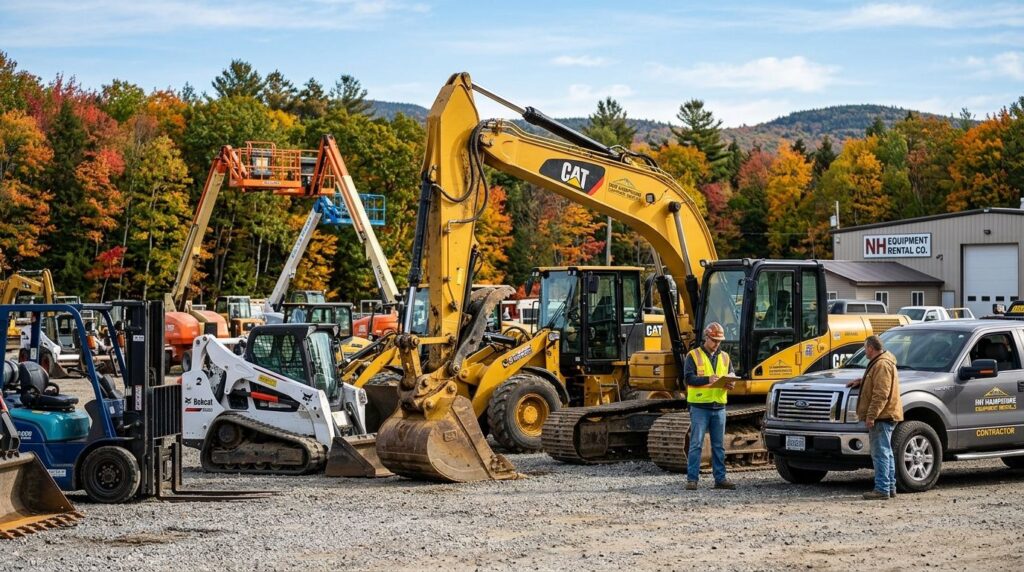
Equipment rental company insurance in New Hampshire covers your rented-out machinery, your yard, your delivery trucks, and the liability that comes from handing heavy equipment to customers who aren't trained to run it. A rental fleet doesn't sit still like a fleet of company trucks — it's on your lot Monday and on a homeowner's driveway or a contractor's job site by Wednesday, which means a standard business owners policy leaves gaps a straight commercial property policy never has to close.
- Equipment rental company insurance in NH needs inland marine coverage for equipment off your lot, not just standard property insurance.
- General liability alone won’t pay if a rented excavator is stolen from a customer’s site — an equipment floater closes that gap.
- New Hampshire requires workers’ compensation for any business with employees, including rental yard and delivery staff.
- Commercial auto coverage is required for delivery trucks and flatbeds moving equipment between the yard and job sites.
- Themello Agency reviews rental fleet coverage in New Hampshire and can bundle inland marine, GL, workers’ comp, and auto into one policy.
Why equipment rental company insurance matters for NH rental businesses
A construction equipment rental business carries two kinds of risk at once: the risk of running a physical yard with staff and vehicles, and the risk of losing control over equipment the second it leaves your lot. New Hampshire's mix of active construction crews, seasonal storm cleanup, and weekend DIY renters means your machines end up in more hands, on more terrain, than a contractor who only runs their own crew.
New Hampshire also has one quirk that trips up small rental operations: state law requires workers' compensation coverage for any business with even one employee, full-time or part-time. That catches counter staff, delivery drivers, and yard mechanics who might otherwise get treated as informal help. In 2026, a single uncovered workplace injury claim can wipe out a small rental company's cash reserves faster than a stolen skid steer.
Update your fleet coverage with an equipment floater
Standard commercial property insurance covers equipment sitting in your building. It stops covering that equipment the moment it's loaded onto a customer's trailer. An inland marine policy, sometimes called an equipment floater, follows the machine wherever it goes.
- Schedule high-value units individually — excavators, skid steers, aerial lifts — rather than lumping everything under one blanket limit
- Confirm the policy covers theft and vandalism at a renter's job site, not just your own yard
- Ask whether coverage applies while equipment is in transit on a trailer or flatbed
- Set values at replacement cost, not actual cash value, so a stolen or totaled unit pays out enough to buy a comparable replacement
- Add a "rented to others" endorsement specifically, since some floaters exclude equipment while it's off-site under a rental agreement
Inland marine insurance built for contractors and rental operations is the piece most NH rental companies underbuy — they carry property insurance and assume it's the same thing.
Add general liability for third-party injury and property damage
General liability covers you when a renter, a bystander, or a neighbor gets hurt or has property damaged because of your equipment. It does not cover damage to the equipment itself — that's the floater's job.
- Cover bodily injury claims if a renter is hurt operating a machine you rented out
- Cover property damage if a rented trencher hits a buried utility line
- Include product liability language for equipment you sell or maintain, not just rent
- Add contractual liability coverage so your rental agreement's indemnification clauses actually hold up
- Extend completed operations coverage if your staff deliver, set up, or demonstrate equipment on-site
General liability insurance is the base layer every rental company needs before anything else gets added on top — it's usually the first policy a landlord or municipal contract will ask you to prove.
Carry workers' compensation for yard and delivery staff
New Hampshire doesn't set a minimum employee count before workers' comp kicks in. One part-time counter clerk is enough to trigger the requirement.
- Cover yard mechanics who service and repair equipment between rentals
- Cover delivery drivers hurt loading or unloading heavy machinery
- Cover counter and dispatch staff for slip-and-fall or repetitive strain claims
- Verify coverage extends to seasonal or part-time hires during peak rental months
- Keep payroll classifications accurate — misclassifying a mechanic as clerical staff creates coverage gaps and audit penalties
Insure delivery trucks and trailers with commercial auto coverage
Personal auto policies exclude vehicles used for business hauling. A flatbed or lowboy moving a mini excavator needs a commercial auto policy built for the actual cargo weight and use.
- Set liability limits high enough to cover injury claims tied to a loaded trailer accident, not just minimum state limits
- Add hired and non-owned auto coverage if staff use personal trucks for equipment pickups
- Include motor truck cargo coverage so damage to equipment in transit is actually covered
- Confirm trailers themselves are scheduled, not just the tow vehicle
Add rental agreement terms and loss-of-use coverage
The paperwork you hand a renter matters as much as the policy behind it. A signed agreement with clear terms keeps a damage dispute from turning into a lawsuit.
- Require a signed rental agreement with a damage and liability waiver on every transaction
- Photograph equipment condition before and after each rental to document pre-existing wear
- Add loss-of-rental-income coverage so a damaged unit in the shop doesn't just cost repair money — it also covers the income you're not earning while it's out of service
- Ask commercial renters, especially contractors, to show proof of their own insurance before handoff
- Restrict rentals of higher-risk equipment (aerial lifts, trenchers) to renters who can show basic operating competency
Layer on umbrella coverage for excess liability
A single severe injury tied to heavy equipment — a rollover, an amputation, a fatality — can exceed standard liability limits without much warning. An umbrella policy extends your general liability and commercial auto limits for a fraction of what raising each underlying policy would cost.
- Extend limits across general liability, auto, and employer's liability at once
- Use it as a lower-cost way to hit the higher limits many commercial contracts and landlords require
- Confirm your underlying policies meet the minimum limits the umbrella requires before you rely on it
Get your rental fleet reviewed
Quick coverage review for equipment rental businesses across New Hampshire.
Coverage comparison for NH equipment rental companies
| Coverage | Best For | Key Limitation |
|---|---|---|
| General liability | Injury or property damage claims from renters and bystanders | Doesn't cover damage to the equipment itself |
| Inland marine / equipment floater | Equipment stolen or damaged off your lot | Requires an accurate, current equipment schedule |
| Workers' compensation | Yard staff, mechanics, delivery drivers | Doesn't cover the renter operating the machine |
| Commercial auto | Trucks and trailers moving equipment | Excludes cargo damage unless motor truck cargo is added |
| Umbrella | Catastrophic injury claims tied to heavy machinery | Sits on top of underlying policies; those need minimum limits first |
Verdict: an equipment rental company operating in New Hampshire in 2026 needs general liability, an equipment floater, workers' compensation, and commercial auto together — none of the four substitutes for the others.
Common mistakes NH equipment rental companies make
- Treating rental units like standard business property. Skipping the equipment floater leaves stolen or job-site-damaged machines completely uncovered once they leave the yard.
- Letting renters walk out without paperwork. No signed agreement or damage waiver means a cracked hydraulic hose turns into an argument instead of a claim.
- Misclassifying delivery drivers as casual labor. New Hampshire's workers' comp requirement doesn't care about job title — it covers anyone on payroll.
- Insuring equipment at actual cash value instead of replacement cost. A stolen skid steer valued at depreciated worth pays out far less than what it costs to replace in 2026.
- Skipping umbrella coverage because nothing's happened yet. One severe injury claim tied to heavy machinery can blow past standard liability limits in a single incident.
FAQ
What insurance does an equipment rental company need in New Hampshire?
An NH equipment rental company needs general liability, an inland marine equipment floater, workers’ compensation, and commercial auto coverage for delivery vehicles. Umbrella coverage is typically added once the base policies are in place.
Does general liability cover equipment I rent out?
No. General liability covers injury or property damage claims caused by your equipment, not damage to the equipment itself. An equipment floater or inland marine policy covers the machine directly.
Is workers’ compensation required for a rental company with just two employees?
Yes. New Hampshire requires workers’ compensation coverage for any business with at least one employee, regardless of company size or whether staff are full-time or part-time.
What’s the difference between inland marine and an equipment floater?
They’re closely related terms — an equipment floater is a specific type of inland marine coverage built to follow mobile equipment wherever it’s used, including off your property.
Do I need commercial auto insurance for delivery trucks?
Yes. Personal auto policies exclude business use, and a truck hauling heavy equipment needs coverage sized to the cargo weight and commercial use, not a personal policy.
How much does equipment rental company insurance cost in NH?
Cost depends on fleet value, employee count, and claims history, so it varies by business. A coverage review is the fastest way to get an accurate number for your operation.
Can I require renters to carry their own insurance?
Yes, and many rental companies do for commercial renters. Requiring proof of insurance before handoff reduces your exposure if the renter causes damage to a third party.
Does umbrella insurance cover a lawsuit from an injured renter?
Umbrella coverage extends your existing general liability and auto limits once those policies are exhausted, so it can apply to a severe injury lawsuit tied to a rental unit.
One last thing
Most rental companies schedule equipment under one blanket inland marine limit and assume they're covered. Blanket floaters often cap per-item payouts well below what a mini excavator or aerial lift actually costs to replace in 2026 — schedule your highest-value units individually so a single loss doesn't leave you short on the replacement.
Related guides
- Commercial auto insurance for New Hampshire business fleets
- Business insurance for contractors in New Hampshire