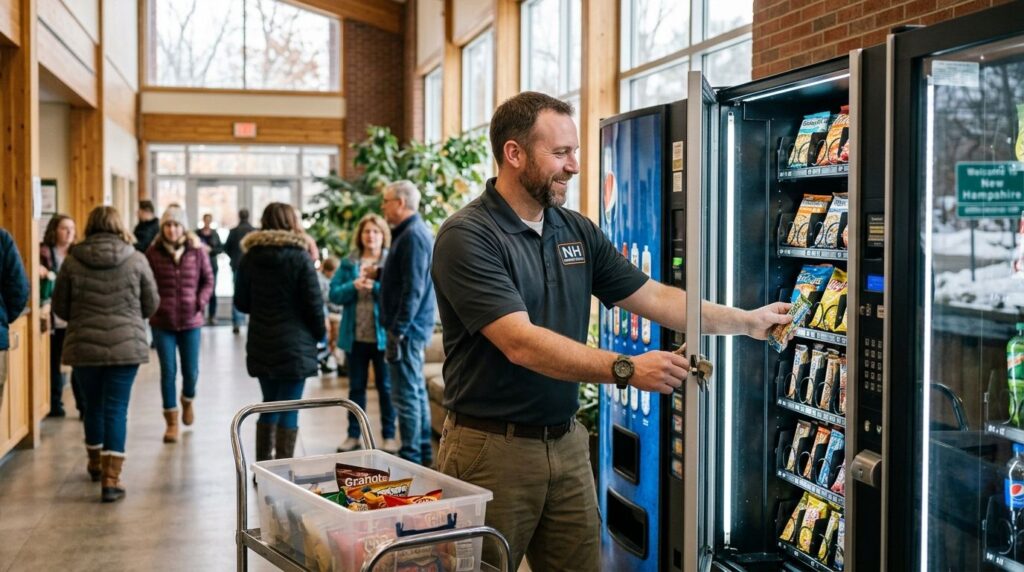
Vending machine business insurance in NH covers the machines themselves, the vehicles that restock them, and the liability exposure that comes from placing equipment on someone else's property. Vending operators carry a mix of risks that don't fit a standard shopkeeper's policy: machines sit on host-site premises you don't control, drivers cover multiple stops a day, and a jammed coin mechanism or a tipped-over unit can trigger a claim you never saw coming.
- Vending machine business insurance NH operators need starts with general liability plus an equipment floater for machines on host sites.
- Commercial auto coverage is required if you drive a titled vehicle to restock routes across New Hampshire in 2026.
- Workers’ compensation becomes mandatory in New Hampshire the moment you hire even one part-time helper.
- A business owners policy (BOP) often bundles liability and property coverage cheaper than buying each separately.
- Cyber liability matters now that most machines take card and mobile payments instead of cash only.
Why vending machine business insurance matters for NH operators
Host locations — schools, gyms, breakrooms, apartment complexes — almost always require proof of general liability before they'll let you place a machine on their property. No certificate of insurance, no placement. That's the practical reason coverage matters before it's the legal one.
New Hampshire also requires workers' compensation coverage for any business with employees, part-time or full-time, with very narrow exceptions. If you're running routes solo today but plan to hire a second driver in 2026, that requirement kicks in the day you sign their first paycheck, not when you get around to shopping for a policy.
Machines themselves carry real replacement cost. A refrigerated unit or a modern touchscreen vending machine represents thousands of dollars sitting unattended in a hallway or lobby you don't own. Standard commercial property policies often exclude equipment kept off your own premises — that's where equipment floaters and inland marine coverage step in.
Insure your machines with an equipment floater
Standard commercial property insurance covers what's inside your building. It usually stops covering equipment the moment it leaves your premises and sits at a host location — which is where 100% of a vending operator's machines live.
- List every machine by serial number, model, and value so a claim doesn't stall on identification
- Confirm the floater covers vandalism and theft, not just fire and weather
- Ask whether the policy covers machines in transit, not just while installed
- Check replacement cost versus actual cash value — a five-year-old refrigerated unit depreciates fast under ACV
- Review coverage limits annually as you add machines to your route
An inland marine policy built for contractors and equipment-heavy operators covers the same category of risk vending operators face: mobile, high-value equipment kept off your own property.
Carry general liability for host-site injuries
General liability is the non-negotiable layer. If someone claims a machine door pinched a finger, a spilled product caused a slip, or a tipped unit caused property damage at a host site, this is the coverage that responds.
- Confirm limits meet what host locations require — many ask for $1 million per occurrence
- Get a certificate of insurance ready to hand any new host on day one
- Check that product liability is included if you stock food or beverages
- Ask whether coverage follows the machine to every host address, not just one listed location
- Review exclusions for machines placed at high-foot-traffic sites like schools or gyms
General liability insurance for New Hampshire small businesses is the base layer most vending operators build everything else on top of.
Cover your restocking vehicles with commercial auto
A personal auto policy typically excludes business use once you're driving a route to restock multiple locations daily. If you're using a van, truck, or trailer titled to the business — or even a personal vehicle used mainly for deliveries — commercial auto coverage is what actually pays a claim.
- Confirm every driver on your route is listed on the policy
- Add cargo coverage if you carry inventory worth restocking a full route at once
- Check whether the policy covers hired or non-owned vehicles if you rent a van seasonally
- Review liability limits against the value of the cargo and the vehicle combined
- Ask about coverage gaps during loading and unloading at host sites
Commercial auto insurance for New Hampshire business fleets applies whether you run one van or a small fleet across multiple counties.
Add workers' compensation once you hire help
New Hampshire law requires workers' compensation coverage for businesses with employees, with almost no exceptions for part-time staff. A vending route that grows from one operator to an operator-plus-driver crosses that line immediately.
- Confirm coverage starts the day the new hire's first shift begins, not after paperwork clears
- Check classification codes match the actual job duties, not a generic clerical code
- Ask about coverage for occasional 1099 help versus true employees
- Review experience modification factors if you've had prior claims
Workers' compensation insurance for New Hampshire small businesses covers this requirement for operators moving past a solo route.
Add cyber liability if machines take card payments
Most vending machines placed in 2026 accept card taps or mobile wallets, not just coins and bills. That payment terminal is a small data-collection point, and a breach at even one machine can trigger notification costs and liability.
- Confirm coverage applies to point-of-sale terminals, not just office computers
- Check whether the policy covers notification costs if customer payment data is exposed
- Ask about coverage for third-party payment processor failures
- Review whether ransomware and system failure are included, not just data breach
Bundle coverage into a business owners policy
A business owners policy, or BOP, packages general liability and commercial property into one policy, often at a lower combined cost than buying each separately. For a vending operation with a small office or storage warehouse plus a fleet of machines, a BOP is usually the efficient starting point before adding equipment floaters and auto coverage on top.
How to choose a business owners policy in New Hampshire walks through how the bundle works and where it stops short of covering machines placed off-site.
Layer umbrella coverage once your route grows
Once you're running dozens of machines across multiple host sites, a single large liability claim can exceed your underlying general liability limits. Umbrella coverage adds a layer on top of general liability, auto, and employer's liability limits.
- Confirm the umbrella follows all underlying policies, not just one
- Check the required underlying limits before the umbrella activates
- Review whether host-site liability claims are explicitly covered
Umbrella insurance for New Hampshire business owners is worth a look once your machine count and route size grow past a handful of locations.
Comparison: coverage options for NH vending operators
| Coverage | Best for | Key limitation |
|---|---|---|
| General liability | Injury or damage claims at host sites | Doesn't cover the machine itself |
| Equipment floater / inland marine | Machines placed off your own premises | Doesn't cover liability to third parties |
| Commercial auto | Restocking vans and route vehicles | Doesn't cover machines in storage |
| Workers' compensation | Any operator with employees | Required by NH law once staff is hired |
| Business owners policy | Small operators bundling liability + property | May not include off-site equipment automatically |
| Umbrella | Large routes with high liability exposure | Requires underlying policies already in place |
Verdict: a general liability policy paired with an equipment floater covers the two most common vending machine claims in New Hampshire — host-site injury and machine damage or theft — and is the minimum most host locations will actually require in 2026.
Common mistakes vending machine operators make
- Skipping the equipment floater because standard property insurance feels like it should already cover machines — it usually doesn't once they leave your premises.
- Using a personal auto policy for restocking runs, which can leave a claim denied if the insurer determines the trip was business use.
- Forgetting to update host-site addresses on the policy after adding new machines, which can complicate a claim if the location isn't listed.
- Waiting to add workers' comp until after hiring a driver, rather than the day the offer is accepted, which creates an uninsured gap in New Hampshire.
- Underinsuring machine replacement cost, especially for refrigerated or touchscreen units that cost more to replace than their depreciated book value suggests.
Get your vending route reviewed
Quick call or text to check your current coverage against your route.
FAQ
What insurance do vending machine operators need in New Hampshire?
Vending machine operators in New Hampshire typically need general liability insurance, an equipment floater for the machines themselves, and commercial auto coverage for restocking vehicles. Workers’ compensation becomes mandatory once you hire employees, even part-time.
Does homeowners or personal auto insurance cover a vending machine business?
No. Personal auto policies generally exclude business use, and homeowners policies don’t cover commercial equipment placed at host sites. A business owners policy or standalone commercial coverage is needed instead.
Do I need workers’ compensation for one part-time helper?
Yes, in most cases. New Hampshire requires workers’ compensation coverage for businesses with employees, and part-time status doesn’t exempt you from that requirement.
Will host locations ask for proof of insurance before I place a machine?
Most host locations, including schools, gyms, and offices, require a certificate of general liability insurance before allowing a machine on-site. Having one ready speeds up placement conversations.
Does general liability insurance cover damage to the vending machine itself?
No. General liability covers injury or property damage claims against third parties. Damage to the machine from theft, vandalism, or an accident needs an equipment floater or inland marine policy.
Is cyber liability insurance necessary for cashless vending machines?
It’s worth considering if your machines accept card or mobile payments in 2026, since a breach at the payment terminal can trigger notification and liability costs not covered under general liability.
How much vending machine business insurance coverage is enough?
Coverage should match the replacement value of all machines on your route plus liability limits that meet or exceed what your largest host locations require, often $1 million per occurrence.
Can I bundle vending machine coverage into one policy?
A business owners policy often bundles general liability and property coverage, though equipment floaters, commercial auto, and workers’ comp are usually added separately depending on your route size.
One last thing
The claim that trips up most vending operators isn't the machine getting damaged — it's the host-site injury claim where the certificate of insurance on file lists the wrong address or an outdated machine count. Keep your coverage schedule current every time you add a stop, and review it at least once before renewal each year.
Related guides
- General liability insurance for New Hampshire small businesses
- Commercial auto insurance for New Hampshire business fleets
- Workers' compensation insurance for New Hampshire small businesses
- Inland marine insurance for New Hampshire contractors
- How to choose a business owners policy in New Hampshire