

Appealing a high flood insurance premium in New Hampshire means challenging the data FEMA used to rate your home, not the sticker price itself. Fix the flood zone, elevation, or foundation details behind the number, and the premium moves with it.
- You appeal a flood insurance premium in New Hampshire by disputing the underlying data (flood zone, elevation, foundation type), not the price FEMA quoted.
- A Letter of Map Amendment (LOMA) removes a property from the mapped high-risk zone when survey data proves it sits above base flood elevation.
- An elevation certificate is the single document most likely to lower a Risk Rating 2.0 premium in New Hampshire in 2026.
- A rating reconsideration through your agent or the NFIP catches input errors made when the policy was first written.
- None of this works if the home genuinely sits low in a Special Flood Hazard Area near a New Hampshire lake, river, or coastline.
Why this matters
FEMA replaced the old flat flood-zone pricing system with Risk Rating 2.0 for new policies starting October 1, 2021, and for renewals starting April 1, 2022. Every address now gets its own price built from distance to water, ground elevation relative to base flood elevation, foundation type, replacement cost, and flood history — not just which zone letter shows up on the map.
That's why two houses on the same New Hampshire street can carry very different premiums even in 2026. It's also why "appealing" a flood premium isn't a phone call asking for a discount. It's a paperwork fight over whether FEMA's data about your specific building is accurate.
If your property sits on a New Hampshire lake, you're already in a higher-scrutiny rating pool — see how lake home flood policies get rated before you file anything. Coastal and riverfront owners face the same scrutiny for different reasons: proximity to open water versus wave-velocity zone exposure.
How to appeal a high flood insurance premium in New Hampshire
Follow these steps in order. Skipping the elevation certificate step is the most common reason appeals stall.
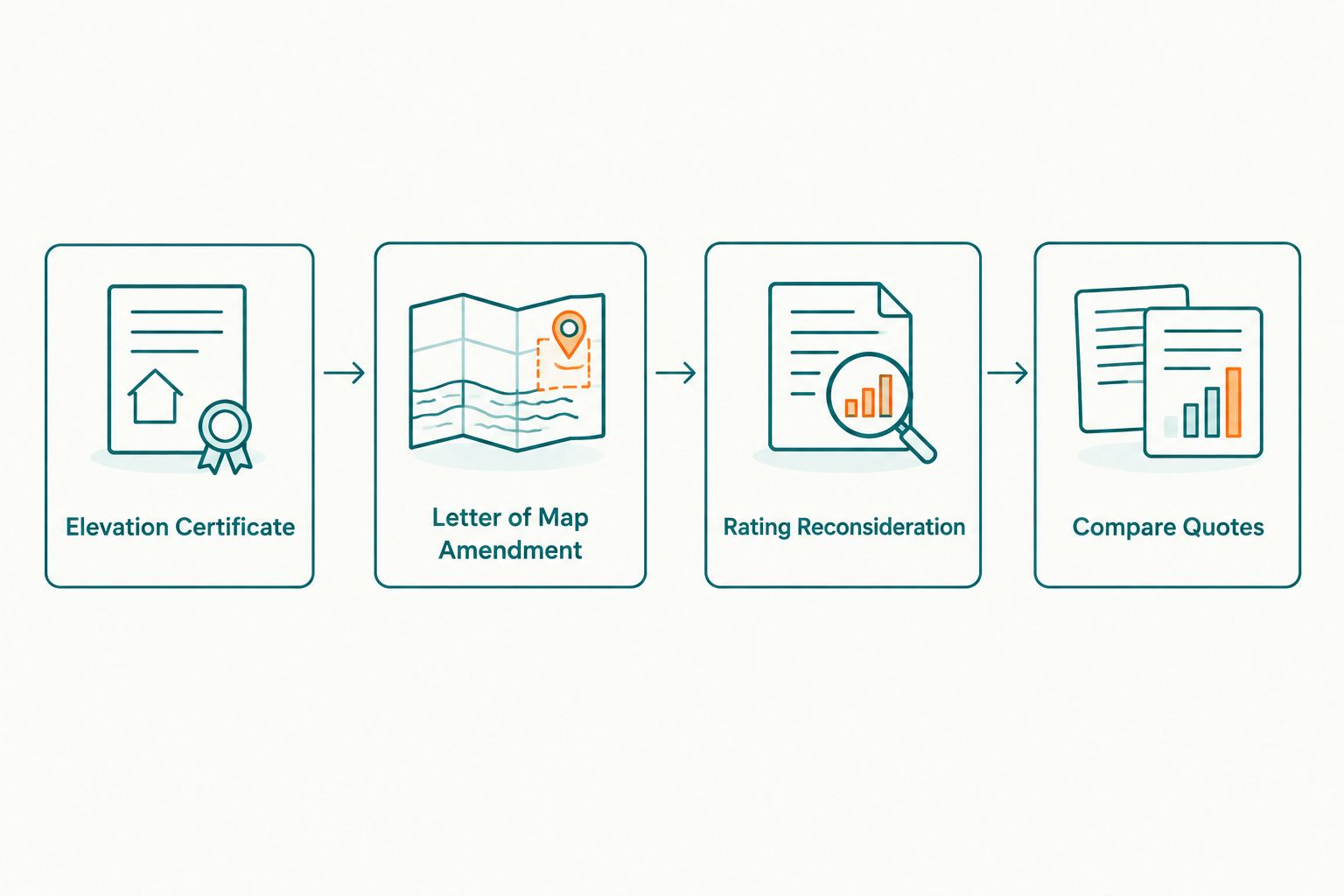
- Pull your current declarations page and rating worksheet. You need to see exactly which inputs — zone, elevation, foundation type — FEMA's system used.
- Order an elevation certificate from a licensed New Hampshire land surveyor. This document measures your lowest floor against base flood elevation and is the backbone of every successful appeal.
- File a Letter of Map Amendment (LOMA) or Letter of Map Revision Based on Fill (LOMR-F) if the elevation data shows your structure sits above the mapped flood risk.
- Request a rating reconsideration through your agent or the NFIP servicing line to correct foundation type, building age, or flood-history errors baked into the original quote.
- Re-shop the policy with a second Write Your Own (WYO) carrier once the corrected data is on file — pricing can still shift between carriers using the same FEMA inputs.
Which appeal option fits your situation
| Option | What it fixes | Best for | Verdict |
|---|---|---|---|
| Elevation certificate | Corrects the lowest-floor height used in Risk Rating 2.0 | Homes built above flood level but rated as if at grade | File first |
| Letter of Map Amendment (LOMA) | Removes the property from the mapped Special Flood Hazard Area | Homes on natural high ground inside a mapped zone | File if survey data supports it |
| LOMR-F | Removes the property from the SFHA after engineered fill raised the lot | Homes elevated by regrading, not natural terrain | Use only with documented fill records |
| Rating reconsideration | Corrects foundation type, building age, or claims-history errors | Any policy with wrong underwriting data on file | Request it — no downside |
Why New Hampshire flood premiums vary
Risk Rating 2.0 doesn't price by town or zip code alone. These are the factors that move a New Hampshire premium up or down:
- Distance to the nearest lake, river, or coastline — closer water means higher baseline exposure.
- Foundation type — a walkout basement or finished lower level rates differently than a slab-on-grade home.
- Lowest floor elevation versus base flood elevation — every foot above or below that line changes the price.
- Replacement cost of the structure — flood coverage scales with what it costs to rebuild, not market value.
- Prior flood claims on the property — claims history follows the address, not the owner.
- A zone versus V zone designation — coastal high-velocity wave zones carry the steepest rates in the state.
Business owners face a separate underwriting path entirely. If you're rating a commercial property instead of a residence, flood insurance for New Hampshire businesses runs through different building-class and contents rules than a homeowner's NFIP policy.
“If your elevation certificate shows the lowest floor sitting above base flood elevation, you’re paying for risk your building doesn’t carry.”
Does a Letter of Map Amendment remove the mandatory flood insurance requirement?
A LOMA removes the federal mandatory purchase requirement tied to a federally backed mortgage, but it doesn't erase flood risk on its own. Mortgage lenders can still require coverage at their discretion, and a finished basement below grade carries flood exposure regardless of what the flood map says — see finished basement flood coverage before dropping the policy entirely.
Can you switch agents to get a lower flood insurance rate in New Hampshire?
Switching agents alone doesn't change the price, because FEMA's Risk Rating 2.0 formula prices the address, not the agent. What a different agent can do is catch input errors — wrong foundation type, wrong construction date, an outdated elevation record — that were never corrected on the original policy.
Is FEMA's Risk Rating 2.0 the reason my premium jumped in 2026?
Yes, for most New Hampshire policyholders still moving through the multi-year phase-in, Risk Rating 2.0 is the reason. Federal law caps annual increases at 18% for primary residences, so a policy that was underpriced under the old system can keep climbing toward its full Risk Rating 2.0 price for several more renewal cycles even in 2026.
Get your flood policy reviewed
A quick call catches Risk Rating 2.0 input errors before you file paperwork.
FAQ
How do you appeal a flood insurance premium in New Hampshire?
You appeal by correcting the underlying rating data — flood zone, elevation, or foundation type — through an elevation certificate, a Letter of Map Amendment, or a rating reconsideration request. FEMA’s Risk Rating 2.0 system reprices the policy once corrected data is filed.
What is a Letter of Map Amendment (LOMA)?
A LOMA is a FEMA determination that removes a specific structure from a mapped Special Flood Hazard Area based on survey elevation data. It removes the federal mandatory purchase requirement but does not guarantee a lender won’t still require coverage.
Do I need an elevation certificate to appeal my flood insurance rate?
Yes, in almost every case. An elevation certificate is the document Risk Rating 2.0 and any LOMA or LOMR-F filing rely on to prove your lowest floor sits above or below base flood elevation.
Can a rating reconsideration lower my flood insurance premium without a new survey?
Yes, a rating reconsideration can fix errors already on file — wrong foundation type, wrong construction year, or outdated claims history — without a new elevation survey, since these are underwriting corrections, not map disputes.
Is flood insurance mandatory in New Hampshire?
Flood insurance is mandatory in New Hampshire only when a federally backed mortgage covers a property in a mapped Special Flood Hazard Area. Outside that requirement, coverage is optional but often advisable near lakes, rivers, and the coast.
Why did my flood insurance premium increase in 2026 with no claims filed?
Premiums can increase in 2026 with no claims filed because Risk Rating 2.0 phases older, underpriced policies toward their full rate over several renewal cycles, capped at an 18% annual increase for primary residences.
Does a finished basement raise flood insurance rates in New Hampshire?
Yes, a finished basement raises flood insurance rates because Risk Rating 2.0 factors in the lowest enclosed floor, and finished space below grade increases both flood risk and potential claim payout.
How long does a flood insurance appeal take in New Hampshire?
Timelines vary by filing type — a rating reconsideration through an agent moves faster than a LOMA, which requires FEMA to review survey documentation before issuing a determination.
One last thing
New Hampshire's Lakes Region and coastal towns carry the highest Risk Rating 2.0 baseline exposure in the state, but appeals succeed more often on basement and crawlspace elevation corrections than on flood zone map disputes. Order the elevation certificate before you touch anything else — it's the document every other appeal path depends on.
Related guides
- How to lower home insurance premiums in New Hampshire
- Home insurance for New Hampshire coastal properties