
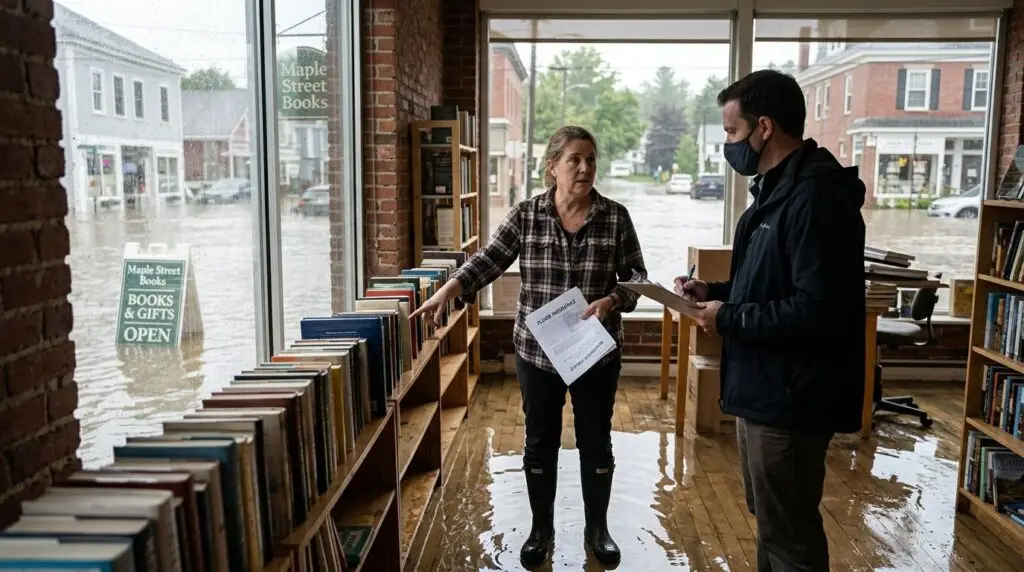
Flood insurance for New Hampshire businesses is a separate policy that pays to repair or rebuild a commercial building and replace its contents after water damage from rising water, storm surge, or overflow — coverage a standard business owners policy does not include. A retail shop in Portsmouth's flood zone faces a different exposure than a farm stand near the Connecticut River or a marina on Lake Winnipesaukee, so the right policy depends on where the business sits and what it would lose if the water got in.
- Flood insurance for businesses in New Hampshire is not included in a standard business owners policy or general liability coverage.
- NFIP commercial policies cap building coverage at $500,000 and contents coverage at $500,000 as of 2026.
- New policies carry a standard 30-day waiting period before coverage takes effect, so buying after a storm warning is too late.
- Businesses outside mapped flood zones still file claims every year — location on a map is not a guarantee of safety.
- Private flood carriers can offer higher limits than NFIP for businesses that need more than $500,000 in protection.
Why flood insurance matters for New Hampshire businesses
General liability and property coverage in a standard business owners policy exclude flood damage outright — that's true whether the business sits on Main Street in a town center or along the Merrimack, Connecticut, or Piscataqua rivers. Businesses near the Great Bay estuary, Lake Winnipesaukee, or any of New Hampshire's flood-prone river corridors carry real exposure, but so do inland businesses hit by flash flooding after heavy rain, which FEMA has documented in New Hampshire in recent years outside mapped high-risk zones.
A flood insurance quote review from Mello Agency looks at your specific address, your building's flood zone designation, and whether your existing business owners policy already assumes coverage it doesn't have. That gap is the single most common reason NH businesses find out too late that a burst dam, an ice jam, or a fast-moving storm wiped out inventory with nothing to pay for it.
Check your flood zone before you shop
Your flood zone designation drives both your risk and, often, your rate. Businesses in high-risk zones (labeled A or V on FEMA maps) usually face lender requirements to carry flood insurance; businesses in moderate- or low-risk zones are not required to but still file claims regularly.
- Pull your building's FEMA flood zone using its street address, not just its town
- Check whether your zone designation has changed since your last map update — FEMA revises maps periodically
- Note whether your building has a basement or ground-floor inventory storage, which raises exposure regardless of zone
- Ask whether your commercial lender already requires flood coverage as a loan condition
- Confirm the elevation certificate on file if your building was constructed after your community's flood map effective date
Understand what your existing policy actually excludes
Most New Hampshire business owners assume their business owners policy or commercial property coverage handles "water damage" broadly. It doesn't — flood, defined as surface water accumulation affecting two or more properties or acres, is a standard exclusion across nearly every commercial property form.
- Re-read the exclusions section of your current policy, not just the declarations page
- Separate "flood" from "water backup" or "sewer backup," which are different endorsements with different triggers
- Check whether your policy covers business income loss during a shutdown — flood-caused income loss needs its own endorsement or a standalone flood policy with that rider
- Ask your carrier directly whether groundwater seepage is treated differently than storm surge or river overflow
- If you lease your space, confirm whether the landlord's policy or your own tenant policy is responsible for contents and improvements
Decide between NFIP and private flood coverage
The National Flood Insurance Program (NFIP) is the default source for most commercial flood policies in the U.S., but it isn't the only option in 2026. Private flood carriers have expanded their New Hampshire commercial offerings and can write coverage above NFIP's $500,000 building and $500,000 contents caps.
- Start with an NFIP quote if your building value and contents fall under $500,000 combined — it's the most standardized option
- Get a private flood quote if your building, inventory, or equipment value exceeds NFIP limits
- Compare waiting periods — NFIP's standard 30-day wait differs from what private carriers may offer
- Ask whether the private carrier's policy is backed by reinsurance that's been active through multiple hurricane seasons, not a brand-new market entrant
- Confirm which option your lender will actually accept if flood coverage is a loan condition
Cover contents and business income as separate line items
A flood policy without a contents endorsement leaves inventory, equipment, and fixtures uninsured even if the building itself is covered. Business income loss during repairs is a separate coverage entirely and isn't automatic under NFIP.
- Inventory your equipment and stock value at replacement cost, not depreciated value
- Add contents coverage as its own limit, not an assumed sublimit of building coverage
- Ask about business income and extra expense coverage if a flood would force a temporary shutdown
- Photograph and document inventory now, before a claim, so proof of loss moves faster
- Review whether coverage extends to a basement or lower-level storage area, which NFIP treats with specific limitations
Review coverage after any renovation or expansion
Adding square footage, moving inventory storage, or finishing a lower level changes your flood exposure and can leave new value uninsured if you don't update the policy.
- Notify your carrier before, not after, a renovation that changes building value or use
- Recalculate contents value annually, especially for retail or seasonal inventory businesses
- Check whether an addition moved any part of the structure into a different flood zone
- Update your elevation certificate if construction changed the building's lowest floor elevation
Bundle flood coverage with the rest of your commercial policy
Flood insurance works best as one piece of a full commercial insurance picture, not a standalone purchase disconnected from general liability, property, and business income coverage.
- Review your business owners policy alongside your flood quote so gaps and overlaps are visible in one conversation
- Ask whether combining flood with your existing commercial carrier simplifies claims handling after a loss
- Confirm your agent is quoting flood coverage against your actual building value, not a generic estimate
- Revisit the whole package annually, since flood zone maps and construction costs both shift over time
Get a flood coverage review
Call, text, or start a quote to see where your business stands.
Comparing flood coverage options for New Hampshire businesses
| Option | Best for | Key limitation |
|---|---|---|
| NFIP commercial policy | Businesses with combined building and contents value under $500,000 | Capped at $500,000 building and $500,000 contents |
| Private flood carrier | Businesses needing coverage above NFIP limits | Availability and terms vary by carrier and building type |
| Excess flood policy layered over NFIP | Businesses near NFIP's cap that want extra cushion | Requires an underlying NFIP policy in most cases |
| No flood coverage, relying on BOP | Not a real option for flood risk | Business owners policies exclude flood damage entirely |
Verdict: a standalone flood policy, NFIP or private, is the only way a New Hampshire business gets paid for flood damage — a business owners policy alone will not.
Common mistakes New Hampshire businesses make with flood coverage
- Assuming "outside the flood zone" means "no risk." Flash flooding and ice-jam flooding hit New Hampshire businesses in moderate- and low-risk zones every year, and standard property coverage still excludes it.
- Buying flood coverage right before a forecasted storm. The standard 30-day waiting period means a policy purchased during a storm watch won't be active in time for that event.
- Insuring the building but skipping contents. Retail stores, restaurants, and contractors with expensive equipment routinely underinsure inventory because they assumed the building limit covered everything.
- Not updating coverage after a renovation. A finished basement or expanded storage area raises exposure that the original flood policy never priced in.
- Treating flood and business income loss as the same coverage. They're separate line items — a business that can't operate for six weeks after a flood needs income protection quoted separately.
FAQ
Do New Hampshire businesses need flood insurance if they’re not in a flood zone?
Businesses outside mapped high-risk flood zones are not required to carry flood insurance, but they still file claims every year from flash flooding and ice-jam events. A standard business owners policy excludes flood damage regardless of zone.
What does a standard business owners policy cover for flood damage in New Hampshire?
Nothing. Business owners policies and commercial property policies exclude flood damage as a standard exclusion, which is why a separate flood policy, NFIP or private, is required.
How much does flood insurance cost for a small business in New Hampshire?
Cost depends on flood zone, building value, elevation, and contents value, and rates vary by carrier. A quote review compares your specific address against current NFIP and private carrier options.
Is NFIP or private flood insurance better for New Hampshire businesses?
NFIP works well for businesses with combined building and contents value under $500,000; businesses that need higher limits or faster claims handling often look at private flood carriers instead.
How long is the waiting period for new flood insurance in New Hampshire?
NFIP’s standard waiting period is 30 days from purchase to when coverage becomes effective, with limited exceptions such as loan closings. Buying coverage during an active storm forecast usually won’t help for that specific event.
Does flood insurance cover lost business income after a flood?
Not automatically. Business income and extra expense coverage during a flood-related shutdown needs to be quoted as its own coverage alongside the flood policy.
Can a landlord’s flood policy cover a tenant business’s inventory?
Usually not. A landlord’s flood policy typically covers the building structure, leaving tenant contents and inventory uninsured unless the tenant carries its own flood coverage.
What businesses in New Hampshire are most exposed to flood risk?
Businesses near the Merrimack, Connecticut, and Piscataqua rivers, Great Bay, and lake regions like Winnipesaukee carry higher exposure, along with any business with ground-floor or basement inventory storage regardless of location.
One last thing
Most New Hampshire business owners assume flood risk is a coastal or riverfront problem — FEMA data has repeatedly shown claims coming from businesses outside mapped high-risk zones after flash-flood and ice-jam events. If your building has never been checked against a current flood zone map, that's the fastest gap to close in 2026, not the last one.
Related guides
- Flood insurance for New Hampshire lake homes
- General liability insurance for New Hampshire small businesses
- Business insurance for campgrounds in New Hampshire