

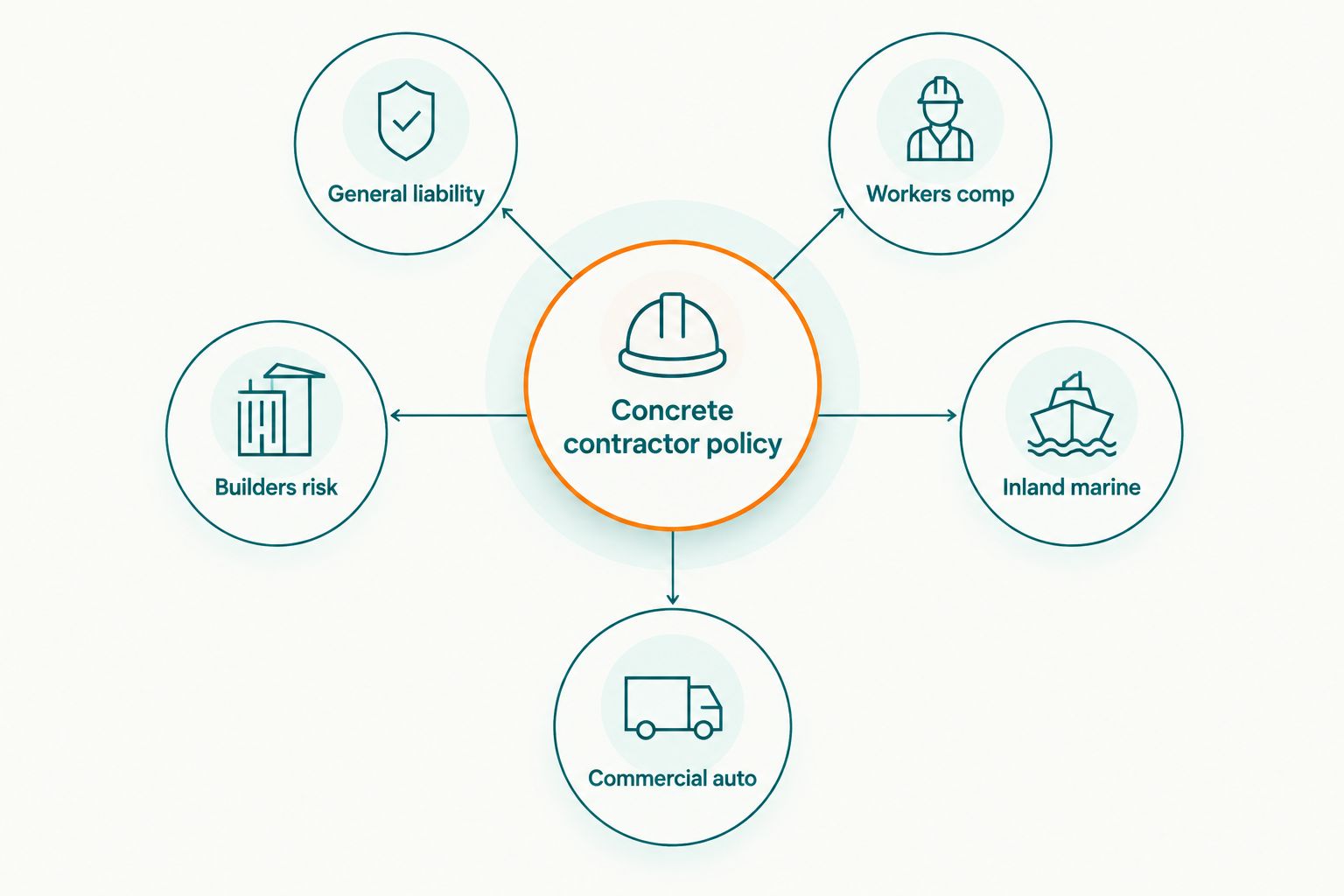
New Hampshire concrete and masonry contractors need business insurance that covers pour-day liability, heavy equipment, and crews working on job sites that shift every few weeks. General liability, workers' compensation, builder's risk, and commercial auto typically bundle into one package built around the physical risk of pouring, forming, and finishing concrete rather than office work. The exposure looks different from a general contractor's package: concrete crews deal with higher slip-and-fall risk on wet pours, heavier equipment values, and tighter weather windows that push job timelines around all season.
- General liability and workers’ compensation are the non-negotiable base for business insurance for New Hampshire concrete contractors in 2026.
- Builder’s risk insurance covers the job site itself — most crews skip it and pay out of pocket when a fresh pour gets damaged.
- Inland marine coverage protects mixers, saws, and forms once equipment leaves the shop, which a standard property policy usually excludes.
- Themelloagency runs a quick review of GL, workers’ comp, and builder’s risk together for New Hampshire concrete and masonry contractors juggling several active sites.
Why this matters for New Hampshire concrete and masonry contractors
New Hampshire requires workers' compensation for any business with one or more employees under RSA 281-A, which means a two-person finishing crew hits that requirement the day the first hire starts. Concrete work also carries product liability exposure that a general contractor's policy doesn't automatically extend to a sub: if a slab cracks or a retaining wall fails months later, the completed-operations portion of general liability is what responds, not the GC's blanket coverage.
Most concrete and masonry outfits in New Hampshire contractors work as subcontractors on someone else's job, which means certificates of insurance and additional-insured requirements show up before you're allowed to bid, not after. Business insurance for New Hampshire concrete contractors has to satisfy the GC's paperwork and cover the crew and equipment on-site — those are two different jobs for a policy to do.
Build the coverage stack, step by step
Confirm your general liability limits match the job
General liability is the base layer every concrete and masonry contractor needs before stepping on a job site, but the standard small-business limit doesn't always fit pour-day risk.
- Check that slip-and-fall coverage extends to wet concrete and staged materials, not just the finished structure
- Confirm completed-operations coverage applies if a slab or wall fails after the job wraps
- Review per-occurrence versus aggregate limits against the size of jobs you're bidding in 2026
- Verify general liability coverage extends to work performed on a client's or GC's property, not just your own yard
- Ask whether product liability applies to concrete mix defects or masonry material failures
Carry workers' compensation for every person on the pour crew
A finishing crew, a laborer hired for one big pour, and a working owner all need to be classified correctly — misclassifying a role by job title instead of actual task is the fastest way to get a claim denied.
- Confirm every subcontractor on-site carries their own workers' compensation and hand over a current certificate
- Classify each crew member by the work they actually do that week, not their usual title
- Cover working owners if your policy or state rules require it
- Add seasonal or short-term labor hired for a large pour before they set foot on the site
- Make sure coverage follows the crew across every town you work in, not just your home base
This is the coverage most New Hampshire concrete contractors already carry for workers' compensation insurance, but the classification review is where gaps show up.
Add builder's risk coverage for each active job site
General liability protects people and property from your work; builder's risk protects the work itself while it's in progress.
- Buy builder's risk before the pour starts, not after materials are already staged
- Confirm it covers theft of forms, rebar, and finishing tools left on-site overnight
- Check that storm and weather damage to a fresh pour is included, not just fire and vandalism
- Coordinate with the GC's own builder's risk insurance so you're not paying for duplicate coverage or leaving a gap between the two policies
- Confirm the policy term matches the actual project length, since most builder's risk policies are written per-project, not annually
Insure trucks, mixers, and trailers under commercial auto
A personal auto policy stops covering a vehicle the moment it's used regularly for business, and insurers check for that at claim time.
- Move mixer trucks, dump trucks, and equipment trailers onto a commercial auto policy
- Add hired and non-owned auto coverage if you rent trucks or trailers for bigger pours
- Confirm coverage for vehicles that cross into Massachusetts for jobs near the border
- Check gross vehicle weight ratings against your policy's stated limits
- List every driver who operates a company vehicle, including part-time crew
Protect tools and equipment with inland marine coverage
A standard commercial property policy generally stops covering equipment once it leaves your shop or yard — that's the gap inland marine coverage fills for saws, vibrators, forms, and laser levels moving between sites.
- Schedule high-value equipment individually rather than lumping it into one blanket number
- Update the equipment list every season, especially after buying new saws or laser gear
- Confirm coverage applies while equipment is in transit, not just parked on-site
- Check theft coverage for tools left in a locked trailer overnight
- Ask whether rented or borrowed equipment is covered under the same schedule
Review contract and certificate requirements before you bid
General contractors and municipalities often require a certificate of insurance with specific limits before you're allowed on-site, and a missing endorsement can knock you out of a bid.
- Read the additional-insured requirement in every contract before signing
- Check bonding requirements separately from insurance requirements on public and municipal jobs
- Confirm your limits meet the GC's stated minimums, not just your own comfort level
- Keep digital copies of current certificates ready to send same-day
- Ask your agent to flag any contract clause that asks for coverage you don't currently carry
“If a mixer truck is titled to the business and used for jobs, it needs commercial auto — a personal auto claim gets denied the moment the adjuster sees business use.”
Coverage comparison for New Hampshire concrete and masonry contractors
| Coverage | Best for | Key limitation |
|---|---|---|
| General liability | Every concrete and masonry contractor bidding work in 2026 | Doesn't cover employee injuries or company vehicles |
| Workers' compensation | Any contractor with employees or on-site subcontracted crew | Doesn't cover the contractor's own tools or the job site |
| Builder's risk | Active pours and masonry jobs under construction | Coverage typically ends once the project is complete |
| Inland marine | Contractors moving mixers, saws, and forms between sites | Payout accuracy depends on an updated equipment list |
| Commercial auto | Mixer trucks, dump trucks, and equipment trailers | A personal auto policy won't cover business use of the same vehicle |
Get a quick review of your coverage
Talk through GL, workers’ comp, and builder’s risk for your next job.
Common mistakes New Hampshire concrete and masonry contractors make
- Relying on the GC's general liability instead of carrying their own — a GC's policy rarely covers a sub's own crew or equipment.
- Skipping builder's risk on renovation and addition jobs, assuming a homeowner's policy covers concrete work in progress. It usually doesn't.
- Insuring a mixer truck under a personal auto policy and finding out at claim time that business use voids it.
- Letting the inland marine schedule go stale after buying new saws or laser equipment mid-season, which shrinks the actual payout.
- Not confirming subcontractor certificates before pour day, which leaves the whole crew exposed if a sub causes property damage.
FAQ
What insurance does a concrete contractor need in New Hampshire?
A New Hampshire concrete contractor typically needs general liability, workers’ compensation, builder’s risk for active jobs, inland marine for tools and equipment, and commercial auto for mixer trucks and trailers. Most GCs and municipalities require proof of the first two before you’re allowed to bid.
Is workers’ compensation required for concrete contractors in NH?
Yes. New Hampshire requires workers’ compensation for any business with one or more employees under RSA 281-A, which covers most concrete and masonry crews the day the first hire starts.
Does builder’s risk insurance cover concrete work in progress?
Builder’s risk covers a job site and the work in progress against theft, vandalism, and storm damage, including a fresh pour before it cures. It usually ends once the project reaches completion, so it has to be renewed or replaced per project.
How much liability coverage do masonry contractors need for municipal jobs?
Municipal and public jobs often set a minimum general liability limit in the bid contract, so the right number comes from the contract itself rather than a flat industry figure. Read the additional-insured clause before submitting a bid.
Can a personal auto policy cover a mixer truck?
No. A personal auto policy typically excludes vehicles used for business, and insurers deny claims once they identify commercial use. Mixer trucks, dump trucks, and equipment trailers need a commercial auto policy.
What’s the difference between general liability and builder’s risk?
General liability covers injuries and property damage caused by your work to third parties. Builder’s risk covers the job site and materials themselves while construction is in progress, including damage to a fresh pour.
Do subcontractors need their own certificate of insurance?
Yes, and a general contractor should collect one before letting a sub on-site. Without it, the GC’s own policy can end up absorbing a claim caused entirely by the subcontractor’s crew.
Is inland marine coverage required for concrete tools and equipment?
It’s not legally required, but it fills a real gap: standard commercial property policies generally stop covering equipment once it leaves the shop. Contractors who move saws, vibrators, and forms between sites regularly carry inland marine for that reason.
One last thing
New Hampshire's freeze-thaw season runs long, and a lot of concrete crews structure builder's risk around active pour months rather than paying for a full annual term that covers a stretch of the year when the crew isn't pouring at all. Match the policy term to your actual work calendar before renewing anything on autopilot in 2026.
Related guides