
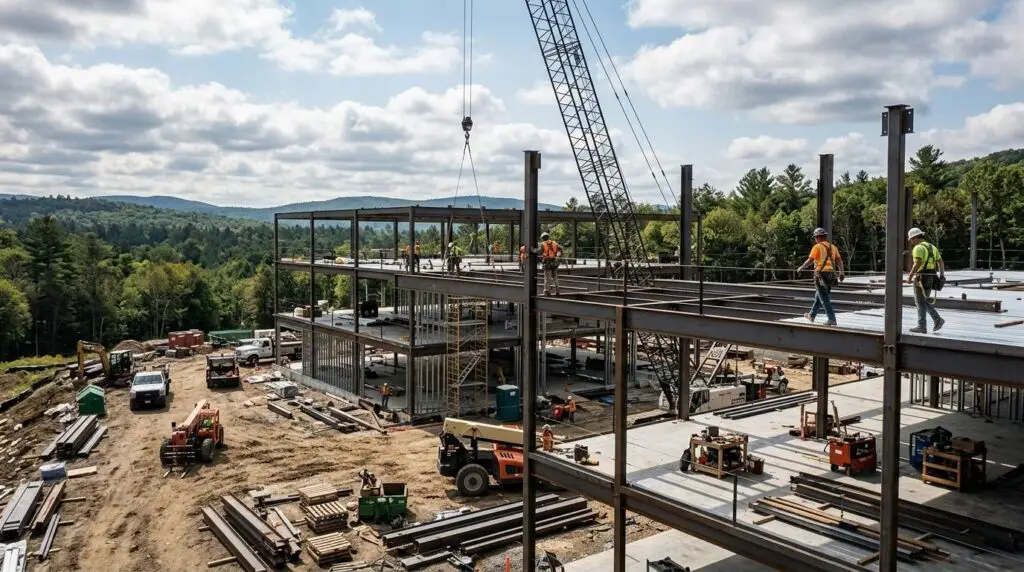
Builders risk insurance for commercial construction projects in NH covers the structure, materials, and equipment on a job site while a commercial building is under construction, with the goal of protecting the project's value against fire, theft, weather, and vandalism until the certificate of occupancy is issued. Commercial jobs differ from a home renovation in one big way: the dollar value under construction is usually higher, the timeline stretches longer, and more than one contractor or subcontractor often needs to be named on the same policy.
- Builders risk insurance for commercial construction in NH must match total completed project value, not materials on hand.
- Themello Agency writes builders risk for general contractors, developers, and owners across New Hampshire commercial jobs.
- Reporting-form policies fit multi-phase commercial builds better than flat completed-value policies.
- Soft costs and delayed opening coverage protect lost rent and loan interest, not just physical damage.
- Renewal timing matters in 2026 when permit delays push jobs past the original policy end date.
Why builders risk matters for commercial construction in NH
A commercial job site in New Hampshire carries risk a homeowner's renovation never sees: multiple trades on site at once, heavier equipment staged outdoors, and a longer exposure window to a Nor'easter, a spring flood, or snow load on a partially framed roof. Standard general liability and commercial property policies do not cover a building that does not yet exist in finished form. That gap is exactly what builders risk insurance fills.
New Hampshire's construction season also runs hard into winter. A commercial shell that is 60% framed in November faces a different exposure than one framed in June, and a 2026 policy needs to account for that seasonal reality, not just square footage.
How to insure a commercial construction project in NH
Confirm your project qualifies as commercial builders risk
Builders risk on a commercial job is written differently than the version used for a single-family renovation. Before requesting quotes, pin down the classification.
- Total construction value including materials, labor, and site prep
- Whether the job is ground-up new construction, an addition, or a rehab
- Every contractor and subcontractor that needs to be a named insured
- Project timeline, including phased or multi-building scope
- Site details: flood zone status, hydrant distance, overnight site security
Get this wrong and you either underinsure a multi-million-dollar shell or pay for coverage sized for residential rehab.
Set the coverage amount to match completed project value
The most common mistake on a commercial job is insuring the value sitting on site today instead of the value of the finished building. The limit should reflect the end state.
- Calculate hard costs: materials, labor, installed equipment
- Add the value of any existing structure being renovated or expanded
- Factor in phased material deliveries on large commercial jobs
- Confirm whether the limit escalates as construction value increases
- Check if the insurer requires monthly value reports
Underinsuring a commercial shell by 20% can leave a six-figure gap after a total loss.
Choose the right policy form for the build
Two structures dominate commercial builders risk. A completed-value policy sets one limit from day one. A reporting-form policy adjusts the limit as construction value climbs, so premium tracks actual exposure at each stage.
- Completed-value form: simpler, fixed limit, common on smaller commercial jobs
- Reporting form: monthly value reports, premium adjusts with progress
- Ask what penalty applies for a late value report
- Confirm how the form treats an existing structure during renovation-in-place
- Compare how each handles partial occupancy before final completion
For a straight ground-up commercial build, completed-value is usually enough; for phased developments or occupied renovations, the reporting form is the more accurate buy.
Cover the site-specific exposures on your job
Generic quotes miss site risk. A lot near a river, a build in a high-theft area, or a project staging rooftop HVAC units outdoors each need endorsements added on purpose.
- Theft of installed and unattached building materials
- Vandalism and malicious mischief on nights and weekends
- Wind, hail, and snow load damage to partially enclosed structures
- Flood, which standard builders risk typically excludes
- Collapse during framing, before the structure is fully load-bearing
Flood deserves a direct flag. Commercial builders working near the Merrimack, Connecticut, or Piscataqua watersheds should confirm flood is added, not assumed. Flood insurance for New Hampshire businesses handles the finished building once it is occupied; the builders risk policy needs its own flood endorsement during construction.
Add soft costs and delayed opening coverage
Physical damage is not the only cost of a delay. A fire that pushes a commercial project back four months also generates extra loan interest, extended design fees, and lost lease income if tenants were scheduled to move in.
- Extra expense to accelerate the rebuild after a covered loss
- Loan interest accrued through the delay period
- Real estate taxes and insurance premiums during the extension
- Lost rental income on pre-leased space
- Legal and professional fees tied to the delay
Developers holding signed 2026 leases should treat this as required, not optional.
Coordinate builders risk with your other commercial policies
Builders risk does not replace general liability, workers' compensation, or inland marine coverage. A commercial job site usually needs all four running at once.
- General liability for third-party injury or property damage on site
- Workers' compensation for employees and, in many cases, subcontractors
- Inland marine for tools and equipment moving between job sites
- Umbrella coverage when project value or liability exposure is high
- One point of contact tracking renewal dates across all four
This is where developers overpay or leave holes: each policy gets quoted separately and nobody checks for overlap. Themello Agency reviews builders risk alongside contractor business insurance and inland marine insurance for New Hampshire contractors so the job site is covered under one coordinated plan instead of four disconnected quotes.
Review the exclusions before you bind
Every builders risk policy carries exclusions that bite harder on commercial work. Read them before binding, not after a denial.
- Faulty workmanship and design defects, usually excluded outright
- Mechanical breakdown of installed equipment before testing is complete
- Employee theft, which generally needs a separate crime endorsement
- Wear and tear or gradual deterioration on long-timeline builds
- War, government seizure, and nuclear exclusions, standard across the market
Extend coverage before the timeline slips
Commercial schedules move. A 2026 project scoped for ten months can run twelve after permit or supply delays. Builders risk policies have fixed term dates and do not auto-extend.
- Track the policy end date against the live completion schedule
- Request an extension at least 30 days before expiration
- Confirm the extension carries the same limits and endorsements
- Ask what a coverage gap does to claims filed later
- Convert to a commercial property policy once occupancy is granted
Get your project coverage reviewed
Quick review of your builders risk limits and endorsements before the job starts.
Comparing builders risk options for NH commercial projects
| Option | Best for | Key limitation |
|---|---|---|
| Completed-value policy | Single-phase commercial builds with a fixed budget | Limit locked upfront, inflexible if scope grows |
| Reporting-form policy | Multi-phase or long-timeline commercial developments | Requires monthly value reporting to the insurer |
| Renovation builders risk | Commercial rehab with partially occupied space | Structured differently than new-build coverage; the residential version is covered in builders risk for home renovation projects in NH |
| Owner-controlled placement | Developers covering many subcontractors under one program | Every sub must be properly named and tracked |
Common mistakes commercial builders make in NH
- Insuring current value instead of completed value. A shell worth a fraction of the finished building today still needs a limit set at the end-state value.
- Assuming flood is included. Standard builders risk excludes flood; NH sites near river corridors need the endorsement written in.
- Letting the policy lapse during a permit delay. The gap between the original end date and actual completion leaves the whole project bare.
- Treating builders risk as a substitute for liability or workers' comp. It covers the structure and materials, not injuries or third-party claims.
- Leaving a subcontractor off the named insured list. A sub without standing on the policy creates a gap on any loss involving their scope of work.
FAQ
What does builders risk insurance cover on a commercial construction project in NH?
It covers the building under construction, on-site materials, and in most cases staged equipment against fire, theft, vandalism, and weather damage. Flood and earthquake typically require separate endorsements.
Is builders risk insurance required for commercial construction in New Hampshire?
State law does not mandate it, but construction lenders and most general contracts require proof of builders risk before work begins. No coverage can hold up loan funding.
How is commercial builders risk different from a home renovation policy?
Commercial projects carry higher values, longer timelines, and multiple named contractors, which often calls for a reporting-form policy instead of the fixed completed-value form used on smaller renovations.
Does builders risk insurance cover flood damage during construction in NH?
Not by default. Flood coverage during construction requires a separate endorsement, which matters for commercial sites near the Merrimack, Connecticut, and Piscataqua watersheds.
Who should be named on a commercial builders risk policy?
The property owner, the general contractor, and any subcontractor with a financial interest in the project. Missing names create coverage gaps after a loss.
What happens if the project runs past the builders risk policy end date?
Coverage does not auto-extend. Request a formal extension before the original expiration date or the project sits uninsured during the delay.
Can builders risk cover lost rent from a delayed commercial opening?
Yes, through a soft costs or delayed opening endorsement. It covers lost rental income, extra loan interest, and extended professional fees caused by a covered loss.
How do I file a builders risk claim in New Hampshire?
Document the damage immediately, notify the insurer within the policy’s reporting window, and preserve the site until an adjuster inspects it. The full sequence is covered in the NH builders risk claim guide.
One last thing
The detail commercial developers skip most often is not the coverage limit. It is the monthly reporting deadline on a reporting-form policy. Miss a value report and some carriers reduce what they pay on a loss that happens in that window. Set a recurring calendar reminder the day the policy is bound in 2026, not after the first report is late.
Related guides
- Builders risk insurance for home renovation projects in NH
- How to file a builders risk insurance claim in New Hampshire
- Business insurance for contractors in New Hampshire
- Inland marine insurance for New Hampshire contractors
- Flood insurance for New Hampshire businesses