
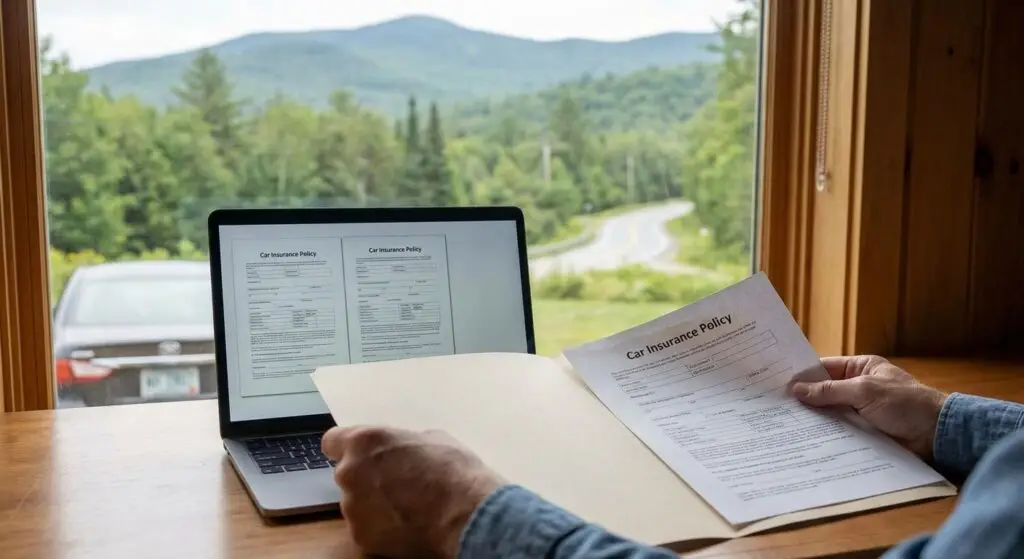
Switching auto insurance companies in New Hampshire takes about 20-30 minutes if you line up the new policy before canceling the old one, and doing it wrong can leave you with a coverage gap or a lapse fee even though NH doesn't legally require the coverage in the first place.
- You can switch auto insurance companies in New Hampshire without a lapse if you buy the new policy before canceling the old one.
- New Hampshire is the only state that doesn’t mandate auto insurance for most drivers, but lienholders and RSA 264 financial responsibility rules still require it for many people.
- Cancel in writing with an exact effective date so any unused premium gets refunded instead of applied to a policy you no longer want.
- Drivers under an SR-22 filing need the new carrier to submit the form before the old policy drops, or the state treats it as a lapse.
Why this matters
New Hampshire doesn't force you to carry auto insurance the way every other state does. That's the one real quirk you need to plan around when you switch: there's no state-mandated grace period, no automatic notification to the DMV, and no penalty just for driving uninsured unless you've been in an at-fault accident or picked up violations that triggered RSA 264 financial responsibility requirements.
That sounds like it makes switching easier, but it actually makes it easier to mess up. Without a state system tracking your coverage, nobody catches a gap for you. If your lender requires proof of insurance on a financed car, or you're carrying an SR-22, a missed day between policies can trigger a default notice or a lapse letter that follows you for years. The fix is sequencing, not paperwork.
What you'll need
- Your current policy declarations page (coverage limits, deductibles, renewal date)
- Vehicle info: VIN, current mileage, and your driving record for the past 3-5 years
- Names and birthdates of every driver on the policy
- Lienholder or lender name and address if the car is financed or leased
- 15-20 minutes to compare quotes and another 10 to make the switch calls
- If applicable, your SR-22 filing details from your current insurer
The steps
1. Pull your current declarations page and know your renewal date
This tells you what you're actually replacing. Note your bodily injury and property damage limits, comprehensive/collision deductibles, and whether you're carrying anything unusual like rental reimbursement or gap coverage.
Most New Hampshire drivers overpay because they quote a lower liability limit than they currently have and mistake the savings for an apples-to-apples deal. Get this number right before you request quotes in 2026, because a $25,000/$50,000 policy will always look cheaper than a $100,000/$300,000 one.
Common mistake: quoting a new company with the state's legal minimum limits just to see a low number, then not realizing the quote isn't comparable to your real coverage.
2. Get at least three quotes with matching coverage
Request quotes with identical limits and deductibles across every company so the price comparison actually means something. If you're not sure what limits make sense for your situation, a quick review of New Hampshire's minimum auto insurance requirements will show you where the legal floor sits versus what most lenders and prudent drivers actually carry.
Ask each quote for the same six numbers: BI per person, BI per accident, property damage, UM/UIM, comprehensive deductible, collision deductible. Anything less than that and you're comparing noise, not price.
Common mistake: accepting a quote that silently drops uninsured motorist coverage to shave the premium, then finding out after an accident with an uninsured driver.
3. Confirm the new policy's start date before you touch the old one
Set the new policy's effective date for the same day the old one cancels, or one day earlier as a buffer. Never let there be even a 24-hour gap between the two.
This matters more in New Hampshire than most states precisely because there's no state backstop tracking your coverage status. If you're financing the vehicle, your lender's system will flag a gap automatically and can force-place expensive coverage on your behalf. Buy the new policy first. Cancel the old one second. Never the other way around.
Common mistake: canceling the old policy on the phone to get it out of the way before the new one is confirmed active.
4. Notify your lender or lienholder of the switch
If the car is financed or leased, the lender is listed as a lienholder on your policy and needs the new insurer's information directly. Most new carriers will handle this notification for you, but confirm it happened.
Skip this step and your lender may not know you're covered at all, even though you are. That's the fastest way to get a forced-placed insurance letter that adds hundreds of dollars a month to your loan for coverage you don't need.
Common mistake: assuming the new insurer automatically knows to contact the lienholder without you providing the loan account number.
5. Cancel the old policy in writing with an exact date
Call or email your current carrier and request cancellation effective on a specific date, in writing. Ask for confirmation of the cancellation and ask directly whether you're owed a refund for unused premium.
Most insurers prorate refunds to the day, so if you paid six months up front and switch after two months, you should get roughly four months back minus any fees. Get the refund timeline in writing too; most carriers process it within 10-15 business days.
Common mistake: letting the policy lapse naturally at renewal instead of canceling, which can still leave a note on your record depending on the carrier's reporting practices.
6. Update your proof of insurance and ID cards
Once the new policy is active, print or download the new ID cards and remove the old ones from your glove box immediately. Keep a digital copy on your phone as backup.
If you're carrying an SR-22 for a prior violation, this step isn't optional busywork. The new insurer needs to file the SR-22 form with the state before or the same day the old policy's SR-22 drops, or the state treats it as a lapse in financial responsibility. Drivers in that situation should confirm directly with an agent handling SR-22 insurance for New Hampshire drivers before making the switch.
Common mistake: switching insurers without telling the new company about an active SR-22 filing, assuming it carries over automatically.
Get a quote before you cancel anything
Compare your current NH auto policy to a new one, coverage-for-coverage, before you make a call.
Troubleshooting
Problem: The old carrier won't confirm my cancellation date. Follow up in writing (email, not just a phone call) and reference the date you requested. Keep a copy for your records in case a billing dispute comes up later.
Problem: I got a refund check that seems too small. Ask for a written breakdown of the proration. Some carriers apply a short-rate cancellation fee if you cancel mid-term instead of at renewal, which can shave 5-10% off the prorated amount.
Problem: My lender says I'm uninsured even though I switched. The new insurer likely hasn't sent the lienholder notification yet. Call the new carrier directly and give them the loan account number so they can send it same-day.
Problem: I have an SR-22 and I'm worried about a lapse. Don't cancel the old policy until the new insurer confirms in writing that the SR-22 has been filed with the state. A one-day gap here can restart a multi-year SR-22 requirement.
Problem: My rate went up after switching, not down. Check whether the new quote matched your old limits exactly, and whether a recent violation or claim aged into the new company's lookback window differently than your old carrier's.
Problem: I'm switching because of a rate hike after a claim. Get a quote anyway, but expect most carriers to price claims similarly for 3-5 years. A high-risk auto insurance option built for New Hampshire drivers is worth comparing if standard carriers are all quoting high.
Tools and resources
- Your state's minimum coverage baseline: New Hampshire's minimum auto insurance requirements (linked above)
- SR-22 filing guidance: SR-22 insurance for New Hampshire drivers (linked above)
- If you're pairing the switch with a homeowners review: how to bundle home and auto insurance in New Hampshire
- Your current declarations page (from your outgoing carrier's portal or app)
- A written cancellation request template — a two-line email with your policy number and requested cancellation date is enough
What to do next
Once the new policy is active and the old one is confirmed canceled, review whether your coverage still fits your driving habits. If you've cut your commute or work from home more in 2026 than you did a year or two ago, check auto insurance for low-mileage drivers in New Hampshire before your next renewal — mileage-based pricing can shift the math again within a year.
FAQ
Can I switch auto insurance companies at any time in New Hampshire?
Yes, you can switch auto insurance companies in New Hampshire at any point in your policy term, not just at renewal. Buy the new policy first and set its effective date to match your old policy’s cancellation date so there’s no gap.
Do I have to notify New Hampshire’s DMV when I switch insurers?
No, New Hampshire doesn’t require most drivers to carry auto insurance at all, so there’s no state notification system to update. The exception is drivers under an SR-22 filing, where the new insurer must submit the form directly to the state.
Will I get a refund if I cancel my auto policy early?
Most carriers prorate your refund to the day you cancel, minus any short-rate fee for ending the policy mid-term. Ask for the refund breakdown in writing when you request cancellation.
What happens if there’s a gap between my old and new auto policy?
A coverage gap can trigger forced-placed insurance from your lender if the car is financed, and it can restart an SR-22 filing period if you’re under one. Even a single day matters because New Hampshire has no state grace period for lapses.
Is New Hampshire really the only state without mandatory auto insurance?
Yes, New Hampshire is the only state that doesn’t require most drivers to carry auto liability insurance. Financial responsibility law (RSA 264) still requires coverage after an at-fault accident, certain violations, or for financed vehicles.
How much does it cost to switch auto insurance companies?
Switching itself is free; there’s no fee to buy a new policy or request a cancellation. The only cost risk is a short-rate cancellation fee from your outgoing carrier if you cancel mid-term instead of waiting for renewal.
Can I switch auto insurance if I have an SR-22 in New Hampshire?
Yes, but the new insurer must file the SR-22 with the state before or on the same day your old policy’s filing ends. Confirm that filing in writing before you cancel the old policy.
Do I need to tell my lender I switched auto insurance companies?
Yes, if your car is financed or leased, the new insurer needs your lienholder’s name and loan account number to file the notification. Skipping this step can trigger a force-placed insurance letter from your lender even though you’re actually covered.
One last thing
New Hampshire not requiring auto insurance for most drivers doesn't mean coverage is optional in practice — it just shifts the requirement onto lenders, SR-22 filings, and RSA 264 after an accident, and none of those systems will tell you if you slipped up. The safest rule when you switch auto insurance companies in New Hampshire in 2026: never let the new policy's start date land later than the old policy's end date, even by a few hours.
Related guides
- How to meet New Hampshire's minimum auto insurance requirements
- SR-22 insurance for New Hampshire drivers
- How to bundle home and auto insurance in New Hampshire
- Best high-risk auto insurance for New Hampshire drivers
- Auto insurance for low-mileage drivers in New Hampshire