
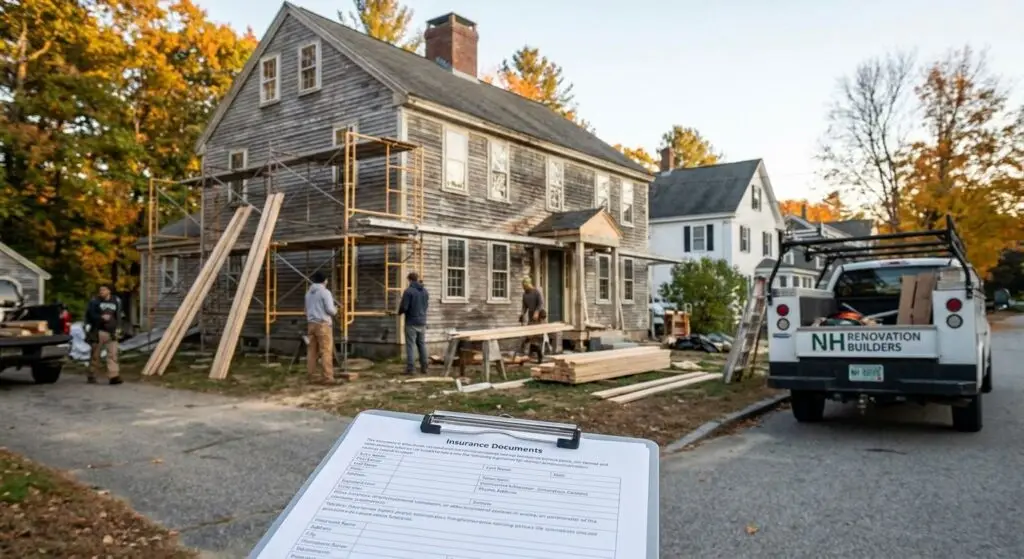
Start a kitchen gut job, a full addition, or a garage-to-living-space conversion in New Hampshire without builders risk insurance, and the months between demo and final inspection are the exact months your homeowners policy won't touch.
- Builders risk insurance home renovation NH policies typically run 1%-4% of total project cost — buy before the permit is pulled.
- Standard NH homeowners policies exclude structures under active renovation; a mid-remodel fire or theft claim gets denied without a rider.
- Rental property and vacation home renovations need separate builders risk terms — landlord and seasonal policies don’t cover construction risk.
- Most NH renovation policies run 3 to 12 months and must be extended if the project runs long, or coverage lapses mid-build.
Why this matters
A standard New Hampshire homeowners policy insures a finished, occupied structure. The moment a contractor opens a wall, pulls a permit, or leaves a roof exposed overnight, most insurers treat that structure as a construction site — and construction sites sit outside a standard policy's fine print, regardless of how long the family has lived there.
Builders risk insurance for home renovation projects in NH fills that specific gap. It covers the structure, materials staged on site, and often the homeowner's liability while work is underway, then steps aside once the certificate of occupancy or final inspection closes the project out. Winter renovations add another wrinkle: a house with the heat off and pipes exposed during a New Hampshire cold snap is a common source of freeze claims, and a builders risk policy is what responds when it happens mid-project.
The stakes scale with the project. A $15,000 bathroom remodel that floods overnight is an inconvenience. A $180,000 second-story addition that burns during framing, with no builders risk policy in place, is a total loss with no payout — and lenders financing renovation loans in 2026 increasingly require proof of coverage before releasing draw money. Additions and full gut jobs get underwritten with the same scrutiny as home insurance for new construction homes in New Hampshire, because from the insurer's chair, a stripped-to-studs renovation and a house mid-build look identical on paper. That underwriting overlap is why so many NH renovation quotes in 2026 start with the same set of questions a new-build quote would ask.
Who this is for
This coverage is for New Hampshire homeowners, landlords, and second-home owners with a renovation budget over roughly $10,000 to $15,000 — the point where materials on site and structural exposure start to matter. It applies to anyone pulling a building permit in Nashua, Manchester, Concord, or anywhere else in the state where the project leaves framing exposed, plumbing open, or the roof off for more than a few days.
It's not for cosmetic work. Painting a room, replacing carpet, or swapping light fixtures doesn't create the structural exposure builders risk insurance is built for — that's still homeowners policy territory. If the project sits between those two extremes, a quick builders risk insurance review with The Mello Agency before the permit gets pulled settles the question faster than guessing.
What to look for in builders risk insurance for home renovation projects in NH
Coverage that follows the project, not the calendar
A renovation-specific policy should track the scope of work, not a fixed annual term. Look for terms of 3, 6, or 12 months with an extension option — New Hampshire renovation projects run long more often than they run on schedule, especially with 2026 permitting backlogs in busier towns.
Limits that match total project cost, not current home value
Undervalue the policy and a total loss during framing pays out on the old structure, not the finished one. The limit should reflect the full renovation budget — materials, labor, and the existing structure being altered — not the pre-renovation appraisal. Expect a deductible in the $1,000 to $2,500 range on most NH builders risk policies, higher for larger additions.
Open perils coverage instead of a named-perils list
Named-perils policies only pay for causes of loss spelled out on the page. Open perils coverage protects against anything not specifically excluded, which matters more during framing and finish stages when a house is exposed to fire, wind, theft, and water in ways a finished home isn't.
Theft and vandalism coverage for materials staged on site
Lumber, appliances, and fixtures sitting in a driveway or garage for weeks are a target. A policy without theft coverage for materials on site leaves that exposure uninsured, and it's one of the more common claims on New Hampshire renovation jobs during framing and finish stages.
Liability protection while contractors are on the property
Builders risk covers the structure and materials — it typically doesn't cover a contractor's employee falling off a ladder. Confirm the contractor carries their own liability and workers' comp, and ask The Mello Agency whether an umbrella policy makes sense as a backstop for your own liability exposure during the project.
How the policy interacts with your existing homeowners coverage
Some New Hampshire carriers will endorse an existing homeowners policy for a renovation instead of writing a standalone builders risk policy. That works for smaller projects; larger additions or full guts usually need the separate policy because the endorsement route caps out fast, sometimes well before the actual rebuild cost is covered.
Top picks by renovation type
None of these six scenarios needs a different insurer — a home insurance review with The Mello Agency can confirm which existing policy already covers part of the gap before you shop for a standalone builders risk term.
The straightforward remodel — the safe pick. Kitchen, bath, or basement remodels under roughly $75,000 rarely need anything exotic: a standard builders risk policy with a 6-month term and theft coverage for materials on site covers the exposure. Verdict: Buy a standalone policy rather than relying on a homeowners endorsement once the project crosses $50,000.
The full gut renovation or major addition — the scale-up pick. Stripping a house to studs or adding a second story pushes the project into new-construction territory for underwriting purposes. Set the policy limit to the full rebuild cost, not the pre-project appraisal, and expect a 9-to-12-month term given how often additions run past their original schedule in 2026. Verdict: Buy, and confirm the limit before the first framing inspection.
The rental property renovation — the landlord pick. Renovating a unit between tenants or upgrading a multi-family property changes the risk profile from what a landlord insurance policy for New Hampshire rental property owners is built to cover day-to-day. Builders risk fills the construction window; the landlord policy resumes once the unit is re-occupied. Verdict: Buy the builders risk term to cover the vacancy-and-construction gap specifically.
The vacation home renovation — the seasonal pick. A camp on a New Hampshire lake or a ski-area property under renovation sits unoccupied for stretches that make insurers nervous, and a vacation home insurance policy for out-of-state owners in New Hampshire generally assumes the home is finished and seasonally occupied, not mid-construction. Verdict: Consider a builders risk rider if the renovation spans an off-season stretch with nobody checking on the property regularly.
The older-home addition — the careful pick. Additions to homes built before 1970 often turn up wiring or structural surprises once walls open, which stretches both budget and timeline. Build a contingency into the policy limit and lean toward the 12-month term option rather than the 6-month default. Verdict: Buy, and revisit the limit if the scope grows mid-project.
The DIY weekend project — the skip. A $6,000 bathroom refresh done over three weekends, with the homeowner living in the house the whole time, usually doesn't justify a standalone builders risk policy. Verdict: Skip it and confirm the existing homeowners policy's minor-renovation language covers the short window instead.
What to avoid
- Assuming a homeowners policy endorsement covers a major addition. Endorsements work for small projects; a full second-story addition or an in-law apartment conversion usually needs a standalone policy with a limit that matches the actual rebuild cost, not a percentage bump on the existing policy.
- Underinsuring the policy to save on premium. A builders risk policy priced against last year's home value instead of this year's project budget leaves a gap exactly when a claim is most likely — mid-framing, before the structure has any finished protection.
- Skipping the scope conversation with your contractor. The underwriting question is the same whether you're planning a home addition in Iowa or Manchester: how long will the structure sit exposed, and whether the policy term matches that window. A four-month framing schedule needs a policy that doesn't lapse in month three.
- Letting the policy expire mid-project. A 6-month term on a renovation that runs to month eight leaves the last two months uninsured unless someone files the extension before the original term ends — a call worth making the moment the schedule slips.
Verdict comparison at a glance
Line up the renovation type against the coverage basis before calling for quotes — it narrows the conversation fast.
| Renovation type | Typical term | Coverage limit basis | Verdict |
|---|---|---|---|
| Straightforward remodel (under $75K) | 6 months | Project cost + existing structure | Buy standalone |
| Full gut or major addition | 9-12 months | Full rebuild cost | Buy standalone |
| Rental property renovation | 6-9 months | Project cost + vacancy window | Buy standalone |
| Vacation home renovation | 6-12 months | Project cost + seasonal exposure | Consider rider |
| Older-home addition | 12 months | Full rebuild cost + contingency | Buy standalone |
| DIY weekend project (under $10K) | N/A | Existing homeowners policy | Skip standalone |
Get a quick coverage review
Call or text before the permit is pulled and confirm the right policy term.
FAQ
What does builders risk insurance cover in NH renovations?
Builders risk insurance covers the structure under renovation, materials staged on site, and often related liability while work is underway. It typically excludes tools, contractor equipment, and the homeowner’s personal property once construction risk is the primary exposure.
How much does builders risk insurance cost for a home renovation in NH?
Builders risk premiums generally run 1% to 4% of the total project cost. A $100,000 addition might carry a premium in the low thousands, depending on project scope, location, and policy term.
Is builders risk insurance required for renovation permits in New Hampshire?
New Hampshire doesn’t mandate builders risk insurance at the state level, but lenders financing a renovation loan in 2026 frequently require proof of coverage before releasing funds. Local building departments don’t typically check for it at permit issuance.
Does homeowners insurance cover home renovations in NH?
A standard homeowners policy usually excludes damage to a structure under active renovation once walls are open or the roof is exposed. Small endorsements can extend limited coverage for minor projects, but major renovations need a standalone builders risk policy.
How long does a builders risk policy last?
Most builders risk policies run 3 to 12 months, matched to the expected construction timeline. Policies can usually be extended if the project runs long, but coverage lapses if the term expires before the extension is filed.
Can I get builders risk insurance for a DIY renovation?
Yes, builders risk insurance is available for owner-managed projects, not just contractor-led ones. Smaller DIY projects under roughly $10,000 often don’t need a standalone policy if the homeowner stays on site and the scope stays cosmetic.
What’s the difference between builders risk and general liability insurance?
Builders risk covers the structure and materials against damage like fire, theft, and weather during construction. General liability covers injury or property damage claims against the contractor or homeowner arising from the work, which is a separate exposure builders risk doesn’t touch.
One last thing
Most New Hampshire homeowners assume the under-construction language buried in their existing policy covers a renovation the same way it covers a finished house. It usually doesn't, and the gap only shows up after a claim gets denied mid-framing. A five-minute call to The Mello Agency before the permit gets pulled costs nothing; a denied claim on a $150,000 addition in 2026 doesn't come back, and that's the trade worth making every time.
Related guides
- Home insurance for homes with in-law apartments in New Hampshire
- Umbrella insurance for New Hampshire homeowners