
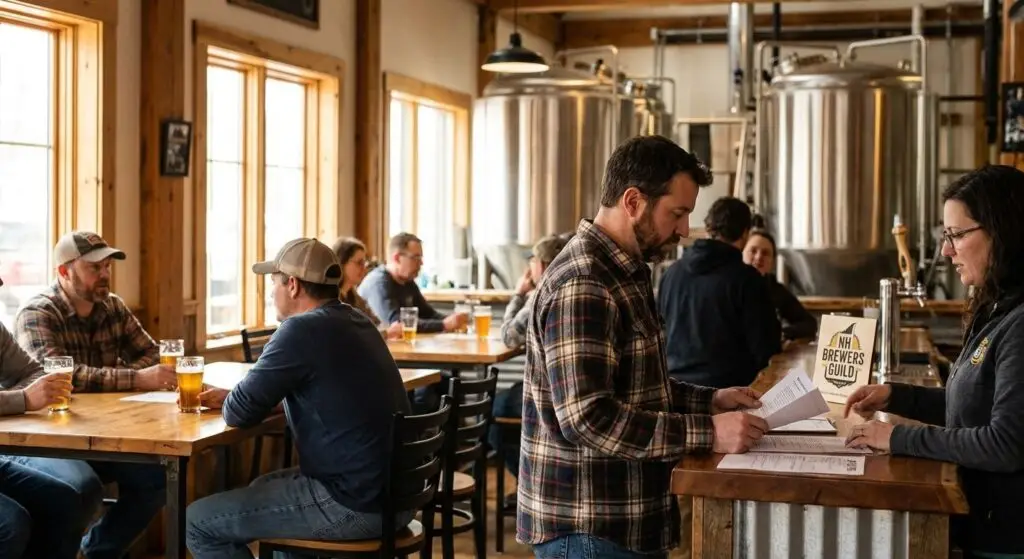
New Hampshire brewery business insurance bundles general liability, liquor liability, property, and workers' compensation into one package sized for taproom pours, fermentation equipment, and beer distribution. Breweries carry risks a standard small-business policy doesn't touch — spoiled batches, keg deliveries, and customers who overserve themselves on a Friday night flight.
- Business insurance for breweries NH must include liquor liability if you pour on-site under an NH Liquor Commission license.
- A Business Owner’s Policy (BOP) bundles general liability and property but usually excludes liquor liability and equipment breakdown — add both.
- Fermentation tanks, chillers, and canning lines need equipment breakdown coverage, not just standard property coverage.
- Workers’ comp in New Hampshire is required once you have employees, including part-time taproom staff.
- Commercial auto covers keg and case deliveries — a personal auto policy won’t pay a claim from a distribution run.
Why this matters for New Hampshire breweries
Breweries stack three businesses into one building: a manufacturing operation, a restaurant-style taproom, and often a distribution fleet. Each piece has its own claim history and its own coverage gap.
Any brewery pouring pints on-premise under an NH Liquor Commission license needs liquor liability — general liability alone won't cover a claim tied to alcohol service, even if the injury happens in your own building. Add self-distribution to local bars and restaurants and you've added commercial auto exposure the day the first keg goes out the door.
Equipment is the other blind spot. A standard property policy pays for fire and theft, but a cracked glycol line or a fermenter that fails mid-batch is a mechanical breakdown — a different coverage, and one a lot of breweries in 2026 find out they don't have only after the loss.
Insure your taproom and pour risk first
Start with liquor liability, since it's the coverage most breweries skip or underbuy. If you serve beer on-site — even just flights in a small tasting room — this is not optional in practice.
- Confirm your NH Liquor Commission license type and match the liquor liability limit to it
- Check whether special event permits (beer gardens, festivals, farmers markets) are automatically covered or need a rider
- Review host liquor liability separately if you allow outside catering or private events
- Ask whether the policy covers assault-and-battery claims tied to overserved patrons — a common exclusion
- Confirm coverage extends to any outdoor seating, patio, or beer garden area
A quick review of your current taproom setup against your policy language catches most of these gaps before a claim does.
Cover your brewing equipment and property
Fermentation tanks, glycol chillers, canning and kegging lines, and walk-in coolers are the most expensive assets on the property — and the ones most likely to be underinsured on replacement cost.
- List every major piece of equipment with current replacement value, not purchase price
- Add equipment breakdown coverage as an endorsement — standard property policies typically exclude mechanical failure
- Cover spoilage separately if a chiller failure or power outage ruins a batch or a full tank
- Confirm business personal property limits include grain, hops, and packaging inventory on hand
- Check whether leased brewing equipment needs to be named separately
Owners running a full production line usually find this is where a general liability policy alone leaves the biggest hole. A general liability policy built for New Hampshire small businesses covers third-party injury and property damage, but it won't touch your own equipment losses — that's a separate conversation worth having early.
Protect against contamination and product recalls
A bad batch that reaches distributors or retail shelves is a different problem than a spilled beer in the taproom — it's a product liability and recall issue.
- Confirm product liability limits cover distributed cans and kegs, not just on-premise sales
- Ask whether recall expense coverage pays for the cost of pulling product from shelves
- Check contamination coverage for ingredient-sourcing issues outside your control
- Review whether your policy covers third-party contract brewing if you brew for another label
Set up workers' compensation for brewery staff
New Hampshire requires workers' compensation once you have employees — brewers, taproom staff, and delivery drivers all count, including part-timers pouring flights on weekends.
- Classify brewers and cellar staff correctly — production roles carry different rates than taproom service
- Include seasonal or part-time taproom staff in your payroll count for the policy
- Cover delivery drivers under the same policy if they're employees, not contractors
- Confirm coverage for injuries tied to heavy lifting, grain handling, and cleaning chemicals
A workers' compensation policy for New Hampshire small businesses is the faster path here — a quick call gets your payroll classified correctly instead of guessing at rates.
Insure your delivery and distribution vehicles
If you self-distribute to bars, restaurants, or retail accounts, any vehicle hauling kegs or cases needs commercial auto — not a personal policy with a business rider bolted on.
- Cover every vehicle used for deliveries, including a personal truck used part-time for the business
- Add cargo coverage for kegs, cases, and equipment in transit
- Confirm liability limits match the risk of driving loaded routes daily, not occasional trips
- Review hired and non-owned auto coverage if staff use their own vehicles for pickups
Commercial auto insurance for New Hampshire business fleets covers everything from a single delivery van to a small fleet, and it's built around exactly this kind of route-based exposure.
Add cyber liability for online orders and POS
Most taprooms run a point-of-sale system, online merch or growler-club orders, and customer data through loyalty programs — all of it exposed if a breach hits.
- Confirm coverage for a POS breach that exposes customer payment data
- Check whether the policy covers the cost of notifying customers after a breach, as most state laws require
- Review coverage for ransomware or system downtime that stops taproom sales
Cyber liability insurance for New Hampshire small businesses is worth adding once you're taking cards and running any online ordering, even a simple growler-club signup.
Consider business interruption coverage
A fire, flood, or equipment failure that shuts the taproom or halts brewing for weeks is a bigger financial hit than the physical damage itself.
- Confirm the policy covers lost income during rebuild or equipment replacement, not just repair costs
- Check the waiting period before payments start
- Review whether the coverage extends to lost distribution contracts during a shutdown
Bundle it into one policy as the faster path
Once you've reviewed each piece separately, bundling general liability, property, and liquor liability into one package usually costs less than buying each coverage standalone and cuts down on gaps between policies.
Start your brewery insurance review
Call, text, or start a quote for your taproom and production coverage.
Comparing coverage options for NH breweries
| Option | Best for | Key limitation |
|---|---|---|
| Standard BOP only | A small taproom with no self-distribution | Excludes liquor liability and equipment breakdown by default |
| BOP + liquor liability rider | Any brewery pouring on-site | Doesn't cover product recall or distribution vehicles |
| Full brewery package (GL, liquor, property, equipment breakdown, workers' comp) | Breweries with a taproom, production line, and staff | Requires a policy review to size limits correctly |
| Separate standalone policies (GL, auto, workers' comp bought individually) | Breweries with unusual risk mixes, like contract brewing | Costs more overall and creates coverage gaps at the seams |
The full brewery package wins for any operation pouring beer on-site and running a production floor — the standalone approach only makes sense for edge cases like third-party contract brewing.
Common mistakes NH breweries make
- Treating liquor liability as optional because general liability sounds like it covers everything — it doesn't cover alcohol-service claims
- Insuring equipment at purchase price instead of replacement cost, which leaves a shortfall when a five-year-old fermenter needs replacing at current prices
- Using a personal vehicle for keg runs without adding commercial auto, which can void a claim entirely
- Skipping workers' comp for part-time taproom staff, assuming it only applies to full-time brewers
- Forgetting spoilage coverage and finding out only after a chiller failure wipes out a full tank of finished beer
FAQ
What insurance does a brewery need in New Hampshire?
A New Hampshire brewery needs general liability, liquor liability if pouring on-site, property coverage with equipment breakdown, workers’ compensation for employees, and commercial auto if self-distributing. A taproom without self-distribution can often skip commercial auto, but the rest apply to nearly every operation.
Is liquor liability required for breweries in NH?
Any brewery pouring beer on-site under an NH Liquor Commission license needs liquor liability coverage, since general liability policies typically exclude alcohol-service claims. Special event permits like beer gardens or festivals often need a separate rider.
Does a standard business owner’s policy cover brewery equipment?
A standard BOP covers fire and theft but usually excludes mechanical breakdown of fermenters, chillers, and canning lines. Equipment breakdown coverage has to be added as an endorsement to close that gap.
Do I need workers’ comp for part-time taproom staff?
Yes, New Hampshire requires workers’ compensation once you have employees, and part-time or seasonal taproom staff count toward that requirement. Classifying production staff separately from taproom staff usually affects the rate.
What insurance covers beer delivery vehicles?
Commercial auto insurance covers vehicles used to deliver kegs and cases to bars, restaurants, or retail accounts. A personal auto policy generally won’t pay a claim tied to business deliveries, even if the vehicle is personally owned.
Does brewery insurance cover a bad batch or contamination?
Product liability coverage handles claims tied to a contaminated or spoiled batch that reaches customers, and recall expense coverage pays for pulling product from shelves. Standard general liability alone doesn’t automatically include recall costs.
How much does business insurance for breweries in NH cost?
Cost depends on taproom size, production volume, payroll, and whether you self-distribute, so pricing varies by operation. A policy review is the fastest way to get an accurate number for your specific setup.
Can a brewery combine liquor liability and general liability into one policy?
Yes, most breweries bundle general liability, property, and liquor liability into one package, which typically costs less than buying each coverage as a standalone policy. Bundling also reduces gaps that show up when coverages are purchased separately.
One last thing
The gap that catches the most breweries off guard isn't liquor liability — it's equipment breakdown. Most owners assume a fermenter failure falls under standard property coverage, and it doesn't; mechanical breakdown is a separate line most policies exclude by default in 2026. Check that one endorsement before anything else.
Related guides
- General liability insurance for New Hampshire small businesses
- Workers' compensation insurance for New Hampshire small businesses
- Commercial auto insurance for New Hampshire business fleets
- Cyber liability insurance for New Hampshire small businesses
- Business insurance for restaurants in New Hampshire