
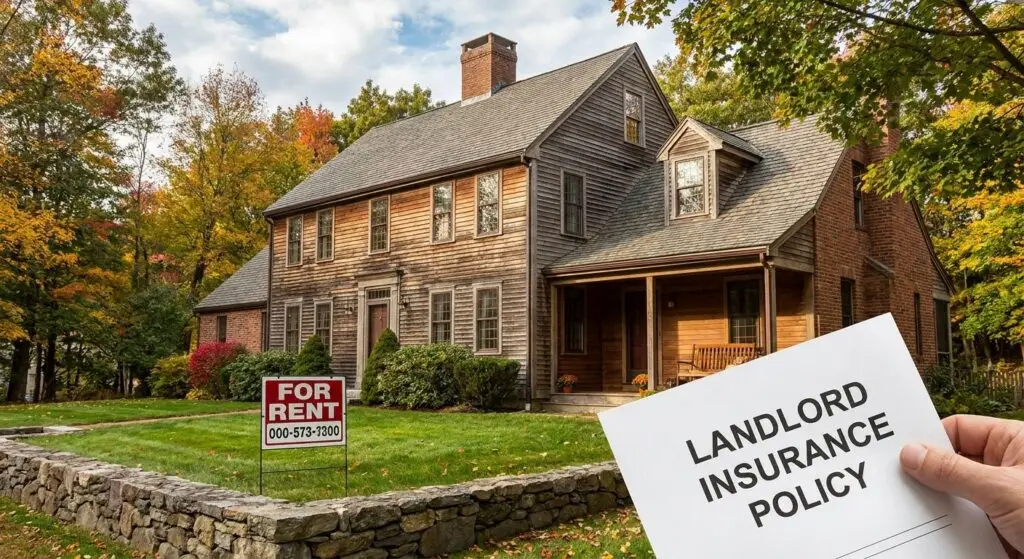
If you rent out a house, condo, or in-law unit anywhere from Manchester to the Lakes Region, a standard homeowner's policy will not cover you once tenants move in — landlord insurance for New Hampshire rental property owners fills that gap with dwelling, liability, and lost-rent protection built for a property you don't live in full-time.
- Landlord insurance in New Hampshire replaces your homeowner’s policy the day a tenant signs a lease — Buy before move-in, not after.
- Loss-of-rent coverage typically pays fair rental value for up to 12 months during a covered repair, per standard landlord (DP-3) forms.
- Out-of-state owners need a policy built for remote management, not a policy borrowed from a primary-residence homeowner plan.
- Wood-stove heated rentals need a stove-specific endorsement in 2026 or the insurer can deny a fire claim outright.
- Bundling landlord coverage with auto can lower the total bill, but always compare the standalone landlord quote first.
Why this matters
A homeowner's policy assumes you live in the house. The moment you hand over keys to a tenant, that assumption breaks, and most standard HO-3 policies exclude damage, liability, or lost income tied to a rented unit. New Hampshire has no state mandate forcing landlords to carry a specific policy, but mortgage lenders almost always require dwelling coverage, and any landlord without liability protection is exposed to a tenant injury claim with no policy standing behind them.
Rental property in New Hampshire also carries specific risk patterns: older housing stock with wood stoves, seasonal vacation rentals owned by out-of-state buyers, and a growing number of in-law apartments added to single-family homes for extra income. Each of those changes what your policy needs to do in 2026, and generic advice from a national insurer's website rarely accounts for New Hampshire's mix of coastal, lake, and rural inland properties.
Who this is for
This guide is for anyone who owns residential property in New Hampshire and rents some or all of it out — a single-family home with an in-law apartment rented to a tenant, a full house rental in a college town like Durham, a vacation property near Lake Winnipesaukee rented by the week, or a multi-unit building held as an investment. It's not for owner-occupants who simply have a roommate paying informal rent under the same insured household — that's usually still covered under a standard homeowner's policy with a rider, not a landlord policy.
What to look for in landlord insurance for New Hampshire
Dwelling coverage sized to rebuild cost, not market value
Rebuild cost in New Hampshire runs higher than assessed market value in most towns because labor and materials pricing doesn't track local real estate swings. A policy underinsured against actual rebuild cost leaves you covering the difference out of pocket after a total loss in 2026's construction market.
Loss of rental income
If a covered event — fire, wind, burst pipe — makes the unit uninhabitable, loss-of-rent coverage replaces the rent you'd have collected while repairs happen. Landlord policies typically extend fair rental value coverage for the repair period, often capped near 12 months, and without it you're covering a mortgage with zero income coming in.
Liability limits that match tenant injury exposure
A tenant or guest injury on your rental property is the single biggest liability exposure a landlord carries. Most landlord policies start liability at $300,000, with a personal umbrella policy layering on $1 million or more for landlords with multiple units or higher-traffic properties.
Coverage for mixed-use and owner-occupied setups
A home with an in-law apartment rented separately needs a policy that treats the rented portion differently from the owner-occupied portion — a plain homeowner's policy usually won't extend liability or dwelling coverage correctly to the rented unit.
Vacancy and seasonal-use gaps
Properties sitting empty between tenants, or vacation rentals used only part of the year, often trigger vacancy clauses that reduce or void coverage after 30 or 60 days unoccupied. Out-of-state owners managing a New Hampshire rental remotely are the group most likely to get caught by this.
Heating system endorsements
Wood stoves, older oil furnaces, and non-standard heating setups are common in New Hampshire's older rental housing stock, and insurers frequently require a specific endorsement and inspection before covering fire loss tied to that equipment.
Scenarios that change your landlord policy
The in-law apartment landlord — the common case. Renting out an attached apartment while living in the main house is one of the most frequent landlord setups in New Hampshire in 2026, and it needs a policy that separately rates the rented unit's liability and dwelling exposure. One overlooked detail: standard homeowner endorsements often cap rented-unit liability far below what a full landlord policy provides. Buy — a policy built for homes with in-law apartments closes that gap directly.
The out-of-state owner — the wildcard. Owners who bought a New Hampshire vacation or rental property while living elsewhere face the highest risk of a claims-handling mismatch, because their policy may assume local, hands-on management that doesn't exist. Response time on a burst pipe or storm claim matters more when you're not there to catch it early. Consider — a policy structured for out-of-state owners with clear claims contact procedures before listing the property for rent in 2026.
The wood-stove heated rental — the safe pick once endorsed. Wood stoves show up constantly in older New Hampshire rental stock, especially in the North Country and Lakes Region, and an un-endorsed stove is one of the fastest ways to get a fire claim denied. A required inspection typically confirms clearance distances and chimney condition before the insurer will add the endorsement. Buy — confirm wood stove coverage is active before the first tenant moves in for heating season.
The bundler — worth pricing, not assuming. Combining landlord coverage with a personal auto policy can lower the total premium, but the discount doesn't automatically beat a standalone landlord quote from a different carrier. Run both numbers before locking in. Consider — check bundling home and auto against a standalone landlord quote side by side.
Get your landlord policy reviewed
Quick review of your current coverage against New Hampshire rental risks.
What to avoid
- A homeowner's policy with a rental rider bolted on. It often looks cheaper on paper, but liability limits and loss-of-rent provisions rarely match a true landlord policy line for line.
- Assuming the tenant's renters insurance covers your building. Renters insurance protects the tenant's belongings and personal liability, not your dwelling, your roof, or your loss of rent.
- Letting a vacancy run past the policy's stated limit. A unit sitting empty for 60-90 days between tenants can reduce coverage to almost nothing right when an empty building is most vulnerable to vandalism or frozen pipes.
Verdict comparison
| Scenario | Best-fit policy feature | Watch for | Verdict |
|---|---|---|---|
| In-law apartment rental | Separate liability rating for the rented unit | Homeowner rider capping liability too low | Buy |
| Out-of-state owner | Remote-management claims process | Vacancy clause triggering during off-season | Consider |
| Wood-stove heated rental | Stove-specific endorsement + inspection | Fire claim denial without the endorsement | Buy |
| Bundled landlord + auto | Multi-policy discount | Bundle discount not beating standalone quote | Consider |
FAQ
What is landlord insurance in New Hampshire?
Landlord insurance in New Hampshire covers a rental property’s dwelling, liability, and lost rental income the way a homeowner’s policy does for an owner-occupied home. It replaces your homeowner’s policy the moment the property is rented out rather than lived in.
Is landlord insurance required by law in New Hampshire?
New Hampshire doesn’t legally mandate landlord insurance, but nearly every mortgage lender requires dwelling coverage on a financed rental property. Skipping liability coverage on top of that leaves a landlord personally exposed to a tenant injury claim.
Does landlord insurance cover lost rent in New Hampshire?
Yes, most landlord policies include loss-of-rent coverage that pays fair rental value while the property is being repaired after a covered loss, often for up to 12 months. It doesn’t apply if the vacancy is from an empty unit between tenants rather than damage.
Can I keep my homeowner’s policy after renting out my New Hampshire property?
No, a standard homeowner’s policy typically excludes damage and liability tied to a tenant-occupied unit once it’s no longer your primary residence. Insurers usually require a switch to a landlord (dwelling fire) policy before or right after the lease starts.
Does landlord insurance cover a tenant’s belongings?
No, landlord insurance covers your building, your liability, and your lost rental income, not the tenant’s personal property. Tenants need their own renters insurance policy to cover their belongings.
What’s the difference between landlord insurance and homeowners insurance?
Homeowners insurance assumes you live in the property full-time, while landlord insurance is built for a property occupied by tenants and includes liability and lost-rent provisions homeowner policies don’t carry. The two aren’t interchangeable once a lease is signed.
Does landlord insurance cover a vacant rental in New Hampshire?
Coverage during a vacancy is limited and usually capped after 30 to 60 days of the unit sitting empty, depending on the policy. Landlords planning a longer vacancy, such as a full renovation between tenants, should ask about a vacant-property endorsement before the standard vacancy limit runs out.
How much does landlord insurance cost in New Hampshire in 2026?
Cost depends on the property’s age, heating system, location, and the liability limit chosen, so there’s no single flat rate across New Hampshire in 2026. A quick coverage review against your specific property is the fastest way to get an accurate number.
One last thing
The detail landlords miss most often isn't the liability limit or the dwelling amount — it's the vacancy clause buried in the policy language. A property that sits empty for a repaint or a slow tenant search can lose most of its coverage right when an empty building is at its most vulnerable to a burst pipe or a break-in. Check the vacancy window on your current policy before you assume you're covered between leases in 2026.
Related guides