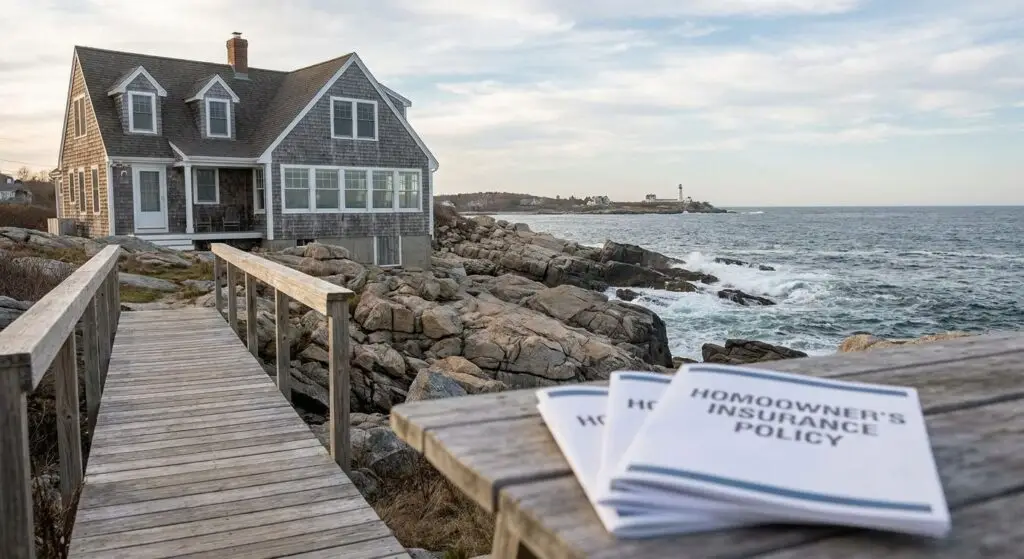
New Hampshire coastal property owners need home insurance built around wind, storm surge, and flood exposure that a standard inland policy simply doesn't price for, with the goal of protecting the equity in a Seacoast home from Hampton Beach to Rye to Seabrook. A house three blocks from the Atlantic carries different risk than a house in Concord, and the policy has to reflect that gap in construction, deductibles, and flood-zone status.
- Home insurance New Hampshire coastal property owners need combines an HO-3 policy with separate flood coverage, not one bundled product.
- Wind and hail on Seacoast homes often carries a percentage deductible instead of a flat dollar amount.
- FEMA flood maps along Rockingham County determine whether NFIP or private flood coverage is required, not optional.
- Rebuild costs on 1920s-1960s Seacoast cottages routinely exceed the original purchase price by 2026 lumber and labor rates.
- Umbrella coverage matters more on the coast because liability exposure (docks, seawalls, rental guests) runs higher than inland homes.
Why home insurance matters for New Hampshire coastal properties
New Hampshire's coastline is short, only about 18 miles, but it concentrates some of the highest home values and highest storm exposure in the state. Homes in Hampton, Rye, North Hampton, and Seabrook sit inside or near FEMA Special Flood Hazard Areas, and mortgage lenders in those zones require flood insurance as a condition of the loan, not a suggestion.
Nor'easters and the occasional hurricane remnant push storm surge into low-lying Seacoast neighborhoods almost every winter. A standard homeowners policy excludes flood water entirely, so the coverage gap on an uninsured coastal home isn't small, it's total for water damage from surge or tidal flooding. That's the reason coastal NH policies look different from a policy in Manchester or Nashua, and why getting the structure right in 2026 matters before the next storm season, not after.
Confirm your flood zone status
Before pricing anything, find out whether the property sits in an AE, VE, or X flood zone on the current FEMA map. Zone determines whether flood insurance is mandatory, what it costs to carry, and how elevation certificates affect the rate.
- Pull the FEMA Flood Map Service Center report for the parcel address
- Ask the town assessor's office for base flood elevation data
- Get an elevation certificate if the home was built before 1975
- Compare NFIP zone status against private flood insurer maps, which sometimes differ
- Check flood insurance for New Hampshire lake homes for how flood policies are structured separately from homeowners coverage
Understand wind and hail deductibles
Coastal New Hampshire homeowners policies frequently carry a separate wind/hail deductible, often written as a percentage of dwelling coverage rather than a flat dollar figure. A 2% deductible on a $500,000 dwelling limit means $10,000 out of pocket before the policy pays a claim.
- Read the declarations page for a named-storm or hurricane deductible clause
- Confirm whether the percentage applies per occurrence or per season
- Ask whether impact-resistant roofing or shutters reduce the wind deductible
- Compare the wind deductible against your emergency savings, not just the premium
Document your dwelling replacement cost
Older Seacoast cottages and converted summer camps often carry outdated replacement cost estimates. Rebuilding to current code, with updated electrical, plumbing, and flood-vent requirements, costs more than the number on a policy written a decade ago.
- Get a contractor estimate for full rebuild cost, not market value
- Factor in New Hampshire building code updates for flood-zone construction
- Ask your agent to run a replacement cost estimator specific to Seacoast labor rates
- Update coverage after any renovation, addition, or roof replacement
Add water backup and sump pump coverage
Groundwater and sewer backup are common on low-lying coastal lots, and standard homeowners policies typically exclude both unless you add an endorsement. This is a separate coverage line from flood insurance and it's inexpensive relative to the exposure.
- Add water backup and sump pump overflow endorsement
- Confirm the endorsement's dollar limit is enough to cover finished basements
- Check whether the endorsement covers mechanical failure of a sump pump during a power outage
- Pair with a generator if the home relies on an electric sump pump
Review liability and umbrella limits
Coastal properties carry higher liability exposure than the average inland home, docks, seawalls, guest traffic, and short-term rental use all raise the odds of a claim. Standard homeowners liability limits, often $300,000, may not be enough.
- Raise personal liability to at least $500,000 on the base policy
- Add an umbrella policy for coverage above the homeowners and auto limits
- Disclose any dock, boat lift, or seasonal rental use to your agent
- Review umbrella insurance for New Hampshire homeowners if the property hosts guests or renters regularly
Check for older-home and grandfathered issues
Many Seacoast homes predate current flood-zone building codes. Knob-and-tube wiring, non-elevated mechanical systems, and outdated plumbing can trigger coverage exclusions or higher premiums.
- Ask whether the home's electrical panel and wiring meet current insurability standards
- Confirm whether mechanical systems (furnace, water heater) sit below base flood elevation
- Get a four-point inspection if the home is 30+ years old
- Budget for elevating mechanicals if a rebuild or major renovation is planned
Bundle policies to control premium creep
Coastal NH premiums have moved up steadily as reinsurance costs and storm frequency both increase. Bundling home with auto, or adding a secondary vacation property to the same carrier, is one of the few realistic levers a homeowner controls directly.
- Bundle homeowners and auto with one carrier for a multi-policy discount
- Ask about discounts for monitored alarm and water-leak sensors
- Request a coastal wind-mitigation credit if the roof was replaced with rated materials
- Compare renewal quotes every two to three years, not just at the first sign of a rate hike
Reassess coverage every renewal
A policy written five years ago rarely reflects 2026 rebuild costs, updated flood maps, or a change in how the home is used. Coastal properties, more than inland ones, need an annual second look.
- Re-run replacement cost estimates at every renewal
- Recheck FEMA flood zone status, maps get updated periodically
- Confirm liability limits still match how the property is used (seasonal, rental, primary)
- Talk through how to determine your home insurance coverage needs in New Hampshire with an agent rather than auto-renewing
Comparison: coverage options for coastal New Hampshire homes
| Option | Best for | Key limitation |
|---|---|---|
| Standard HO-3 homeowners policy | Primary residences outside the flood zone | Excludes flood water and often sublimits wind/hail |
| NFIP flood policy | Homes in FEMA-mapped AE or VE zones, required by most lenders | Coverage caps are set by federal program limits |
| Private flood insurance | Homes wanting higher limits or faster claims than NFIP | Availability varies by carrier and by zone |
| Umbrella policy | Coastal homeowners with docks, rentals, or guest exposure | Doesn't replace flood or wind coverage, sits above the base policy |
The straightforward read for 2026: a coastal New Hampshire home almost always needs an HO-3 policy plus a separate flood policy, not one bundled product that claims to cover everything.
Get your coastal NH policy reviewed
A quick review checks flood zone status, wind deductibles, and rebuild cost together.
Common mistakes coastal NH homeowners make
- Assuming distance from the ocean means no flood risk. Storm surge and tidal backup reach properties several blocks inland along the Seacoast, not just waterfront lots.
- Reading the wind deductible as a flat number. A 2% named-storm deductible on a $600,000 dwelling is $12,000, not the $500 flat deductible on the rest of the policy.
- Letting a vacation or seasonal property carry a primary-residence policy. Seasonal use changes liability and vacancy terms, and misclassifying it can jeopardize a claim; check vacation home insurance for out-of-state owners in New Hampshire if the home isn't occupied year-round.
- Underinsuring an older Seacoast cottage at market value instead of rebuild cost. Land value and rebuild cost are different numbers, and only rebuild cost matters for the dwelling limit.
- Skipping high-value home insurance for New Hampshire homeowners on a coastal property near or above standard policy caps, leaving a real coverage gap on the most expensive asset most families own.
FAQ
Do I need flood insurance for a New Hampshire coastal home?
If the home sits in a FEMA-designated AE or VE flood zone, most mortgage lenders require flood insurance as a loan condition in 2026. Homes just outside the mapped zone can still flood during storm surge, so many Seacoast owners carry it voluntarily.
Is home insurance more expensive on the New Hampshire coast?
Yes, coastal properties typically carry higher premiums than inland homes because of wind, hail, and flood exposure. Percentage-based wind deductibles also raise the out-of-pocket cost at claim time compared to a flat inland deductible.
What’s the difference between NFIP and private flood insurance in New Hampshire?
NFIP is the federal flood program with set coverage caps, while private flood insurers can offer higher limits and sometimes faster claims processing. Availability of private flood coverage depends on the specific flood zone and carrier.
Does a standard homeowners policy cover storm surge in New Hampshire?
No, storm surge is flood water and standard HO-3 policies exclude flood damage entirely. A separate NFIP or private flood policy is required to cover surge damage.
How much liability coverage do I need for a coastal NH property with a dock?
Most agents recommend at least $500,000 in personal liability, with an umbrella policy layered on top if the property has a dock, boat lift, or hosts guests regularly. Disclose water-adjacent features to your carrier so the policy actually covers them.
Can I bundle flood insurance with my homeowners policy in New Hampshire?
Flood insurance is written as a separate policy from homeowners coverage, whether through NFIP or a private flood carrier, and it isn’t bundled into a standard HO-3 policy. Some carriers do offer multi-policy discounts when both are placed through the same agency.
What happens if I let my flood insurance lapse on a coastal home?
A lapse can trigger a waiting period before new coverage takes effect, often 30 days under NFIP rules, leaving the home uninsured against flood during that window. Lenders may also flag the lapse as a loan compliance issue.
One last thing
The detail most coastal New Hampshire homeowners miss isn't the flood zone, it's the wind deductible math. A percentage deductible sounds small on paper until it's applied to a $700,000 dwelling limit after a nor'easter, and by then it's too late to change the policy structure. Run that number now, in 2026, while there's time to adjust the deductible or add savings to cover it.
Related guides
- Flood insurance for New Hampshire lake homes
- Vacation home insurance for out-of-state owners in New Hampshire
- High-value home insurance for New Hampshire homeowners
- Umbrella insurance for New Hampshire homeowners
- How to determine home insurance coverage needs in New Hampshire