
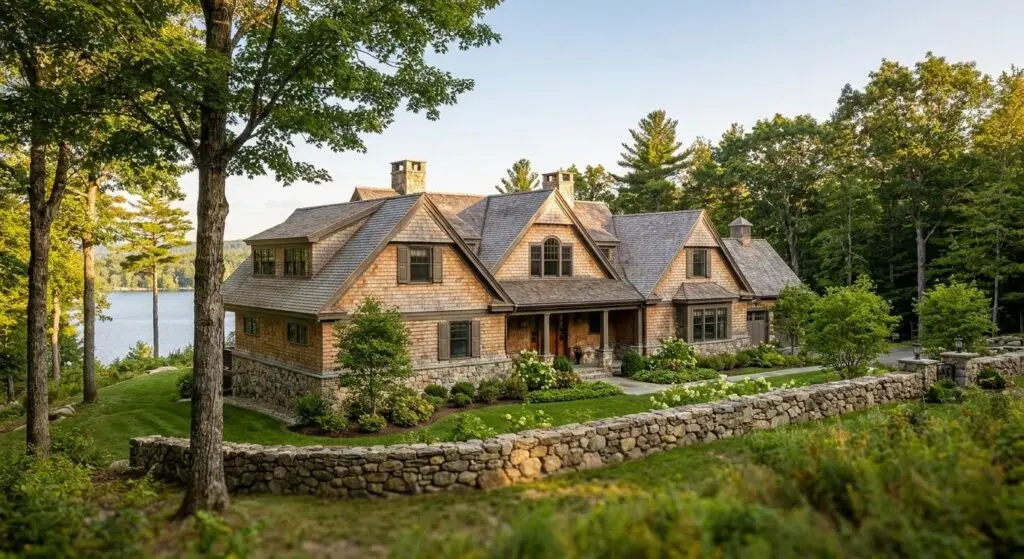
High-value home insurance for New Hampshire homeowners fills the gap a standard HO-3 policy leaves open: full rebuild cost on custom or lakefront construction, scheduled coverage for valuables like jewelry and art, and liability limits sized to match real assets. Homes with high-end finishes, waterfront exposure, or detached structures need a different set of endorsements than a standard tract house, and this guide covers which ones matter and in what order to add them.
- High value home insurance in New Hampshire means guaranteed or extended replacement cost, not market value coverage.
- Schedule jewelry, art, and collectibles separately — standard homeowners policies cap unscheduled property claims low.
- Add an umbrella policy before a lawsuit forces the issue; it layers liability above home and auto limits.
- Home insurance excludes flood damage everywhere in New Hampshire, including lakefront homes outside mapped zones.
- The Mello Agency reviews high-value New Hampshire policies line by line and flags gaps standard quotes miss.
Why high-value home insurance matters for New Hampshire homeowners
A standard homeowners policy is built around an average rebuild cost for an average house. Once you own a custom build, a lakefront property, or a home with detached guest quarters, that average stops applying and the dwelling limit on a stock policy quietly falls behind actual rebuild cost.
The fix starts with running a real coverage needs assessment instead of accepting whatever limit a quote engine assigns by default. New Hampshire adds its own wrinkles: granite ledge and rock excavation drive up rebuild costs, well and septic systems need their own replacement estimates, and snow-load roof framing costs more than standard framing in most other states. None of that shows up in a market-value comp.
High-value coverage isn't a luxury add-on — it's the difference between a claim check that rebuilds the house and one that leaves a six-figure gap.
Calculate your true rebuild cost, not market value
Market value and rebuild cost move independently, especially in New Hampshire's tight lake and coastal markets where land value inflates the sale price without touching what it costs to rebuild the structure.
- Get a contractor's per-square-foot rebuild estimate, not a real estate market comparison.
- Add line items for custom features: stone facades, high-end kitchens, finished walkouts, in-ground pools.
- Price in New Hampshire-specific rebuild costs: well and septic replacement, snow-load roof framing, foundation work on ledge.
- Recalculate every renewal — 2026 material and labor costs are not the same as 2020 or even 2024 costs.
- Ask for a formal replacement cost estimator run rather than a carried-forward number from last year's policy.
Schedule high-value personal property individually
Standard homeowners policies cap categories like jewelry, firearms, and fine art at low sub-limits that a single item can blow through.
- List jewelry, watches, fine art, wine collections, and firearms with individual appraised values.
- Update appraisals every 3-5 years, sooner after any major acquisition or upgrade.
- Photograph and inventory every scheduled item so a claim doesn't start from scratch.
- Confirm whether the schedule covers accidental loss, not just theft or fire.
Layer liability protection with an umbrella policy
A lawsuit doesn't stop at your home policy's liability limit, and high-value homeowners are more visible targets for claims tied to pools, docks, and guest injuries.
Umbrella insurance sits above both home and auto liability limits and picks up where those policies stop paying.
- Extends liability coverage above home and auto limits in one combined layer.
- Covers legal defense costs, which erode standard liability limits fast.
- Extends to watercraft, rental units, and off-premises incidents in many policies.
- Matters more with pools, docks, trampolines, or dogs on the property.
Cover flood and water risk separately
Home insurance excludes flood damage everywhere in New Hampshire — this holds true regardless of dwelling limit or carrier.
Flood insurance is a separate policy, and lakefront or river-adjacent homes carry real exposure even outside FEMA-mapped high-risk zones.
- Add flood coverage even if the home sits outside a mapped Special Flood Hazard Area.
- Add water and sewer backup coverage for finished basements and walkouts.
- Review ice dam and freeze damage terms — New Hampshire winters generate frequent claims in this category.
- Confirm the flood policy's effective date; most carry a waiting period before coverage starts.
Name and insure detached structures individually
Docks, boathouses, guest cottages, and detached garages often go unlisted on a standard policy and default to a small percentage of the main dwelling limit.
- Confirm each detached structure carries its own stated limit, not a blanket percentage.
- Flag business-use exclusions if a guest house or in-law space gets rented out.
- Add equipment breakdown coverage for generators, well pumps, and geothermal systems.
- Check dock and boathouse coverage against actual replacement cost, not original purchase price.
Review your policy every renewal
Rebuild costs, personal property values, and liability exposure all shift year to year, and a policy that fit in 2023 rarely still fits in 2026 without adjustment.
- Re-run the rebuild cost estimate after any renovation, even a kitchen remodel.
- Re-appraise scheduled property on a set schedule, not only after a loss.
- Revisit liability limits after acquiring a pool, dock, rental unit, or dog.
- Compare renewal terms against current market offerings rather than auto-renewing.
Work with an independent agent who places high-value New Hampshire homes
Manual review catches most gaps, but matching a custom or waterfront home to the right carrier and endorsement stack takes market access most homeowners don't have on their own. The Mello Agency reviews high-value home insurance policies for New Hampshire homeowners line by line, flags sub-limits before they become claim disputes, and places coverage with carriers built for custom and waterfront risk.
Get a quick coverage review
Talk through your dwelling limit, scheduled property, and liability gaps.
Comparing high-value home insurance options
| Option | Best for | Key limitation |
|---|---|---|
| Standard HO-3 policy | Homes with standard finishes and typical construction | Caps rebuild payout at the stated dwelling limit, no cushion for overruns |
| Extended replacement cost endorsement | Homeowners who want a cushion above the stated limit | Overage is usually capped at a fixed percentage, still finite |
| Guaranteed replacement cost endorsement | Custom and high-end homes with unusual construction | Not offered by every carrier; requires accurate rebuild cost data upfront |
| Specialty high-net-worth carrier policy | Homes with extensive scheduled property, waterfront exposure, or multiple structures | Fewer carriers write these; usually requires an independent agent to place |
| Umbrella liability add-on | Owners with pools, docks, dogs, rental units, or high visibility assets | Liability only — doesn't cover the dwelling itself |
Verdict: guaranteed replacement cost paired with an umbrella policy is the strongest combination for custom-built New Hampshire homes, and standard HO-3 alone is the weakest fit once rebuild cost climbs past a stock dwelling limit.
Common mistakes New Hampshire high-value homeowners make
- Insuring to market value instead of rebuild cost — sale price and rebuild cost move independently in tight lake and coastal markets.
- Leaving jewelry and collectibles unscheduled until after a loss, when it's too late to add coverage retroactively.
- Skipping flood insurance because the home sits outside a mapped flood zone, ignoring real lakefront exposure.
- Underestimating detached structures — docks, guest houses, and garages often go unlisted or underinsured.
- Renewing the same dwelling limit year after year without adjusting for construction cost inflation into 2026.
FAQ
What’s the best high value home insurance in New Hampshire?
The best high-value home insurance in New Hampshire matches guaranteed or extended replacement cost with liability limits sized to your actual assets. The right carrier depends on your home’s construction, location, and whether it includes waterfront or detached structures, which is why an independent review beats a generic quote.
Is high value home insurance more expensive than standard homeowners insurance?
Yes, high-value home insurance typically costs more than standard homeowners coverage because it insures higher dwelling limits, scheduled property, and higher liability limits. The increase reflects the value being protected, not an arbitrary rate hike.
Does high-value home insurance cover flood damage in New Hampshire?
No, flood damage is excluded from standard and high-value home insurance policies everywhere in New Hampshire. Flood coverage requires a separate policy, and lakefront homes carry real exposure even outside mapped flood zones.
How much dwelling coverage do I need for a custom-built New Hampshire home?
Dwelling coverage should match your home’s full rebuild cost, not its market value. Get a contractor’s rebuild estimate re-run every renewal, since 2026 labor and material costs won’t match prior years.
What is scheduled personal property coverage?
Scheduled personal property coverage insures individual high-value items like jewelry, art, and firearms at their appraised value, above the low sub-limits built into a standard homeowners policy. Each item is listed with its own coverage amount.
Do I need an umbrella policy with high-value home insurance?
Yes if you own a pool, dock, rental unit, or dog, or simply carry more visible assets that raise lawsuit exposure. An umbrella policy extends liability coverage above your home and auto limits in one combined layer.
What’s the difference between extended and guaranteed replacement cost?
Extended replacement cost adds a fixed percentage cushion above your stated dwelling limit, while guaranteed replacement cost pays the full rebuild cost regardless of the stated limit. Guaranteed coverage fits custom and high-end homes better because rebuild costs are harder to estimate precisely.
How often should I review a high-value home insurance policy?
Review the policy at every renewal, and immediately after any renovation, appraisal update, or new acquisition like a pool or dock. Rebuild costs and asset values shift enough year to year that a policy from 2023 rarely still fits in 2026.
One last thing
Generators, well pumps, and geothermal systems fall under equipment breakdown coverage, not standard property coverage — a gap that surfaces most often after a lake-house power outage in the middle of a New Hampshire winter, right when the equipment is needed most. Check for this endorsement specifically; it rarely appears by default on a standard high-value quote.
Related guides
- Best homeowners insurance for New Hampshire lake properties
- Vacation home insurance for out-of-state owners in New Hampshire