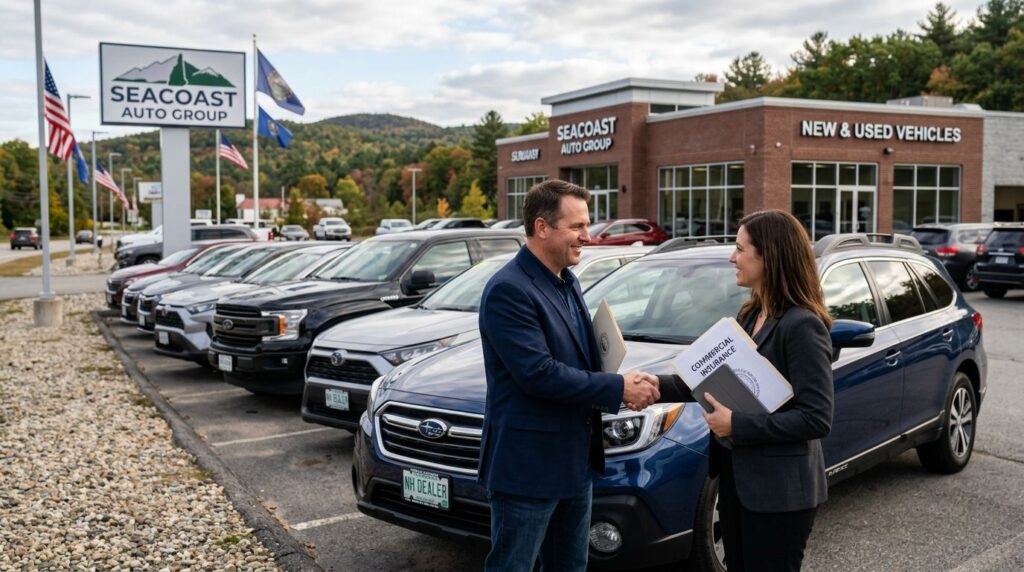
Auto dealership insurance in New Hampshire covers the risks unique to selling, storing, and test-driving vehicles you don't personally own: lot inventory, garagekeepers liability, dealer plates, and the employees who move cars around your property all day. A standard business owner's policy doesn't touch most of that — dealerships need a garage package built specifically for vehicle sales and service operations.
What separates a dealership from a typical New Hampshire small business is exposure that shifts by the hour. A car on your lot at 9am might be on a customer's test drive at noon and back in your service bay by 3pm, and each of those moments carries different liability. The Mello Agency builds dealership coverage around that movement, not around a single static address.
- Auto dealership insurance in NH combines garage liability, garagekeepers coverage, and commercial auto — a standard BOP covers none of it.
- New Hampshire requires workers’ compensation once you have employees, including a one-person sales team.
- Lot inventory is the most underinsured asset at NH dealerships, especially December through March.
- Garage liability does not cover your own tow truck or parts van — that needs separate commercial auto.
- The Mello Agency packages garage, fleet, and workers’ comp into one dealership review in 2026.
Why auto dealership insurance matters for New Hampshire dealers
A dealership's biggest financial exposure isn't the showroom — it's the lot. Inventory parked outside through a New Hampshire winter faces ice damage, plow strikes, and theft risk that a generic property policy handles poorly, if at all.
Add employees test-driving unsold vehicles, mechanics working on customer cars in your bay, and a sales floor that touches personal financial data on every credit application. That's four or five distinct liability categories stacked on one address.
New Hampshire's dealer licensing process through the Department of Safety already requires a surety bond before you get plates. Carriers then ask for garage liability and garagekeepers coverage as a matter of course, because the business insurance for New Hampshire auto repair shops risk pool and the dealership risk pool overlap heavily — both put other people's vehicles in your custody.
A dealership without garagekeepers liability is uninsured on every trade-in and every service car sitting on its lot.
Confirm your dealer license and bond before anything else
Coverage conversations go nowhere if your licensing paperwork doesn't match your operation. Fix this first in 2026.
- Verify your NH Department of Safety dealer license is active and matches your legal business name
- Confirm your surety bond amount still fits your current inventory turnover
- Document dealer plate usage per vehicle rather than blanket-assigning plates
- Keep a running log of who drives on dealer plates and why
Set inventory and garagekeepers limits to peak lot value
Garagekeepers legal liability covers vehicles in your care, custody, or control — the trade-ins and service cars that aren't yours but are your problem if something happens to them. Inventory coverage handles the vehicles you own.
- Confirm garagekeepers responds to fire, theft, and vandalism, not collision alone
- Set inventory limits at peak lot value, not average value across the year
- Add comprehensive coverage for winter weather damage — ice and plow strikes are routine NH lot claims
- Separate limits for owned inventory versus customer trade-ins awaiting resale
- Re-check limits every year as average vehicle values move
Cover test drives and demo vehicles explicitly
Every test drive puts a vehicle on a public road under your dealer plate. If a customer crashes during one, garage liability responds — a customer's personal auto policy does not extend to a car they don't own.
- Confirm your garage liability policy names test drives as a covered activity
- Copy and file a driver's license before keys change hands
- Put in writing which employees can approve a test drive without a manager
- Extend coverage to demo vehicles that sales staff drive after hours
Insure your service fleet separately
A tow truck, parts van, or customer shuttle is a business-owned vehicle, not lot inventory. Those need commercial auto insurance for New Hampshire business fleets alongside the garage policy.
- List every business-titled vehicle by VIN, not by general description
- Confirm hired and non-owned auto coverage for staff running errands in personal cars
- Check that towing and roadside riders are included if you offer pickup or delivery
- Set liability limits above the state minimum — multi-vehicle accidents exhaust minimums fast
Put workers' compensation in place before the first hire
New Hampshire requires workers' compensation for businesses with employees, with narrow exceptions. One mechanic on payroll triggers it.
- Classify service techs and sales staff under the correct NH job codes
- Confirm coverage for lift equipment, tire, and shop tool injuries
- Review claims history annually — a clean record lowers renewal cost
- Check for gaps if you use 1099 contractors for detailing or lot prep
Layer general liability under an umbrella
General liability handles slip-and-fall claims in the showroom and customer injuries on the lot. General liability insurance for New Hampshire small businesses sets the base; an umbrella extends it once a single claim could blow past those limits.
- Confirm base limits cover one serious injury claim without exhausting the policy
- Add product liability if you sell used vehicles with dealer warranties
- Add an umbrella once general liability and auto limits both reach six figures
- Revisit limits whenever inventory value or lot foot traffic jumps
Protect the financial data on every credit application
Credit apps, trade appraisals, and financing forms sit in your systems for years. Cyber liability covers the cleanup when that data leaks.
- Confirm coverage for breach notification costs under New Hampshire's data breach law
- Ask whether your financing and DMS vendor carries its own coverage
- Confirm ransomware is covered, not just data theft
- Audit which employees can open stored customer financial records
Coverage options compared for NH dealerships
| Coverage | Best for | Key limitation |
|---|---|---|
| Garage liability + garagekeepers | Lot inventory, test drives, customer vehicles in custody | Does not cover business-owned service vehicles off the lot |
| Commercial auto | Tow trucks, parts vans, shuttles | Does not extend to inventory or customer cars |
| Workers' compensation | Any dealership with employees | Mandatory in NH once you hire — not a choice |
| General liability + umbrella | Showroom and lot injury claims | Umbrella only responds after base limits are exhausted |
| Cyber liability | Dealerships storing financing paperwork digitally | Covers direct breach costs, not lost reputation |
The Mello Agency's verdict: a licensed New Hampshire dealership with inventory and staff needs garage liability, garagekeepers, workers' comp, and commercial auto as the base — cyber and umbrella layer on once volume grows.
Get your dealership coverage reviewed
One quick review covers garage liability, fleet, and workers’ comp together.
Common mistakes New Hampshire dealerships make
- Treating a business owner's policy as enough. A standard BOP excludes garagekeepers liability, which leaves every trade-in and service car on your lot uncovered.
- Underinsuring winter lot damage. NH ice and plow claims cluster between December and March, and inventory weather limits are often set far below peak lot value.
- Skipping workers' comp with one employee. The New Hampshire requirement starts at your first hire, not at some headcount threshold.
- Assuming personal auto covers test drives. It never does. Your dealer plate and your garage liability are what answer the claim.
- Leaving the service van off the policy. Garage liability covers the lot, not your own tow truck — that's a separate commercial auto line and a frequent denial.
FAQ
What is the best auto dealership insurance in NH?
The best auto dealership insurance in NH is a garage package combining garage liability, garagekeepers, workers’ compensation, and commercial auto. The right mix in 2026 depends on inventory value, staff count, and whether you run service or delivery vehicles.
Is garage liability different from commercial auto insurance?
Yes. Garage liability covers vehicles on your lot and customer cars in your custody, while commercial auto covers vehicles your business owns and titles, like a tow truck or parts van. Most NH dealerships need both.
Does a business owner’s policy cover a car dealership?
No. A standard BOP excludes garagekeepers liability and lot inventory, which are the two largest exposures a dealership carries. Dealerships need a garage package written for vehicle sales operations.
Do New Hampshire dealerships need workers’ compensation?
Yes. New Hampshire requires workers’ compensation for businesses with employees, with narrow exceptions, and it applies from your first hire. That includes a single service tech or a one-person sales team.
Who is liable if a customer crashes during a test drive?
Your dealership’s garage liability coverage responds first, because the vehicle is yours and the dealer plate is yours. A customer’s personal auto policy does not extend to a car they do not own.
Does dealership insurance cover hail and winter damage to lot inventory?
Comprehensive inventory coverage does, but only up to the limit on your policy. New Hampshire dealers should set that limit at peak lot value since ice and plow damage claims concentrate between December and March.
Do I need cyber liability insurance for a car dealership?
If you store credit applications and financing paperwork digitally, yes. Dealerships hold the same sensitive financial data as lenders and are subject to New Hampshire breach notification requirements.
How often should a dealership review its insurance?
Annually at minimum, and immediately after any change in inventory volume, staff count, or service operations. Limits set two years ago rarely match current vehicle values in 2026.
One last thing
The most common denial New Hampshire dealerships hit isn't a lot claim — it's the service van. Owners assume garage liability wraps every vehicle on the property, then find out their tow truck or parts van needed its own commercial auto line. Check that one item before your next renewal.
Related guides
- Workers' compensation insurance for New Hampshire small businesses
- Umbrella insurance for New Hampshire business owners
- Cyber liability insurance for New Hampshire small businesses