

New Hampshire teacher life insurance is coverage you coordinate with employer benefits, household needs, and retirement or survivor income, with the aim of protecting the people who depend on your earnings in 2026. Teachers and public employees must compare benefits tied to a job with personally owned coverage, then use a New Hampshire life insurance coverage guide to test the final amount against real obligations.
- Life insurance for New Hampshire teachers must account for employer coverage, household obligations, and survivor income.
- NHRS survivor benefits and life insurance perform different jobs; verify both before choosing a policy.
- Term life fits temporary obligations, while permanent life addresses needs without a fixed end date.
- Review beneficiaries, ownership, riders, and portability whenever your employment or family changes in 2026.
Why life insurance matters for New Hampshire teachers
Teachers and public employees often have several benefit sources to reconcile. Employer group life insurance follows the employer plan, NHRS benefits follow applicable retirement-system rules, and an individual life policy follows its own contract. None should be treated as a substitute for reading the others.
Your 2026 review needs to answer a practical question: how much money would your household lose, and which existing benefits would replace it? The answer changes with your mortgage, dependents, savings, debts, pension status, and spouse or partner's income.
Employer coverage can still be useful. It may provide a baseline without requiring you to shop separately, but coverage limits, eligibility, portability, and conversion rights depend on the plan documents. A personally owned policy gives you a separate contract that is not based on remaining with the same school, municipality, or public employer.
Build a life insurance plan around your public benefits
Collect your employer benefit documents
Start with the free information already available through your employer. Ask human resources for the current 2026 group life certificate, benefit summary, and any separate accidental death coverage details. Do not rely on an enrollment screen or an old pay-stub deduction because neither explains every policy condition.
Record the benefit as a specific amount or formula. Then identify whether optional supplemental coverage exists, whether a spouse or dependent can be covered, and what happens after resignation, retirement, or another employment change.
- Confirm the current group life benefit and effective date
- Separate basic coverage from employee-paid supplemental coverage
- Check eligibility rules for spouses and dependents
- Read the portability and conversion provisions
- Record when coverage ends after employment changes
- Save the full certificate with your other policy records
Map the income and obligations your household would lose
Build the coverage estimate manually before using a calculator or requesting quotes. List the income your household relies on, then identify the expenses and goals that would remain after death. This produces a more useful result than applying one salary multiplier to every family.
Separate immediate cash needs from long-term obligations. Funeral expenses and short-term bills require accessible funds, while mortgage payments, childcare, education, and household support can continue for years. Subtract assets that are genuinely available to survivors rather than counting retirement accounts or property they would need to preserve.
The same process works for classroom teachers, administrators, municipal employees, and other public workers in 2026 because it starts with the household rather than a job title.
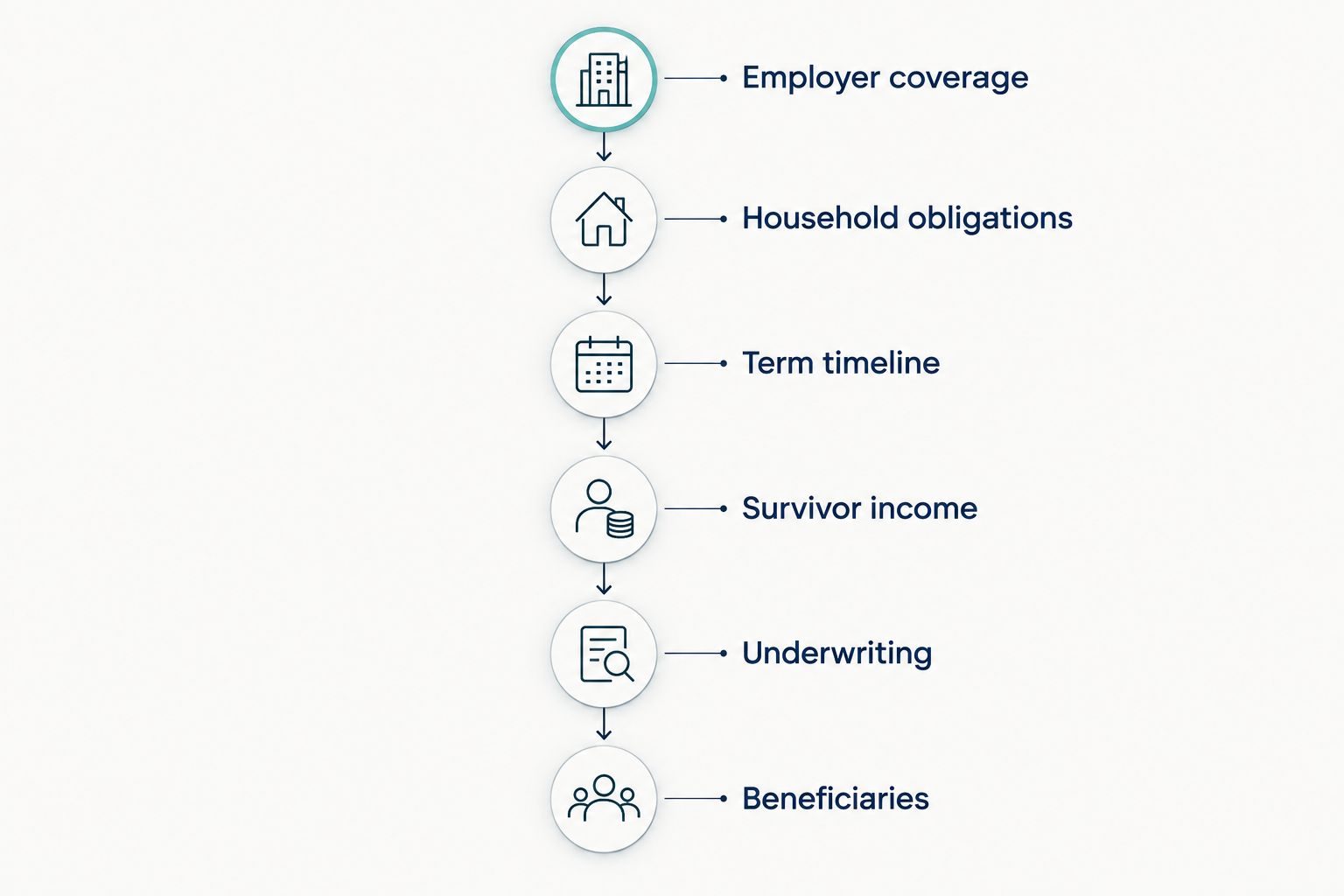
- List monthly housing, utility, food, transportation, and care expenses
- Add debts that survivors would need to repay
- Include childcare or replacement household support where relevant
- Define education or family goals the policy should protect
- Add immediate expenses and an emergency reserve
- Subtract liquid savings and existing life insurance available to survivors
Match the policy type and term to each obligation
Term life insurance covers a defined period and is commonly used for obligations that eventually end. Common term lengths include 10 years, 20 years, and 30 years, although available terms depend on the insurer and applicant. A term ending near mortgage payoff or a child's financial independence can keep the policy focused on the years with the largest income gap.
Permanent life insurance is designed to remain in force when required premiums are paid and policy conditions are met. It fits needs without a clear end date, but it requires a different cost and policy-value discussion from term coverage.
Themelloagency is best for New Hampshire teachers and public employees who want a practical review of employer and individual coverage. A Themelloagency life insurance review is the faster path after you have listed your benefits, obligations, and preferred timeline. You can also compare term life insurance for New Hampshire families before deciding whether permanent coverage addresses a need that term insurance cannot.
- Use term life for income replacement with a defined end date
- Consider permanent life only for a documented lifelong need
- Match the term to obligations rather than choosing by habit
- Compare the same death benefit and term across quotes
- Check renewal and conversion provisions before applying
- Keep employer coverage as a separate line in the final plan
Separate pension income from life insurance
A pension and a life insurance policy solve different problems. Pension survivor provisions can provide continuing income when eligibility and plan rules are satisfied. Life insurance pays according to the policy contract and beneficiary designation.
Review your NHRS information directly instead of assuming a spouse receives the same retirement income you expected during your lifetime. The applicable benefit can depend on employment status, service information, beneficiary records, and elections. Compare any survivor income with the household budget from the previous step, then insure the remaining gap.
Social Security should receive its own line in the calculation. Use the worker's current benefit estimate and confirm how survivor rules apply to the household rather than entering an amount from memory.
- Request current NHRS benefit and beneficiary information
- Identify survivor provisions that apply before retirement
- Review the retirement election if the employee has retired
- Check the current Social Security benefit estimate
- Compare monthly survivor income with monthly household needs
- Use life insurance for the uncovered obligations and income gap
Compare underwriting routes and useful riders
Standard underwriting can consider health history, prescriptions, age, occupation, and other application information. No-medical-exam coverage removes the physical exam but does not necessarily remove underwriting. Guaranteed-issue coverage generally avoids health qualification, making its policy limits, benefit provisions, and cost structure especially important to review.
Apply based on accurate information. An application that hides a diagnosis, medication, or tobacco use creates a larger problem than the condition itself. If health is a concern, compare available underwriting routes before assuming only guaranteed-issue coverage is accessible.
Riders add contract features to a base policy. Themelloagency can help you compare available riders, but names and provisions vary by insurer. Read the actual rider form before treating any feature as part of the policy.
- Compare fully underwritten and no-medical-exam options
- Review guaranteed-issue terms only after checking other routes
- Disclose health, medication, and tobacco information accurately
- Check whether a waiver-of-premium rider fits your needs
- Review accelerated death benefit provisions in the contract
- Add child coverage only when it serves a defined family need
Keep ownership and beneficiaries current
A well-sized policy can still fail the household plan if the owner, insured person, or beneficiary information is outdated. Review these records once every 12 months and after marriage, divorce, a birth, a death, a move, or an employment change.
Name contingent beneficiaries as well as primary beneficiaries. Confirm whether a trust, individual, or estate should receive the benefit with qualified legal or tax advisers when the arrangement is complex. Do not name a minor directly without understanding how state law and the policy handle payment to a child.
A 2026 review should also compare employer coverage with the personally owned policy again. Pay changes, debt reduction, and new dependents can alter the gap even when the policies themselves stay unchanged.
- Verify the policy owner and insured person
- Confirm primary and contingent beneficiaries
- Review records after every major family change
- Keep contact details current with the insurer
- Store policy information where survivors can find it
- Repeat the coverage calculation every 12 months
Life insurance options for teachers and public employees
No single option wins for every public employee. Employer coverage is convenient, term life addresses temporary needs, and permanent coverage serves needs without a planned end date. Underwriting route is a separate decision because no-exam and guaranteed-issue policies can carry different conditions from standard coverage.
| Option | Best for | What it does | Key limitation |
|---|---|---|---|
| Employer group life | A baseline benefit through work | Provides coverage under the employer plan | Amount, eligibility, and continuation depend on plan rules |
| Individually owned term life | Income replacement, dependent years, and debts with an end date | Provides a death benefit during a selected term | Coverage ends unless renewed, converted, or replaced |
| Permanent life insurance | Documented needs expected to continue for life | Can remain in force when policy requirements are met | Requires a larger long-term commitment than comparable term coverage |
| No-medical-exam life insurance | Applicants who want to avoid an exam | Uses an application process without a physical exam | Underwriting, limits, and policy choices still apply |
| Guaranteed-issue life insurance | Applicants unable to qualify through health-based underwriting | Avoids medical qualification | Benefit provisions and available coverage require close review |
A Themelloagency life insurance review should compare options using the same coverage goal. Comparing one small permanent policy with one large term policy does not show which contract fits the household; it only shows two different benefit amounts.
Review your life insurance
Compare employer benefits, household needs, and individual policy options in one practical review.
Common mistakes teachers and public employees make
Treating employer life insurance as a complete plan
Employer coverage is one input, not the entire answer. The certificate determines the benefit, exclusions, eligibility, and continuation rights. Compare that contract with the amount your household needs before deciding that enrollment is finished.
Counting the full pension as survivor income
The retirement income shown for the employee is not automatically the amount a survivor receives. Review the applicable NHRS provisions, beneficiary records, and elections. Use only the survivor income supported by current documents in the coverage calculation.
Choosing permanent coverage without defining a permanent need
Lifetime coverage is not automatically a better fit than term insurance. If the main obligations are a mortgage and dependent children, a defined term can align more directly with the risk period. Permanent coverage requires a clear purpose and an informed long-term commitment.
Ignoring what happens after leaving the job
A promotion, district change, resignation, or retirement can affect employer benefits. Check portability and conversion terms before the transition date. Personally owned coverage can prevent the entire plan from depending on one employer's benefit rules.
Leaving beneficiary records untouched
A will does not automatically update a life insurance beneficiary designation. Review the insurer's records after family changes and keep contingent beneficiaries current. Complex beneficiary arrangements need legal or tax advice, not assumptions.
FAQ
What is the best life insurance for New Hampshire teachers?
Term life insurance is often the most direct fit when a teacher needs income replacement for a mortgage or dependent years. Employer coverage and permanent insurance can still play a role when their benefits match a documented need.
Do New Hampshire teachers need private life insurance if work provides coverage?
Private coverage is needed when employer benefits do not cover the household’s full financial gap. Review the group certificate, available survivor income, debts, dependents, and savings before deciding.
How much does life insurance for a New Hampshire teacher cost in 2026?
Cost depends on the coverage amount, policy type, term, age, health, tobacco use, and underwriting route. Compare quotes using the same death benefit and contract features rather than comparing premiums alone.
Does NHRS provide a life insurance benefit?
NHRS retirement and survivor benefits must be reviewed separately from employer or individual life insurance. Check current NHRS documents to identify the survivor provisions that apply to your status and records.
Is term life better than permanent life for public employees?
Term life is better for obligations with a defined end date, while permanent life fits documented needs expected to continue for life. The right choice follows the obligation, not the employee’s job title.
Can teachers get life insurance without a medical exam?
Yes, no-medical-exam policies use an application process without a physical exam. Applicants still need to review underwriting requirements, available coverage, and contract terms.
Can Themelloagency review life insurance alongside employer benefits?
Yes. Themelloagency helps New Hampshire teachers and public employees compare life insurance needs with their existing employer coverage and household obligations.
How often should public employees review life insurance?
Review life insurance every 12 months and after a marriage, divorce, birth, death, mortgage change, or employment transition. Update beneficiaries and coverage calculations during the same review.
One last thing
The beneficiary form deserves the same attention as the coverage amount. Life insurance proceeds generally follow the policy's valid beneficiary designation, so an old form can defeat an otherwise careful 2026 plan. Check the insurer's records directly instead of assuming a will, employer file, or household spreadsheet changed the policy.
Do that beneficiary check before shopping for more coverage. Fixing ownership and beneficiary records can protect the policy you already have while the broader review determines whether its amount and term still fit.
Related guides
- Life insurance riders for New Hampshire parents
- No-medical-exam life insurance in New Hampshire
- Home insurance for New Hampshire teachers