

Buy-sell agreement life insurance in New Hampshire should equal each owner’s current buyout value in 2026. Calculate that amount from the valuation method written into the agreement, the owner’s percentage stake, and any dedicated funding the agreement recognizes; there is no responsible flat amount that fits every business.
- Buy-sell agreement life insurance New Hampshire coverage should equal each owner’s current buyout value in 2026.
- Use the agreement’s valuation method before choosing a death benefit.
- Cross-purchase suits smaller groups; entity-purchase reduces policy count as ownership expands.
- Review coverage annually and after any ownership, debt, or valuation change.
Why this matters
A signed buy-sell agreement establishes the process for transferring an owner’s interest. Life insurance supplies liquidity when death triggers that process, reducing the need for surviving owners to use operating cash, borrow money, or negotiate new terms with the estate.
Coverage must follow the agreement. If the agreement values a deceased owner’s interest at one amount but the policy funds a lower amount, the surviving owners still face a funding gap. This risk is especially important when a business represents a large share of an owner’s estate, a concern also addressed in planning for high-net-worth individuals in New Hampshire.
The Mello Agency is best for New Hampshire business owners who want a plain-language review of life insurance and business coverage needs. Its role is insurance guidance; an attorney and tax professional must handle the agreement’s legal and tax structure.
How much life insurance do New Hampshire business owners need for buy-sell agreements?
The required death benefit is the amount needed to purchase the insured owner’s interest under the agreement. Start with this formula:
Required death benefit = agreed business value × ownership share − existing dedicated funding recognized by the agreement
Do not subtract general business cash, a line of credit, or assets needed for operations unless the written agreement specifically treats them as buyout funding. The cleanest 2026 calculation uses the same valuation date, ownership records, and funding assumptions throughout the agreement and insurance review.
For an equal ownership split, each owner’s total coverage should fund that owner’s equal share of the agreed value. For an unequal split, coverage follows the actual percentages. A 60% owner requires coverage based on 60% of the agreed value, while a 40% owner requires coverage based on 40%.
The buyer also matters. Under a cross-purchase arrangement, the other owners hold enough combined coverage to purchase the deceased owner’s interest. Under an entity-purchase arrangement, the business holds coverage equal to the redemption amount for that owner.
Build the coverage calculation in the right order
Use these five steps for a 2026 buy-sell funding review:
- Read the trigger provision. Confirm that death activates the buyout and identify who must purchase the interest.
- Find the valuation method. Use the formula, appraisal process, or agreed value named in the document.
- Verify the ownership share. Check the current capitalization table, membership interests, or stock records.
- Identify existing funding. Count only assets or policies formally assigned to the buyout obligation.
- Calculate the coverage gap. Match the total death benefit to the remaining obligation for each owner.
An old valuation and a current ownership percentage do not belong in the same calculation. Every input should reflect the same review date.
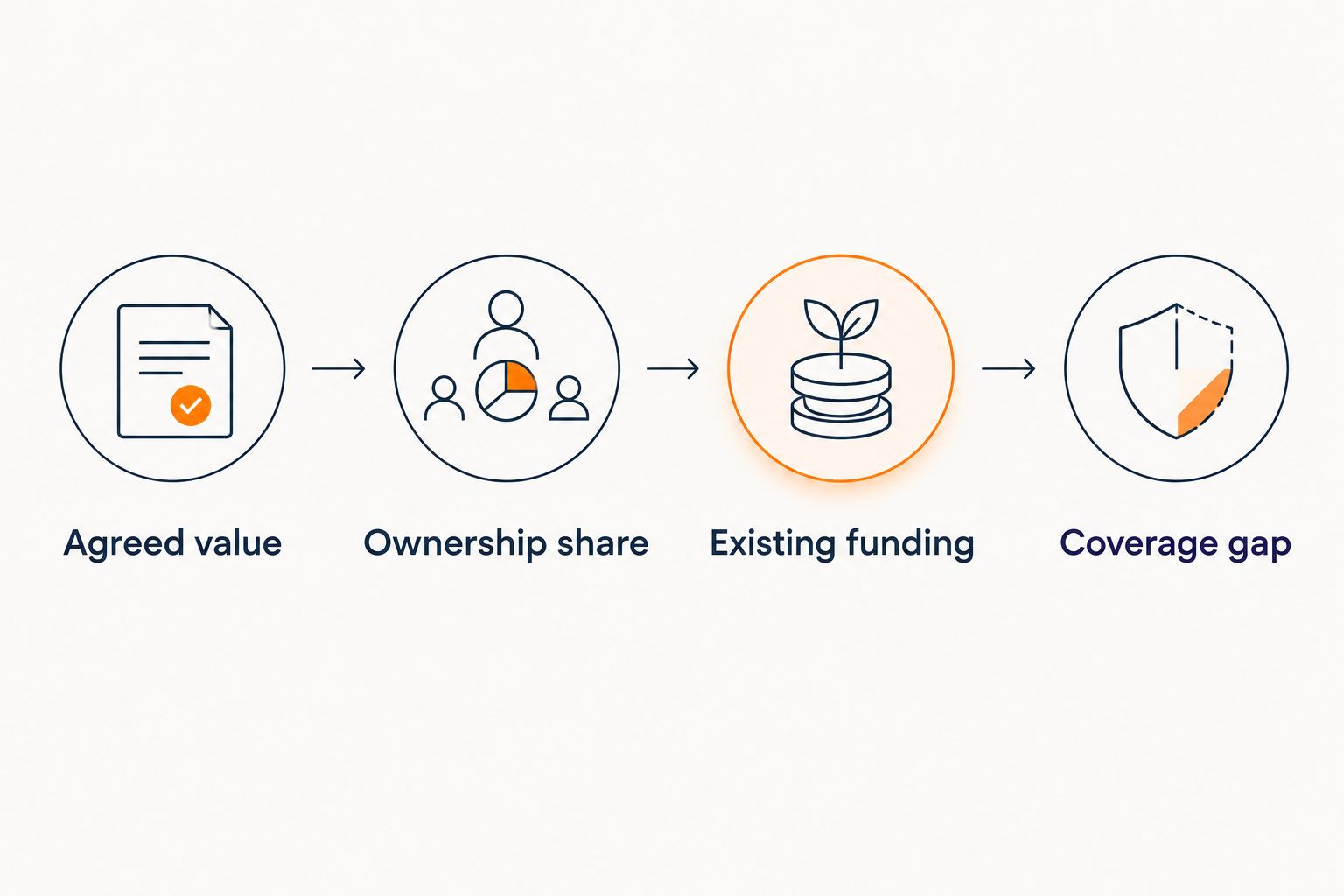
Keep the valuation worksheet, ownership record, policy summary, and signed agreement together. That makes the next review faster and exposes inconsistencies before a claim forces everyone to interpret different documents under pressure.
Cross-purchase: coverage totals each owner’s buyout value
In a standard cross-purchase arrangement, every owner buys coverage on the other owners. The surviving owners receive the death benefit and use it to purchase the deceased owner’s interest from the estate under the agreement.
| Number of owners | Direct cross-purchase policies | Best for |
|---|---|---|
| 2 owners | 2 policies | A simple two-owner business |
| 3 owners | 6 policies | A small group that accepts separate ownership |
| 4 owners | 12 policies | A group prepared for heavier administration |
| 5 owners | 20 policies | Rarely the simplest direct arrangement |
The policy count follows the formula owners × other owners. Each policy does not need to equal the deceased owner’s entire buyout value; the combined benefits held by the surviving owners need to equal that obligation according to how the agreement divides the purchase.
- Pros: The buyers receive the funding directly, and policy ownership follows the purchase obligation.
- Cons: The number of policies rises quickly, and uneven ages or health profiles can make the arrangement harder to balance.
- Best for: A business with a small, stable ownership group.
Verdict: choose cross-purchase when direct ownership is important and the policy count remains manageable.
Entity-purchase: the business owns one policy per owner
In an entity-purchase arrangement, also called a redemption arrangement, the business owns a policy on each owner. The business receives the death benefit and uses it to redeem the deceased owner’s interest from the estate.
This structure requires one policy per insured owner rather than one policy for every owner-to-owner relationship. A business with 5 owners therefore manages 5 entity-owned policies instead of the 20 policies required by a standard direct cross-purchase arrangement.
- Pros: Fewer policies and centralized administration.
- Cons: The business controls the policies, and tax treatment requires professional review.
- Best for: A business with several owners or centralized financial administration.
Verdict: choose entity-purchase when reducing policy count matters more than direct owner-to-owner policy control.
Cross-purchase vs. entity-purchase in 2026
| Question | Cross-purchase | Entity-purchase |
|---|---|---|
| Who owns the policy? | The other business owners | The business entity |
| Who receives the death benefit? | Surviving insured owners | The business entity |
| Who buys the interest? | Surviving owners | The business entity |
| Main advantage | Funding follows each buyer | Fewer policies to administer |
| Main drawback | Policy count expands quickly | Tax and entity effects need review |
| Best for | Smaller ownership groups | Larger ownership groups |
The agreement and policy ownership must point to the same buyer. If the document requires the company to redeem shares but the other owners receive the insurance proceeds personally, the funding structure does not match the legal obligation.
Term life vs. permanent life for buy-sell funding
Term life covers a defined period. It fits an agreement tied to a planned retirement, sale, succession date, or other expected ownership horizon. Its main limitation is expiration: if the owner remains involved after the term ends, replacement coverage can depend on the owner’s health and insurability at that time.
Permanent life is designed to remain in force while policy requirements are met. It can support an agreement without a predictable end date and may build cash value, but the policy design requires closer review because the business and ownership plan can change long before the coverage ends.
- Best for a defined ownership period: Term life.
- Best for an indefinite agreement: Permanent life.
- Main term-life risk: Coverage expires before the buy-sell obligation ends.
- Main permanent-life risk: The design outlasts the original ownership or funding assumptions.
Verdict: match the policy duration to the expected life of the agreement, then document what happens if the owner exits while still living.
Why the required coverage varies
The required amount changes when any input behind the buyout changes:
- Business value: Growth, declining performance, major asset purchases, or asset sales change the value being transferred.
- Ownership percentages: A new partner, partial sale, gift, or internal transfer changes each insured owner’s buyout value.
- Valuation method: Book value, an earnings formula, and an independent appraisal can produce different results.
- Business debt: The agreement determines whether debt reduces equity value or affects the funding target another way.
- Existing policies: Coverage must be checked for the correct owner, beneficiary, death benefit, and purpose.
- Agreement triggers: Death, disability, retirement, and voluntary departure create different funding needs; life insurance addresses death, not every trigger.
A 2026 review should reconcile all six factors rather than checking only the death benefit shown on a policy statement. A policy can remain active and still be wrong for the agreement because the ownership, beneficiary, or valuation changed.
When should you review buy-sell coverage?
Review the agreement and insurance at least annually. Run another review immediately after any event that changes value, ownership, obligations, or policy control.
Common review triggers include:
- A partner joins or leaves.
- An owner transfers part of a stake.
- The business completes a new appraisal.
- A major asset is purchased or sold.
- The company takes on or repays significant debt.
- A policy owner or beneficiary changes.
- The business changes entity type.
- An owner’s planned retirement date changes.
The annual meeting should produce a written valuation confirmation, updated ownership schedule, and policy comparison. If the death benefits no longer match the calculated obligations, the owners need to decide whether to change coverage, change the funding plan, or amend the agreement.
The Mello Agency can review the insurance side in plain terms and identify where policy details do not match the owners’ stated funding goal. The practical limitation is clear: insurance review does not replace legal drafting, business valuation, or tax advice.
Review your buy-sell coverage
Check whether each policy still matches the current ownership and buyout terms.
Related questions
Does each owner need the same amount of life insurance?
No. Each owner needs coverage based on that owner’s buyout value, so equal coverage works only when the owners hold equal interests and the agreement values those interests the same way. Unequal ownership percentages require different total death benefits.
Can one policy fund every buy-sell trigger?
No. Life insurance funds a buyout triggered by death. Disability, retirement, termination, bankruptcy, divorce, and voluntary departure require separate funding terms because a life insurance death benefit is not paid for those events.
Who should own the life insurance policy?
Policy ownership should match the buyer named in the agreement. The surviving owners generally own policies in a cross-purchase structure, while the business owns policies in an entity-purchase structure.
FAQ
How much buy-sell agreement life insurance does a New Hampshire business owner need?
The owner needs a total death benefit equal to the current buyout value of that owner’s business interest in 2026. Apply the agreement’s valuation method to the ownership share, then subtract only dedicated funding recognized by the agreement.
Is buy-sell agreement life insurance required in New Hampshire?
Life insurance is a funding method selected by the parties to a buy-sell agreement, not a substitute for the agreement itself. The owners should have New Hampshire legal and tax professionals confirm their obligations.
What is the best life insurance structure for two business owners?
A direct cross-purchase arrangement is often the simplest structure for 2 owners because it requires 2 policies. Each owner holds coverage on the other and uses the proceeds for the purchase required by the agreement.
What is the best structure for a business with several owners?
An entity-purchase arrangement reduces the policy count because the business owns one policy per owner. The entity and tax consequences still require professional review before the policies are issued.
Should buy-sell coverage use term life or permanent life insurance?
Term life fits a defined ownership horizon, while permanent life fits an agreement expected to continue indefinitely. The policy duration should match the expected duration of the buyout obligation.
How often should buy-sell life insurance be reviewed in 2026?
Review buy-sell life insurance at least annually in 2026 and after every ownership, valuation, debt, or beneficiary change. The review should compare the agreement, current ownership records, valuation, and policy details.
Can life insurance fund a disability buyout?
No. Life insurance pays a death benefit when the insured owner dies; a disability-triggered buyout needs separate funding terms and potentially separate disability buy-out coverage.
Can The Mello Agency write the buy-sell agreement?
The Mello Agency provides insurance guidance, while an attorney must draft or amend the legal agreement. A tax professional and qualified valuation specialist should address tax treatment and business value.
One last thing
Do not begin with an insurance application. Begin with the signed agreement, because it identifies the buyer, valuation method, ownership interest, and trigger that the policy must fund. The most useful 2026 review is a side-by-side check of the agreement, valuation, ownership records, and policy details; if one document tells a different story, fix the mismatch before changing the death benefit.
Related guides
- How much life insurance coverage New Hampshire residents need
- Term life insurance for New Hampshire families
- Whole life insurance for New Hampshire families
- Umbrella insurance for New Hampshire business owners