New Hampshire apple orchards and farm stands business insurance covers three operations under one roof: growing and harvesting the crop, running a retail stand, and hosting pick-your-own visitors, each with its own claims exposure. A homeowners policy or a bare-bones farm policy rarely covers all three, which is why an orchard built around agritourism needs a different coverage stack than a wholesale-only grower selling to a distributor.
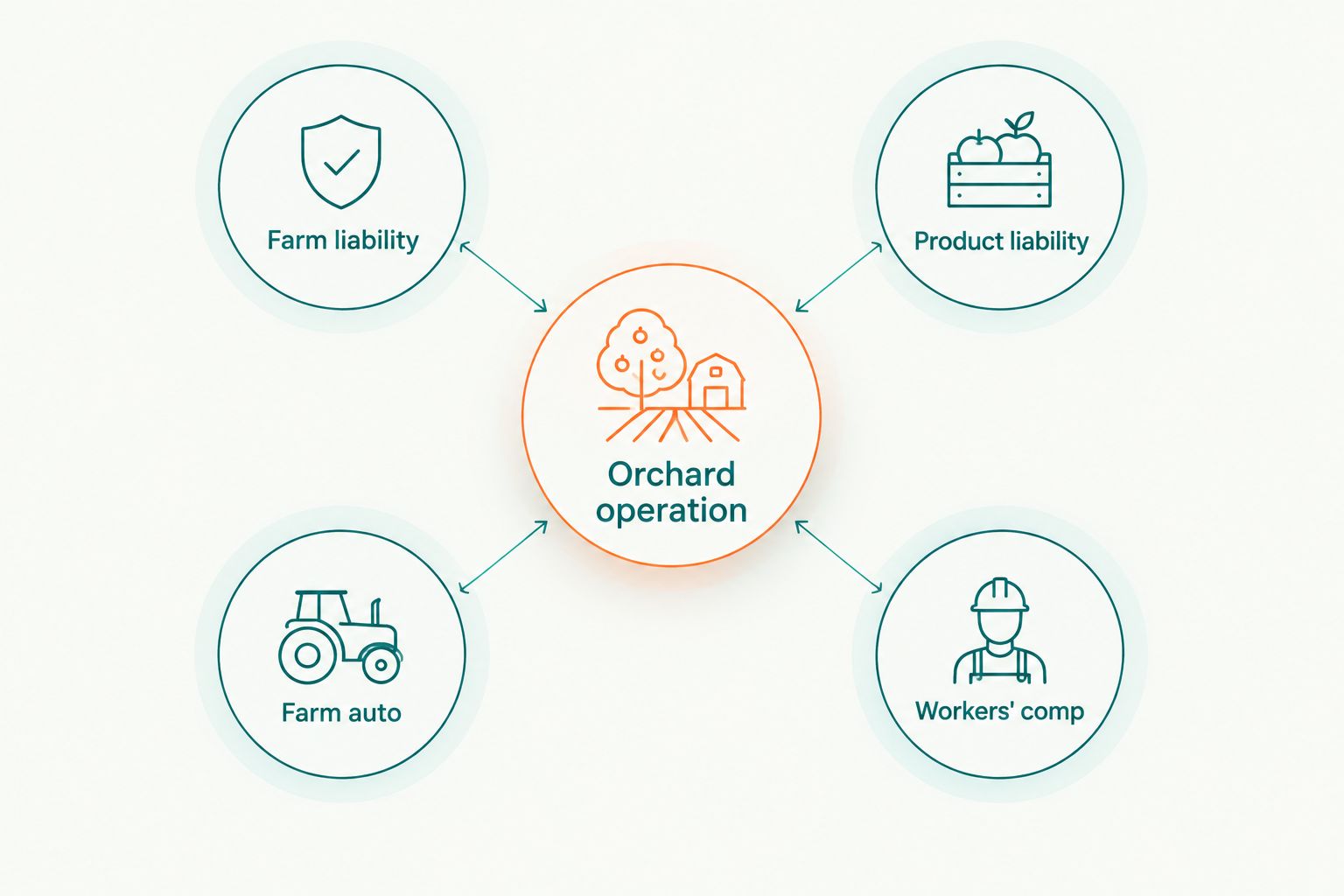
- New Hampshire apple orchards need farm liability, product liability, farm auto, and workers’ comp — not one generic plan.
- Pick-your-own visitors, cider presses, and wagon rides push liability past what a private farm policy assumes.
- Seasonal and part-time crew trigger New Hampshire’s workers’ comp requirement once you have one employee.
- A farm stand selling jam, cider, or baked goods needs product liability layered onto general liability.
- Themello Agency reviews orchard and farm stand coverage before the 2026 pick-your-own season opens.
Why business insurance matters for New Hampshire apple orchards
Apple season in New Hampshire runs roughly Labor Day through late October — a three-month window that concentrates almost the entire year's foot traffic into a handful of weekends. That compression is the exposure. A quiet Tuesday in the orchard and a packed Saturday during peak color are the same property with wildly different liability profiles, and most standard farm policies were priced for the quiet Tuesday.
Add a cider press running near an open retail area, ladders left out near a pick-your-own row, a hayride crossing a public road, and a stand selling jars of jam next to raw fruit, and you have four distinct liability categories layered on one small business. Themello Agency treats apple orchards and farm stands as agritourism businesses first, growers second, because that's where the claims actually happen.
New Hampshire law also requires workers' compensation coverage for any business with one or more employees, full or part time — a detail orchards miss when they think of harvest help as "family pitching in" rather than payroll.
Map every visitor-facing activity
Walk the property before calling anyone and write down every activity that puts a member of the public within reach of equipment, uneven ground, or animals.
- Pick-your-own rows and orchard paths
- Hayrides or wagon tours, including any stretch on a public road
- Cider pressing demonstrations or a working press near the stand
- A corn maze, petting area, or playground
- Parking areas and restrooms open to visitors
- A cider donut fryer or baking operation on-site
Separate crop, retail, and agritourism liability
A single "farm liability" line item doesn't automatically mean everything on the property is covered. Break the operation into three buckets and check each one against your current policy.
- Crop and land: growing, harvesting, storage, orchard equipment
- Retail: raw fruit sold by the pound, packaged cider, jam, baked goods, gift baskets
- Agritourism: pick-your-own access, hayrides, demonstrations, events
Cover the farm stand's retail exposure
A roadside stand is a retail operation the moment money changes hands for anything beyond raw produce grown on-site. That's the same exposure category as a seasonal market vendor, and it needs its own endorsement rather than an assumption that farm liability stretches to cover it. Themello Agency's craft fair and pop-up vendor coverage page walks through how retail-at-a-fixed-location liability works for seasonal sellers, and the same logic applies to a farm stand table.
- Point-of-sale liability for packaged goods
- Signage and structure coverage for the stand itself
- Cash-handling and theft exposure during peak weekends
- Coverage for goods purchased for resale, not just farm-grown items
Insure farm vehicles and equipment
Tractors, hay wagons, and flatbeds used for hayrides or hauling bins cross a line the moment they leave the field for a public road. Personal auto policies exclude farm-use vehicles almost universally, and a general farm policy often caps equipment coverage well below replacement cost. Themello Agency's farm vehicle and tractor insurance guide breaks down what needs a commercial farm auto endorsement versus what a standard policy already covers.
- Tractors and loaders used both in-field and for public rides
- Flatbeds or trailers hauling apple bins on public roads
- Cider presses, sorting equipment, and refrigeration units
- Any vehicle a seasonal employee drives as part of their job
Carry workers' comp for seasonal and family crew
Cashiers at the stand, pick-your-own attendants directing traffic, and the teenager running the cider press on weekends all count as employees the moment they're paid. New Hampshire's one-employee threshold means most orchards trigger the requirement well before harvest peak.
- Weekend and seasonal cashiers
- Pick-your-own attendants and parking helpers
- Family members drawing a wage, not just volunteering
- High school or college crew hired for the fall rush
Add product liability for cider, jam, and baked goods
Raw apple sales carry one liability profile; anything processed, pressed, canned, or baked carries another. Product liability picks up where general liability leaves off once a product leaves the property in a jar or a jug.
- Unpasteurized versus pasteurized cider disclosure requirements
- Labeling on jams, jellies, and packaged baked goods
- Allergen disclosure for baked items sold at the stand
- Coverage that follows the product to off-site farmers markets
Layer umbrella coverage above the base limits
A typical general liability policy sits at $1 million per occurrence and $2 million aggregate — reasonable for a quiet farm, thin for a Saturday when hundreds of visitors move through the same acre. One slip on wet grass near the cider press, or one wagon incident, can push a claim past a base limit fast during peak weekends. An umbrella policy sits above the base coverage and absorbs what the underlying policy can't.
Get your orchard coverage reviewed
A quick review before your 2026 season opens can catch gaps a generic policy misses.
Coverage options for New Hampshire orchards and farm stands
| Option | Best for | Key limitation |
|---|---|---|
| Farm or agribusiness package policy | Orchards that grow, sell, and host pick-your-own on one property | Bundled limits often assume lighter foot traffic than a peak weekend brings |
| Business Owners Policy (BOP) | A retail stand with no heavy equipment or agritourism activity | Usually excludes farm vehicles and hayrides |
| Standalone general liability | Small roadside stands without pick-your-own or machinery on-site | Leaves product liability and farm auto uncovered |
| Product liability endorsement | Any orchard selling packaged cider, jam, or baked goods | Only covers what's scheduled, not raw fruit sales by default |
| Commercial umbrella policy | Orchards drawing large weekend crowds during peak season | Sits above other policies, doesn't fix a weak base liability limit |
If your farm stand sells anything you didn't grow, your farm policy alone won't cover the claim — that's the line that trips up more orchards than any other coverage gap.
Common mistakes New Hampshire orchards make with business insurance
- Treating pick-your-own as private farm work. Visitors picking their own apples are customers on your property, not guests on a private farm — the liability standard is different.
- Assuming a homeowners or farm policy covers the retail stand. Retail sales, even seasonal ones, typically sit outside a standard farm or homeowners policy.
- Skipping workers' comp for seasonal or family help. New Hampshire's one-employee threshold applies whether the person is a stranger or a relative on payroll.
- Setting liability limits for a quiet weekday, not a peak Saturday. Limits set years ago against a smaller crowd don't scale with agritourism growth.
- Leaving off-site sales uncovered. Cider and baked goods sold at a farmers market or a second location need coverage that travels with the product.
FAQ
What insurance does a New Hampshire apple orchard need?
A New Hampshire apple orchard typically needs farm or general liability, product liability for anything sold beyond raw fruit, farm auto coverage for tractors and wagons, and workers’ comp once you pay any employee. Orchards with pick-your-own or hayrides usually add agritourism liability or an umbrella policy for peak-weekend crowds.
Does homeowners insurance cover a farm stand?
No, a standard homeowners policy generally excludes business activity, including a roadside farm stand selling produce or packaged goods. The stand needs its own commercial liability coverage even if it sits on residential-zoned land.
Do I need workers’ comp for seasonal orchard help in New Hampshire?
Yes, New Hampshire requires workers’ compensation coverage for any business with one or more employees, including part-time or seasonal harvest crew. Family members drawing a wage count the same as an outside hire.
Is pick-your-own covered under a standard farm policy?
Not automatically. Many farm policies are written for growing and selling crops, not for inviting the public onto the property to pick fruit, which is a higher liability category that often needs its own endorsement.
What’s the difference between a BOP and a farm package policy?
A Business Owners Policy typically fits a retail stand with no heavy equipment or livestock, while a farm package policy bundles crop, equipment, and land coverage for an operating orchard. Orchards running pick-your-own or hayrides usually need the farm package plus added agritourism liability.
Do I need product liability to sell cider and jam at a farm stand?
Yes, product liability covers claims tied to anything processed, pressed, canned, or baked before sale, which sits outside general farm liability. Raw fruit sold by the pound is a different liability category than packaged cider or jam.
How much liability coverage does an orchard need for pick-your-own weekends?
A common baseline is $1 million per occurrence and $2 million aggregate, but orchards with heavy peak-weekend traffic often add a commercial umbrella policy on top. The right limit depends on visitor volume during your busiest fall weekends.
Does farm insurance cover tractors and hay wagons used for rides?
Personal auto policies exclude farm-use vehicles almost universally, and standard farm liability often caps equipment coverage below replacement cost. Tractors and wagons used for public hayrides typically need a commercial farm auto endorsement.
One last thing
Most orchards set their liability limits once, at start-up, against a smaller version of the business than the one running today. If pick-your-own weekends have grown since your policy was last reviewed, the limit probably hasn't grown with it. Before the 2026 pick-your-own season opens, ask whether your general liability figure reflects your busiest Saturday or your quietest Tuesday — those are two very different numbers.
Related guides
- Workers' compensation insurance for New Hampshire small businesses
- Umbrella insurance for New Hampshire business owners