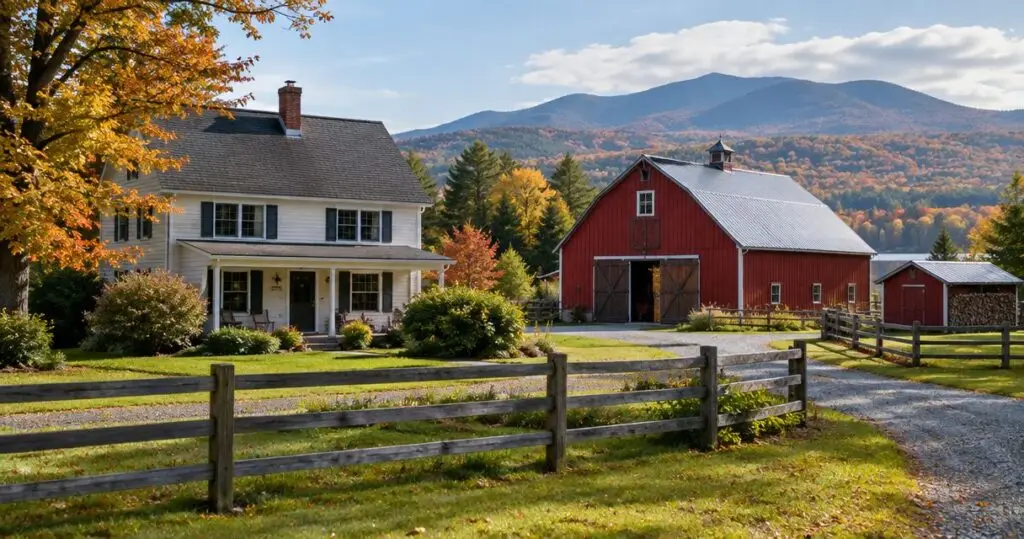
New Hampshire barn owners’ home insurance is property and liability coverage for a dwelling and eligible detached structures, with the aim of paying covered losses without leaving the barn overlooked. In 2026, these owners need a closer review because a barn, workshop, equipment shed, or converted stable can exceed the policy’s default limit or fall under different rules because of its use.
- Home insurance for barns and outbuildings in New Hampshire starts with checking the Coverage B limit, exclusions, and settlement method.
- Many standard policy forms set other-structures coverage near 10% of the dwelling limit, but the declarations page controls.
- Business, farm, boarding, and rental activity requires separate review because personal home insurance can restrict commercial use.
- Themello Agency home insurance reviews are best suited to New Hampshire owners who want each detached structure checked individually.
- The 2026 priority is documenting the barn’s rebuild needs, contents, current use, heat sources, and visitor exposure.
Why home insurance matters for New Hampshire barn owners
A detached barn is usually handled separately from the dwelling even when both appear on one policy. The declarations page commonly labels this protection as Coverage B or other structures, but the limit, covered causes of loss, valuation method, and exclusions depend on the specific policy.
Start with a New Hampshire home coverage needs review. The house limit does not tell you whether the barn has enough protection, and a lender’s insurance requirement does not confirm that every detached structure is properly listed.
New Hampshire weather adds practical questions in 2026. Snow, wind, fallen trees, frozen plumbing, and water entry can damage a detached building, but coverage depends on the cause of loss and the contract language. Flood remains outside standard homeowners insurance, while deterioration, neglected maintenance, insects, and rot are generally not sudden covered events.
The barn’s use matters just as much as its construction. Personal storage presents one risk profile; horse boarding, repair work, farming, paid events, or product sales present another. Commercial activity can trigger exclusions or require a business, farm, or equestrian policy.
Themello Agency is best suited to New Hampshire homeowners who want a direct barn-by-barn review instead of assuming the default other-structures limit is enough.
How to review barn and outbuilding coverage
Map every detached structure
Start manually with a 15-minute walk around the property. List every building that does not share a wall or roof with the insured house, including structures that seem too small to matter. One combined Coverage B limit can apply across all eligible detached structures, so an unnoticed shed can still consume part of the same limit after a covered loss.
Record the building’s current use, approximate dimensions, construction type, roof material, utilities, heat source, and general condition. Take at least 3 clear photos of each structure: one exterior overview, one interior view, and one image of the roof or major mechanical feature.
- List barns, garages, workshops, sheds, coops, greenhouses, and shelters
- Mark each structure as personal, agricultural, commercial, vacant, or mixed use
- Note electricity, plumbing, heating, and fuel storage
- Record major improvements or changes in use
- Photograph every building from inside and outside
Read Coverage B
Open the declarations page and find Coverage B or other structures. Many standard homeowners forms set this limit at about 10% of Coverage A, the dwelling limit, but carriers can change that percentage or apply different terms. Treat 10% as a common starting point, not a promise of coverage.
Then read the policy section that defines an other structure. Confirm whether the barn qualifies, which causes of loss apply, and whether a deductible is taken from a covered claim. Look for language addressing structures rented to others, business property, farming, animals, vehicles, vacancy, collapse, and water.
The settlement method also matters. Replacement cost aims to pay the covered cost of repair or replacement subject to policy terms, while actual cash value accounts for depreciation. An older barn insured on an actual-cash-value basis can produce a materially smaller settlement than its rebuild requirement.
- Find the Coverage B limit on the declarations page
- Confirm whether one limit applies to all detached structures combined
- Identify replacement cost or actual cash value wording
- Read exclusions for business, farming, rental, vacancy, and deterioration
- Check the deductible and covered causes of loss
- Ask for written clarification when the wording is unclear
Set the rebuild limit
Estimate what it would take to replace the structure, not what it would sell for as part of the property. Market value, tax assessment, original construction expense, and rebuild requirements measure different things. A basic storage shed and a barn with finished rooms, utilities, stalls, or specialized electrical work do not need the same limit.
Start with a manual inventory of materials and features, then request a contractor estimate when the building is large, unusual, historic, or improved. A Themello Agency home insurance review can compare that rebuild figure with the available Coverage B limit and identify whether an increased limit or specifically scheduled structure is available.
Repeat this process every 12 months and after a renovation. A roof replacement, electrical upgrade, finished workshop, added plumbing, or structural addition changes the amount that needs protection in 2026.
- Base the limit on replacement needs rather than sale value
- Include permanent utilities, built-ins, stalls, doors, and attached fixtures
- Obtain a contractor estimate for complex or older barns
- Compare the combined structure values with the policy limit
- Ask whether the barn can be scheduled separately
- Review the estimate every 12 months
Separate contents
The barn and the property stored inside it occupy different coverage buckets. Coverage B generally addresses the structure, while tools, furniture, equipment, supplies, and personal belongings usually fall under personal-property terms. A sufficient barn limit does not prove that everything inside is protected.
Create a room-by-room inventory with descriptions, serial numbers, receipts, and photos. Store 2 copies in separate locations, with at least one copy away from the property. This record helps identify items that face special limits, exclusions, or different coverage because they support a business or farm operation.
Vehicles also need careful classification. Cars, motorcycles, recreational vehicles, and some farm equipment can require their own policies rather than relying on homeowners coverage. Ask how the contract treats each item instead of grouping everything under the word equipment.
- Separate permanent fixtures from movable property
- Record serial numbers for tools and powered equipment
- Keep receipts, appraisals, and photos outside the barn
- Flag property used for income-producing activity
- Confirm coverage for vehicles and mobile equipment individually
- Ask whether high-value items need scheduled coverage
Disclose use
Tell the carrier exactly what happens in and around the barn. Personal storage, hobby animals, paid horse boarding, woodworking sales, vehicle repair, farm production, short-term rental use, and public events create different property and liability exposures. A description such as storage is not accurate when customers, boarders, workers, or paying guests regularly enter the building.
Paid equestrian activity deserves a dedicated review. Owners who board horses, provide lessons, breed animals, or operate a stable should compare personal coverage with business insurance for New Hampshire equestrian and horse boarding facilities. A farm or business policy can address exposures that a personal homeowners contract restricts.
Heat sources require the same direct disclosure. Report wood stoves, pellet stoves, space heaters, furnaces, propane tanks, and fuel storage. The carrier can request installation details, inspections, clearances, or protective devices before accepting the risk.
- Describe every personal, farm, rental, and business activity
- Report customers, workers, tenants, boarders, and event guests
- Disclose animals and how they are housed or handled
- Identify every permanent and portable heat source
- Explain fuel, chemical, hay, and equipment storage
- Update the carrier before changing how the barn is used
Review liability
Property coverage repairs covered physical damage; liability coverage addresses covered claims alleging bodily injury or property damage. Barns can create visitor, animal, equipment, fire, and premises risks that are not visible from the dwelling itself.
Walk the access route from the driveway to the barn. Check steps, loft ladders, railings, lighting, doors, gates, fencing, floor openings, stored machinery, and restricted areas. Fixing a hazard reduces the chance of injury, but it does not replace the need to confirm policy terms and limits.
Ask whether animal liability, business activity, employees, volunteers, and rented structures are covered, restricted, or excluded. An umbrella policy can add another liability layer, but it normally requires qualifying underlying coverage and does not repair an exclusion in the base policy.
- Inspect entrances, stairs, lofts, floors, gates, and fencing
- Restrict public access to equipment and hazardous storage
- Confirm how the policy treats animals and visitors
- Review business and rental exclusions
- Check the required underlying liability limits for umbrella coverage
- Document repairs and safety improvements
Keep proof
Coverage reviews work better when the property record is current. Keep the policy, declarations page, endorsements, inspection reports, photos, receipts, contractor estimates, and written answers from the carrier together. Save a second copy away from the home so a fire or severe weather event cannot destroy both the building and the records.
Use a 12-month calendar reminder for a full review and update the file immediately after a renovation, new business activity, equipment purchase, tenant change, or newly acquired animal. The 2026 policy should describe the property as it exists now, not as it looked when the original application was completed.
- Save the declarations page and every endorsement
- Keep written answers about structure and activity coverage
- Store contractor estimates and inspection reports
- Maintain dated photos of each building and its contents
- Preserve 2 copies in separate locations
- Complete a full review every 12 months
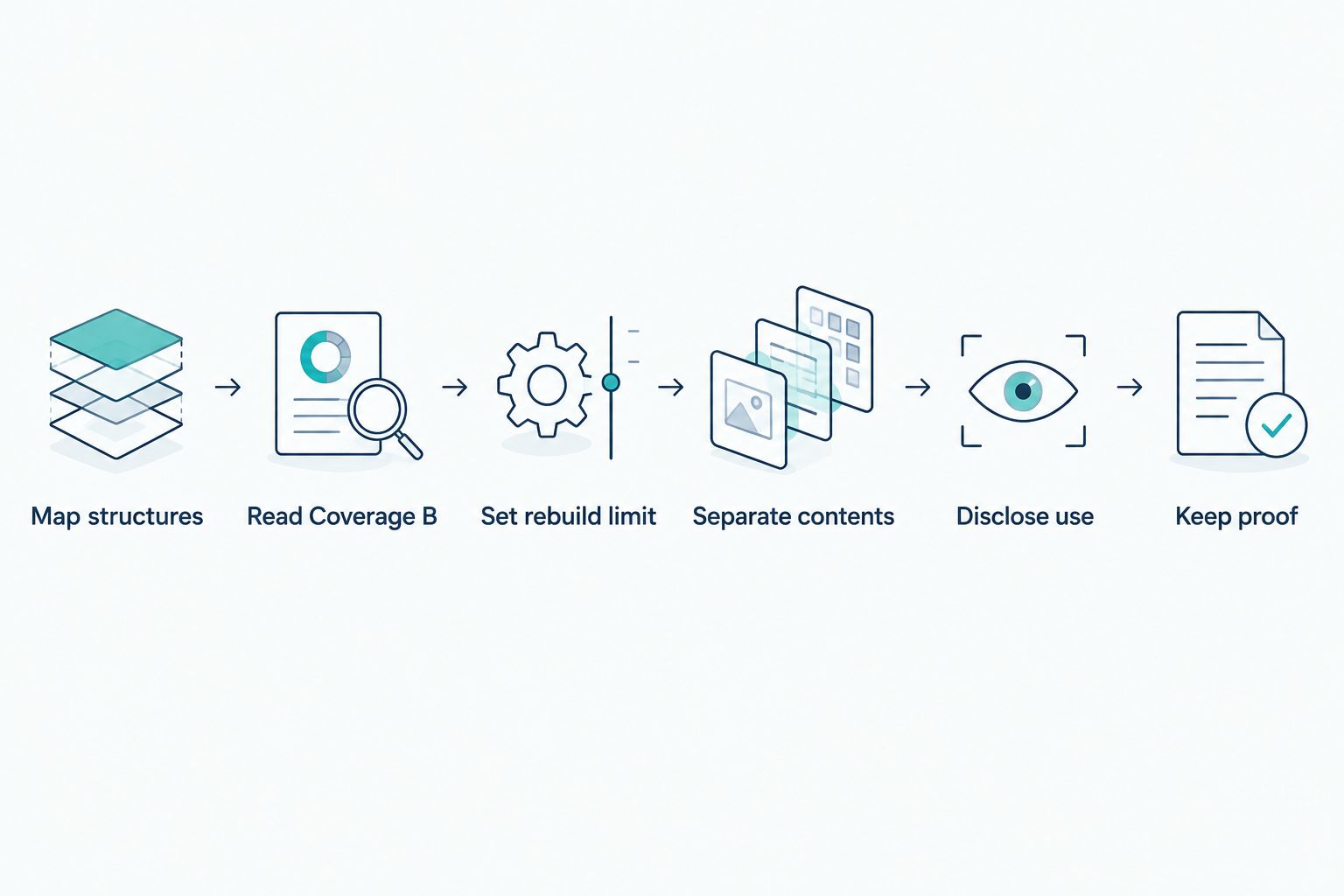
The review follows a clear order: identify the structures, read the contract, set the limit, separate the contents, disclose the use, and preserve the proof.
Once the manual checklist is complete, Themello Agency can use it to review the home insurance terms without relying on a broad description of the property. The carrier still controls underwriting, policy wording, inspections, and claim decisions.
Review your barn coverage
Bring your structure list, current policy, and photos for a direct coverage review.
Compare coverage options for detached structures
The right 2026 option depends on the barn’s value, contents, use, and liability exposure. These options solve different problems and can work together.
| Option | Best for | Main advantage | Key limitation |
|---|---|---|---|
| Standard Coverage B | Best for small personal-use sheds and basic detached garages | Already included in many homeowners policies | The shared limit can be too low for several or substantial structures |
| Increased Coverage B | Best for personal-use properties with higher combined rebuild needs | Raises the amount available for eligible detached structures | Does not remove business, farm, rental, or maintenance exclusions |
| Scheduled structure endorsement | Best for a specific high-value barn or workshop | Identifies the structure and its limit more clearly | Availability and terms depend on the carrier |
| Scheduled personal property coverage | Best for qualifying high-value movable items | Gives listed property separate treatment under stated terms | Does not insure the barn itself or correct business-use exclusions |
| Farm, equestrian, or business policy | Best for income-producing or operational use | Addresses commercial property and liability exposures | Requires accurate classification of the operation and its activities |
| Themello Agency review | Best for owners comparing these paths | Organizes structure, contents, use, and liability questions | The insurer still sets final terms and eligibility |
Common mistakes New Hampshire barn owners make
Treating the barn and contents as one limit
The structure and movable property usually fall under different policy sections. Raising Coverage B alone does not automatically raise protection for tools, equipment, supplies, or business property stored inside.
Using market value as the rebuild figure
A real-estate estimate describes the property’s sale context, not the work required to reconstruct one building after a covered loss. Use a structure-specific rebuild estimate for the coverage discussion.
Describing paid activity as personal use
Boarding, lessons, repairs, farming, storage rental, events, and product sales can change eligibility and exclusions. Disclose the activity before a claim forces the issue.
Ignoring heat and fuel sources
Wood stoves, portable heaters, furnaces, propane, gasoline, and stored hay affect the risk. Give the carrier accurate details and complete any requested inspection or correction.
Waiting for renewal to report a change
A renovation or new use can create an immediate mismatch. Update the policy when the change occurs, then confirm the revised terms in writing rather than waiting for the next 12-month review.
FAQ
Does New Hampshire home insurance cover a detached barn?
A homeowners policy can cover an eligible detached barn under Coverage B or other structures. The declarations page, endorsements, use of the barn, and exclusions determine the actual protection.
Is 10% of dwelling coverage enough for a barn?
A 10% other-structures limit is enough only when it matches the combined rebuild needs of all eligible detached structures. Compare the limit with a current estimate for the barn, garages, sheds, and other buildings.
Does barn insurance cover tools and equipment stored inside?
Not under the structure limit itself. Tools and equipment generally fall under personal-property terms, where special limits, vehicle exclusions, or business-use restrictions can apply.
Do I need business insurance if I earn money from my barn?
Income-producing barn use requires a business, farm, or equestrian coverage review. Homeowners policies can restrict or exclude commercial property and liability exposures even when the barn itself appears under Coverage B.
Does homeowners insurance cover flood damage to a barn?
Standard homeowners insurance excludes flood damage to the home and detached structures. Separate flood insurance is required for covered flood losses, subject to that policy’s terms and eligibility.
Will home insurance cover a wood stove in a detached workshop?
Coverage depends on disclosure, installation, carrier rules, and the cause of loss. Report the stove before a loss and provide any inspection or installation records the insurer requests.
How often should I review insurance for a barn or outbuilding?
Review the coverage every 12 months and immediately after a renovation, new use, equipment change, or business activity. Themello Agency can compare the updated property details with the current policy in 2026.
One last thing
A barn can have enough structural coverage and still leave its contents or liability exposure unresolved. For 2026, use three separate questions during every review: what rebuilds the building, what covers the property inside, and what responds if someone is injured. One broad yes about the barn does not answer all three.
Related guides
- Home insurance for New Hampshire homes with wood stoves
- Home insurance for older and historic New Hampshire homes
- Umbrella insurance for New Hampshire homeowners