
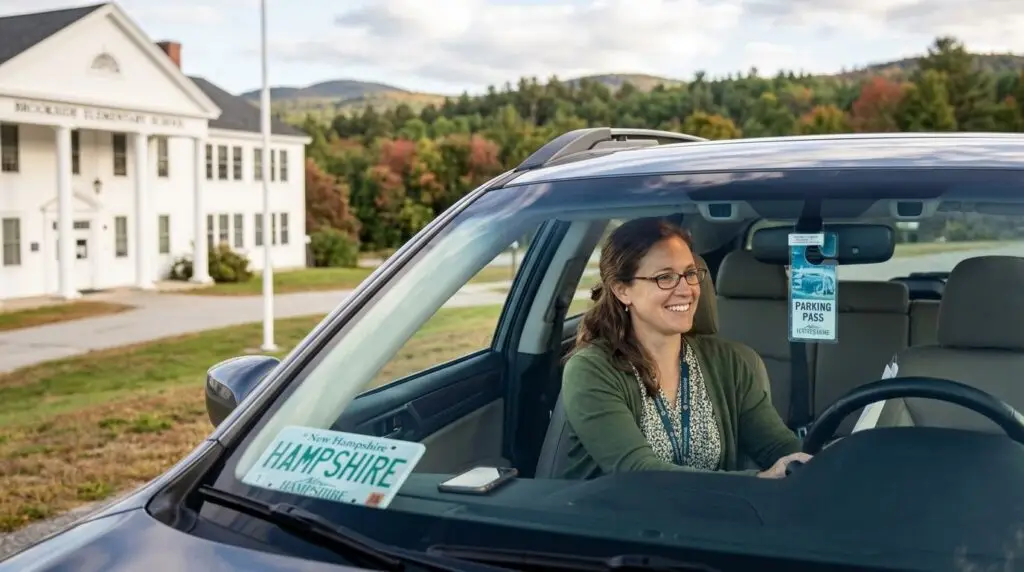
Auto insurance for teachers in New Hampshire works the same as any personal auto policy, but a teacher's driving pattern — short in-district commutes, summer schedule changes, occasional trips hauling students to games or field trips in a personal car — changes which discounts and coverage limits actually save money. New Hampshire is the only state that does not legally require drivers to carry auto insurance, but nearly every district employee still needs to meet the state's financial responsibility law, and most teachers carry more than the bare minimum because of what's parked in the school lot.
- Auto insurance for teachers NH should start with an educator discount check before shopping full quotes.
- New Hampshire has no mandatory auto insurance law, but financial responsibility limits still apply to every licensed driver.
- Bundling home and auto is the single biggest lever most NH teachers leave on the table in 2026.
- Low-mileage and usage-based programs fit a 10-month school-year commute better than a standard annual policy.
- Coaching, tutoring, or driving students in a personal vehicle needs a coverage check, not an assumption.
Why auto insurance matters differently for teachers
A teacher's driving profile doesn't look like a typical commuter's. School is in session roughly 180 days a year, summer break drops mileage sharply, and a lot of educators pick up a second job, summer coursework, or coaching duties that add unplanned trips. None of that shows up automatically on a standard auto policy — you have to ask for it.
Carriers price auto insurance around who is behind the wheel and how often. A teacher commuting 12 miles to a single district five days a week, nine months a year, is a lower-risk driver than the average full-time commuter, and that gap is worth real premium dollars once the policy reflects it. Check the home side at the same time: home insurance for teachers in New Hampshire often qualifies for the same professional-affinity discounts as auto.
Update your driver profile with your actual commute
Most teachers are still rated on whatever commute distance was entered years ago, even after changing schools or moving.
- Recalculate mileage from your current address to your current school, not your first-year assignment
- Flag summer months as reduced-use if you don't commute daily June through August
- Report a garage-kept vehicle if you park at home overnight instead of on-street
- Correct your occupation code — some carriers list a generic office-worker code instead of educator, which can miss a discount
- Update household drivers if a teen driver in your home just got licensed
Ask about professional and educator discounts
Plenty of teachers never ask whether their district, union, or professional association qualifies them for an affinity discount, because the renewal notice doesn't mention it.
- Ask your carrier directly whether an NEA, AFT, or state teachers' association discount applies
- Ask for a multi-policy discount if your home and auto sit with different carriers right now
- Ask about a defensive driving course credit — many NH carriers apply this regardless of age
- Confirm whether autopay or paperless billing knocks anything off the premium
- Look for a good-student discount if you have a teen driver who's also a student
A fuller list of what's available statewide is on the auto insurance discounts available in New Hampshire guide.
Review liability limits before you drive students anywhere
Coaching a team, running a club that meets off-campus, or giving a colleague a ride after a late staff meeting all put your personal auto policy on the hook if something goes wrong.
- Confirm your liability limits cover a multi-passenger accident, not just a single-driver claim
- Ask whether your district provides any coverage for school-sanctioned trips in a personal vehicle — most don't
- Consider raising bodily injury liability if you regularly drive students or coworkers
- Check whether an umbrella policy is cheaper than raising auto limits alone
- Never assume a personal-errand exception applies once a student or minor is in the car
Match your policy structure to a 10-month schedule
A standard annual auto policy assumes the same driving pattern every month. Teaching doesn't work that way, and the mismatch usually costs the teacher money.
- Ask about low-mileage rating if you drive under roughly 7,500 to 10,000 miles a year, an option built for low-mileage drivers in New Hampshire
- Ask whether a telematics or usage-based program tracks your summer reduction automatically instead of requiring a manual update
- Don't let coverage lapse over summer even if the car sits — a lapse resets your continuous-coverage credit
- Time your policy review for August, before the new school year commute locks in
- Re-shop every two years minimum; a rate that was competitive in 2023 may not be your cheapest option in 2026
Confirm you're meeting New Hampshire's requirements, not just habit
New Hampshire doesn't force drivers to buy auto insurance, but skipping it means you are personally responsible for damages if you cause an accident, and most lenders financing a car require coverage anyway.
- Check the state's financial responsibility limits against what your current policy actually carries
- Walk the specifics with how to meet New Hampshire's minimum auto insurance requirements
- Confirm uninsured and underinsured motorist coverage — critical in a state where some drivers legally carry none
- Ask whether your lender or lease requires comprehensive and collision regardless of state law
- Reconfirm limits any time you change vehicles, since a newer financed car changes what's required
Bundle home and auto if you haven't already
Most teachers skip this because their home and auto policies were bought years apart, from different agents, and nobody has revisited it since.
- Ask for a bundled quote even if you're satisfied with both carriers separately
- Compare the bundled discount against each policy's standalone price — sometimes splitting still wins
- Re-run the comparison at renewal, not just at signup, because bundled pricing shifts year to year
- Bundle a second vehicle or a motorcycle into the same review while you're at it
A teacher driving a low-mileage, garage-kept car nine months a year with an unclaimed educator discount is very likely overpaying in 2026 — check both before renewing.
Get your NH auto policy reviewed
A quick review covers discounts, liability limits, and bundling in one pass.
Comparison: auto insurance options for NH teachers
| Option | Best for | Key limitation |
|---|---|---|
| Standard annual policy | Teachers with a steady year-round commute plus side driving duties | Doesn't adjust for the summer mileage drop automatically |
| Low-mileage rated policy | Teachers under roughly 7,500 to 10,000 miles a year | Requires mileage reporting or odometer check-ins |
| Usage-based telematics program | Teachers who want automatic credit for a light, safe driving pattern | Tracking app or device required; not offered by every NH carrier |
| Bundled home and auto | Homeowners currently carrying two separate policies | Only pays off if the bundled discount beats both standalone rates |
| Financial-responsibility-level coverage only | Older, paid-off vehicles with low replacement value | Leaves you exposed for at-fault accident costs and vehicle damage |
Common mistakes NH teachers make
- Assuming summer break automatically lowers the bill. Carriers don't adjust mileage or usage ratings unless you report the change.
- Never mentioning coaching or student transport. Driving students in a personal vehicle without flagging it can complicate a claim.
- Skipping the educator discount because the renewal notice never asks. Affinity discounts are opt-in, not automatic.
- Letting the policy sit unshopped for years. A rate that was fine in your first district can drift well above market by 2026.
- Treating home and auto as separate errands. Reviewing them in one sitting is where most of the savings show up.
FAQ
Is there a special auto insurance discount for teachers in New Hampshire?
Some carriers offer an educator or professional-affinity discount tied to NEA, AFT, or state teachers’ association membership. It isn’t universal, so ask your carrier directly rather than assuming it’s applied.
Does New Hampshire legally require auto insurance?
No. New Hampshire is the only state without a mandatory auto insurance law, but drivers are still held to the state’s financial responsibility limits and lenders require coverage on a financed vehicle.
Can I get a lower rate for driving less during summer break?
Yes, if you report the reduced mileage or move to a low-mileage or usage-based rating. Carriers do not apply this automatically just because school is out.
Does my personal auto policy cover me if I drive students to a school event?
That depends on your liability limits and your carrier’s rules on transporting non-family passengers. Review your bodily injury limits before regularly driving students or coworkers.
Is bundling home and auto insurance worth it for teachers?
Often yes, but not always. Compare the bundled price against each policy priced separately, since bundled discounts vary by carrier and change at renewal.
What is the difference between low-mileage and usage-based insurance?
Low-mileage rating uses a reported annual mileage figure, while usage-based programs track actual driving through an app or device and adjust pricing from that data.
How often should teachers re-shop auto insurance?
Every two years at minimum, and any time your commute, vehicle, or household drivers change. August is the natural checkpoint before a new school year starts.
Do I need extra liability coverage if I coach a school sport?
Consider higher bodily injury liability or an umbrella policy if you regularly drive multiple students or staff, since districts usually do not cover personal-vehicle trips.
One last thing
The educator discount and the summer mileage adjustment are two separate line items. Claiming one doesn't trigger the other, and most teachers who call about one never think to ask about both in the same conversation — do both in a single review and you only have to have the call once in 2026.
Related guides
- Home insurance for teachers in New Hampshire
- How to bundle home and auto insurance in New Hampshire
- Cheap auto insurance for New Hampshire drivers