

New Hampshire home insurance doesn't run on one statewide number. A house in coastal Rockingham County faces different pricing pressure than the same size home in rural Coos County, because carriers price on rebuild cost, flood exposure, and local claims history, not a flat county rate. The bigger hidden cost most Granite State homeowners miss: a standard policy excludes flood damage, and Seacoast or river-adjacent counties often need a separate flood policy to actually close the gap.
- New Hampshire’s 10 counties don’t share one home insurance rate — coastal Rockingham and river-adjacent counties carry different exposure than the North Country.
- A standard NH homeowners policy excludes flood damage; Seacoast and lakefront properties often need a separate flood policy on top of the base premium.
- Rebuild cost, roof age, distance to a fire station, and local claims history move your number more than the county line does.
- Themello Agency pulls county-specific quotes from multiple carriers instead of guessing at a statewide average.
- The real average home insurance cost in New Hampshire by county only shows up once an underwriter prices your actual address in 2026.
Why this matters
Statewide averages published elsewhere blend a condo in Manchester with a camp on Lake Winnipesaukee and a farmhouse in Coos County. That blended number doesn't match anyone's actual bill in 2026, because the underwriting factors behind it never show up in a single headline figure.
What actually moves your premium: dwelling replacement cost per square foot, roof age and material, distance to a staffed fire station, and whether your address sits in a mapped flood zone. Before comparing county numbers, review your coverage needs so you're pricing the right policy, not just the cheapest one.
Average home insurance cost in New Hampshire by county
No insurer publishes a flat rate per county — pricing runs on the address, not the county line. What does vary predictably by county is the mix of risk factors an underwriter weighs, summarized below for all 10 counties.
| County | Region | Primary cost driver |
|---|---|---|
| Rockingham | Seacoast | Coastal flood and wind exposure |
| Strafford | Seacoast/Southern | River flooding, moderate density |
| Hillsborough | Southern | Highest population density, higher rebuild costs |
| Merrimack | Southern/Central | Mixed urban-rural housing stock |
| Belknap | Lakes Region | Lake Winnipesaukee shoreline, seasonal homes |
| Carroll | Lakes Region/White Mountains | Vacation homes, forest-adjacent land |
| Cheshire | Monadnock | Older housing stock, rural response times |
| Sullivan | Upper Valley | Rural, older homes, well/septic reliance |
| Grafton | North Country | Heavy snow load, remote fire coverage |
| Coos | North Country | Most rural, longest fire response, harsh winters |
The verdict: the county tells you what risks an underwriter will ask about in 2026 — it doesn't tell you the number on the declarations page.
Why home insurance costs vary across New Hampshire counties
- Rebuild cost per square foot — local contractor and material rates differ between the Seacoast and the North Country
- Roof age and material — a 20-year-old roof triggers different underwriting than a new one, regardless of county
- Distance to a fire hydrant or staffed station — rural townships often carry a lower protection class
- Flood zone designation and elevation — coastal and river-adjacent parcels get flagged differently than inland lots
- Local claims history — ice dams, wind, and water damage patterns cluster by region, not by county border
- Home age and systems — older wiring, plumbing, and wood stove use raise questions in every part of the state
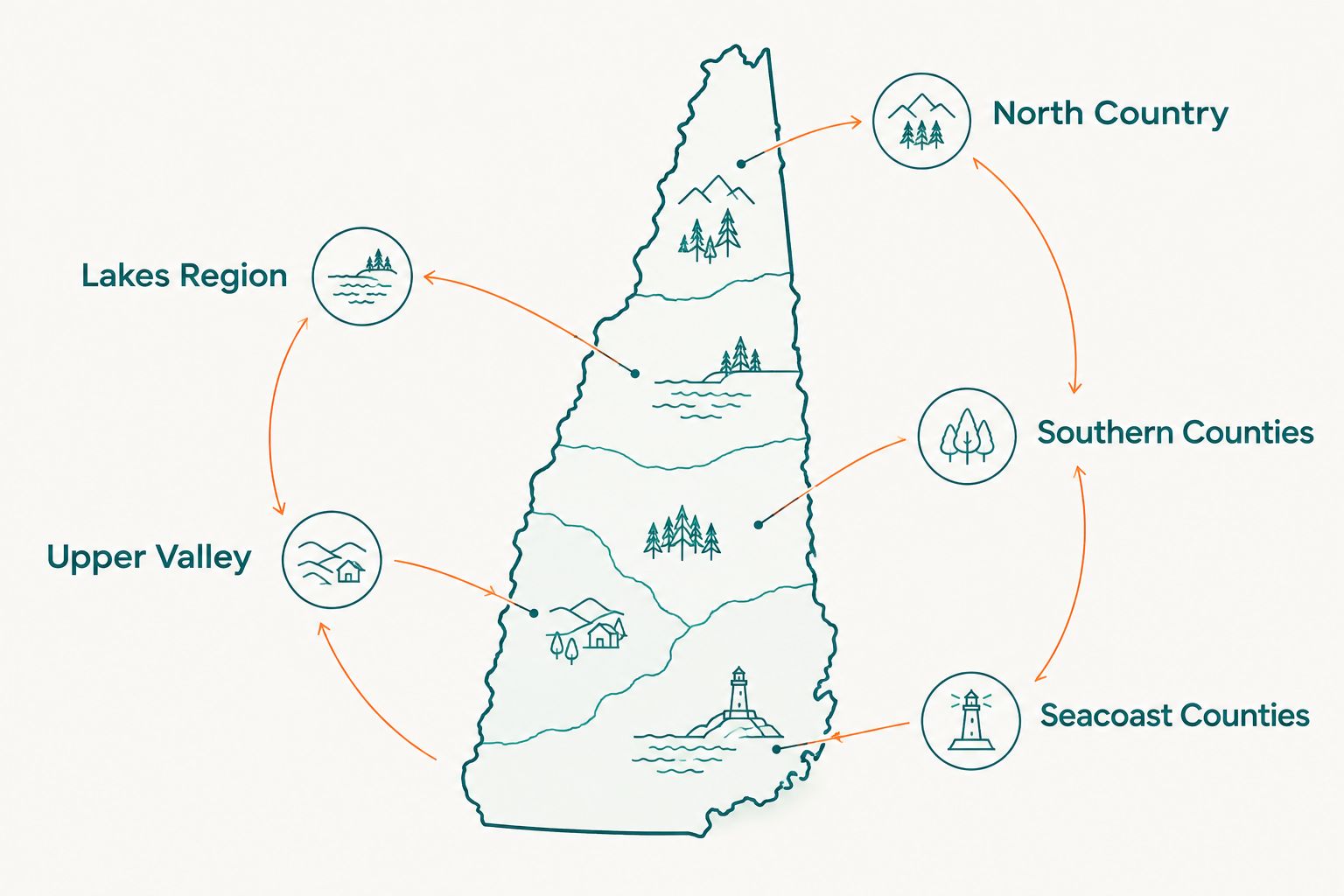
Seacoast counties: Rockingham and Strafford
Rockingham and Strafford border the Atlantic and the tidal Piscataqua and Squamscott rivers. Homes here get asked about elevation certificates and separate flood coverage more than anywhere else in the state. Distance from the water still matters within the same zip code — a place two blocks from Hampton Beach carries different exposure than a house two miles inland.
Lakes Region: Belknap and Carroll
Belknap and Carroll hold Lake Winnipesaukee and the eastern White Mountains. Seasonal and lakefront homes here see more claims tied to ice dams and burst pipes in properties left unoccupied over a New Hampshire winter, plus underwriting questions about detached boathouses and docks.
Southern tier: Hillsborough and Merrimack
Hillsborough and Merrimack cover Manchester, Nashua, and Concord — the most densely populated part of the state. Higher labor and material costs in these markets push rebuild-cost estimates up, and older multi-family conversions add underwriting complexity that a rural single-family home doesn't carry.
Monadnock and Upper Valley: Cheshire and Sullivan
Cheshire and Sullivan carry more pre-1950s farmhouse stock than the rest of the state, which means more questions about knob-and-tube wiring, older plumbing, and wood stove installations. Older and historic homes in this region often need a specific endorsement most standard policies don't include automatically.
North Country: Grafton and Coos
Grafton and Coos see the heaviest snow load in New Hampshire and the longest volunteer fire department response times. Both factors show up directly in protection class ratings, which is one reason two homes of identical size can price differently just because one sits ten minutes closer to a staffed station.
See your county-specific number
A quick review shows what your address actually costs to insure in 2026.
Is homeowners insurance required by law in New Hampshire?
No — New Hampshire does not legally require homeowners insurance in any county. A mortgage lender will require it before closing, and a paid-off homeowner who skips it absorbs the full cost of a wind or water claim alone.
Does a standard New Hampshire home insurance policy cover flood damage?
No — flood damage is excluded from every standard New Hampshire homeowners policy, regardless of county. Homes in Rockingham County's Seacoast towns and anywhere along the Merrimack or Connecticut Rivers typically need a separate flood policy to close that gap.
The quotable line for 2026: the county tells an underwriter what questions to ask, but only an address-level quote from Themello Agency tells you what the policy actually costs.
FAQ
What is the average home insurance cost in New Hampshire by county in 2026?
There’s no single statewide figure for 2026 — New Hampshire’s 10 counties price differently based on flood zone, rebuild cost, and local claims history, so an address-specific quote is the only accurate number.
Which New Hampshire counties have the highest flood risk?
Rockingham and Strafford Counties carry the highest flood risk because of their Atlantic coastline and tidal rivers. Inland counties along the Merrimack and Connecticut Rivers face secondary river-flood exposure.
Does New Hampshire require homeowners insurance?
New Hampshire does not require homeowners insurance by state law in any county, but every mortgage lender requires it as a loan condition.
Is flood insurance separate from home insurance in New Hampshire?
Yes, flood insurance is always a separate policy from a standard New Hampshire homeowners policy, regardless of which county the home sits in.
Does home age affect insurance cost in New Hampshire?
Yes, older homes common in Cheshire, Sullivan, and Coos Counties typically cost more to insure because of outdated wiring, plumbing, and higher rebuild costs for period materials.
How can New Hampshire homeowners lower their premium?
Raising the deductible, bundling auto and home policies, and replacing an older roof are the fastest ways New Hampshire homeowners lower a premium in any county.
Do lakefront homes in New Hampshire cost more to insure?
Yes, lakefront and seasonal homes in Belknap and Carroll Counties often cost more to insure due to detached structures, dock exposure, and winter vacancy risk.
One last thing
New Hampshire's Atlantic coastline runs about 13 miles — the shortest of any coastal U.S. state — and it touches only three towns: Hampton, Rye, and Portsmouth, all in Rockingham County. That tiny stretch of shoreline is why Rockingham carries different underwriting questions than every other county in New Hampshire, even the ones bordering the state's biggest rivers. If you're comparing counties on paper in 2026, remember the map is doing less work than your specific address.
Related guides
- Best home insurance companies for New Hampshire homeowners
- How to lower home insurance premiums in New Hampshire
- How much flood insurance costs in New Hampshire