
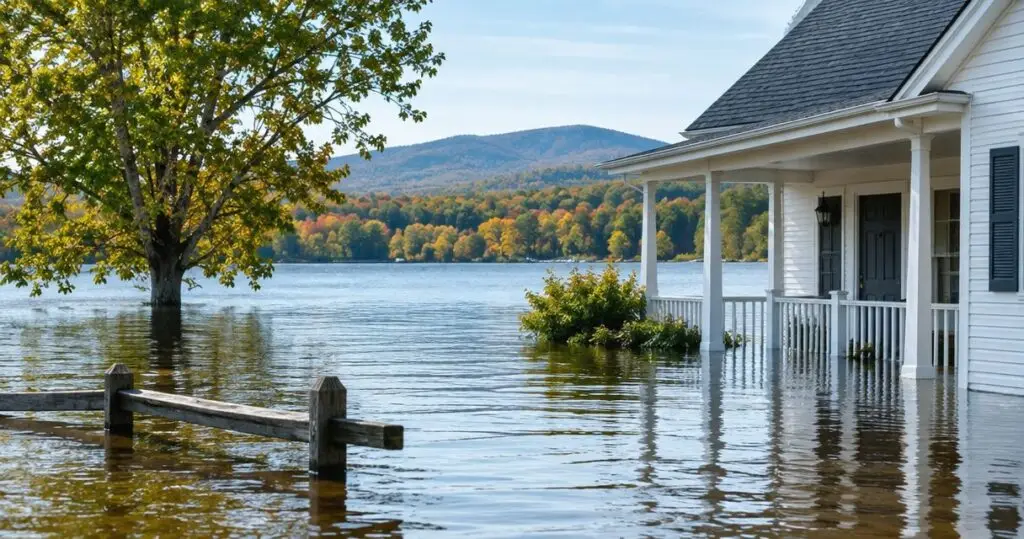
Flood insurance in New Hampshire runs about $888 a year on average through the National Flood Insurance Program (NFIP), but that number moves fast once you factor in flood zone, elevation, and building type — homes near the Merrimack, Connecticut, or Pemigewasset rivers, or on a New Hampshire lake, often land between $1,500 and $3,000+ a year. The average hides a second cost most homeowners miss: NFIP prices building coverage and contents coverage separately, so a finished basement full of furniture, flooring, and mechanicals adds a real dollar amount most people never budget for.
- NFIP flood insurance in New Hampshire averages $888 a year, but high-risk zones near rivers and lakes often run $1,500-$3,000+.
- NFIP caps building coverage at $250,000 and contents coverage at $100,000 — anything above that needs a private flood policy.
- A standard 30-day waiting period applies before NFIP coverage starts, so last-minute purchases before spring runoff don’t help.
- Private flood insurance in New Hampshire can beat NFIP pricing for lower-risk homes and offers higher coverage limits.
- Basements get limited NFIP coverage regardless of how much you pay — furniture and finishes are largely excluded.
Why this matters
New Hampshire doesn't get the hurricane headlines Florida or Louisiana get, but river and lake flooding hits the state every spring during snowmelt and after heavy fall storms. Standard homeowners insurance in New Hampshire excludes flood damage outright — no rider, no exception — so the only way to cover rising water is a standalone flood policy through NFIP or a private carrier.
If your mortgage is federally backed and your home sits in a Special Flood Hazard Area, the lender requires flood insurance as a condition of the loan. Outside that mapped zone, it's optional, but plenty of New Hampshire homeowners near lakes and rivers buy it anyway because the flood zone maps don't always match where water actually goes. A quick review of your coverage needs is the fastest way to find out where you stand before renewal season.
Cost of flood insurance in New Hampshire: NFIP vs. private flood
| Option | Typical annual cost | Coverage limit | Best for |
|---|---|---|---|
| NFIP (federal) | Averages $888, higher in mapped high-risk zones | $250,000 building / $100,000 contents | Homes in a Special Flood Hazard Area with a federally backed mortgage |
| Private flood insurance | Varies by insurer and individual risk assessment | Can exceed NFIP's $250,000/$100,000 caps | Higher-value homes, lake properties, or homeowners who want coverage above NFIP limits |
Verdict: NFIP is the default for most New Hampshire homes in a mapped flood zone, but private flood insurance is worth pricing out for lake and river properties above $250,000 in rebuild value.
NFIP flood insurance: national average is $888 a year
FEMA prices NFIP policies through a system called Risk Rating 2.0, which moved away from flat flood-zone pricing to a model based on distance from a flooding source, elevation, replacement cost, and the number of floors below flood level. That's why two houses in the same New Hampshire town, both technically in the same flood zone, can carry different premiums.
An elevation certificate is the single biggest lever homeowners have here — a home built above the base flood elevation typically prices out lower than one built at or below it, even at identical square footage. Communities that participate in FEMA's Community Rating System (CRS) also unlock discounts ranging from 5% to 45% off the base NFIP premium, depending on the town's flood-mitigation score.
Private flood insurance: cost varies by risk, not zone maps
Private flood carriers don't use NFIP's rating tables, so pricing swings more by individual underwriting than by a published national average. For a lower-risk New Hampshire home outside a mapped flood zone, private flood insurance sometimes beats NFIP on price. For a higher-risk property that needs coverage above the $250,000/$100,000 NFIP caps, private flood is often the only way to insure the full rebuild value.
The tradeoff: private policies vary more by carrier in what they exclude, and availability isn't universal across every New Hampshire town. That's a conversation worth having policy-by-policy rather than assuming one option automatically wins.
Why flood insurance cost varies across New Hampshire
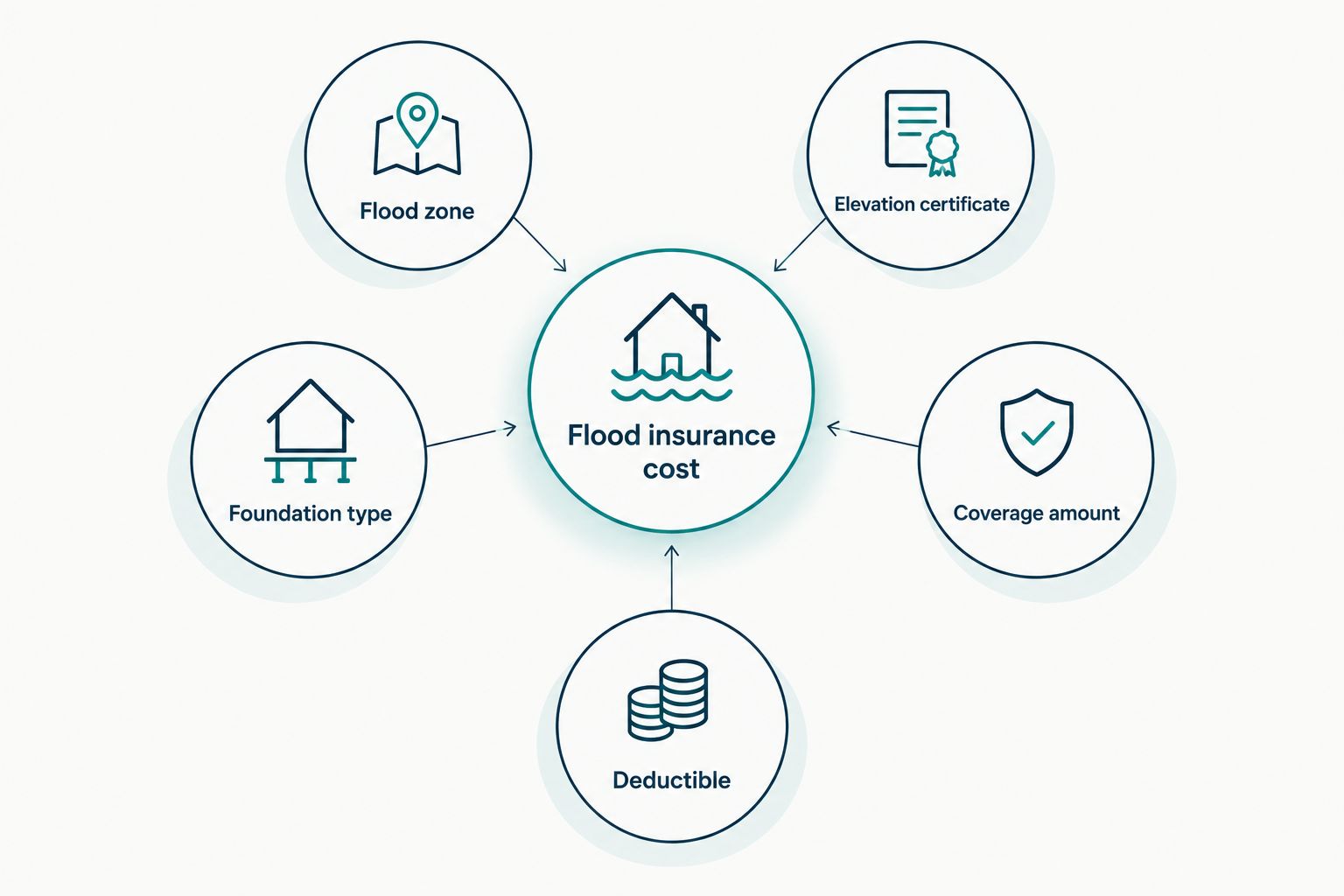
- Flood zone designation — a mapped high-risk zone (AE, VE) prices well above a moderate- or minimal-risk zone (X)
- Elevation certificate results — how high the lowest floor sits relative to base flood elevation
- Foundation type — basements, crawlspaces, and slab-on-grade homes get rated differently
- Building age and construction — older construction methods and materials affect replacement cost estimates
- Coverage amounts chosen — building coverage up to $250,000 and contents up to $100,000 under NFIP, more under private flood
- Deductible selected — higher deductibles lower the annual premium, same as with home or auto insurance
- Community's CRS participation — towns with active flood-mitigation programs pass discounts to residents
A finished basement changes the math the most. NFIP limits basement and below-grade coverage to specific items — utilities, foundation elements, and cleanup — not furniture, flooring, or finished walls. If that describes your setup, the finished basement flood coverage page breaks down what's actually covered before you assume a standard policy protects the whole space.
A quick review with an agent settles most of this without guesswork — the Themello Agency team can walk through NFIP and private flood side by side and flag which factors are actually pushing your number up before you commit. For businesses carrying separate flood exposure, the flood insurance for New Hampshire businesses page covers how commercial flood pricing differs from residential.
Get a flood coverage review
Compare NFIP and private flood options for your address in one call.
Is flood insurance required in New Hampshire?
Flood insurance is required in New Hampshire only when a home sits in a mapped Special Flood Hazard Area and carries a federally backed mortgage — otherwise it's optional, though river and lake proximity make it a common purchase anyway. Lenders enforce this at closing and at renewal, so a flood zone remap can trigger a new requirement even on a home that never needed it before.
Does homeowners insurance cover flood damage in New Hampshire?
No, standard homeowners insurance in New Hampshire excludes flood damage entirely, regardless of carrier or policy tier. Rising water from a river, lake, snowmelt, or storm surge needs a separate NFIP or private flood policy — homeowners insurance only responds to wind-driven rain or burst pipes, not external flooding.
How much does flood insurance cost for a lake home in New Hampshire?
Lake homes in New Hampshire typically price above the $888 national NFIP average because proximity to standing water and lower elevation both push the premium up. The exact number depends on the same factors as any other property — flood zone, elevation certificate, and foundation type — which is why two homes on the same lake can carry different bills.
FAQ
How much does flood insurance cost in New Hampshire in 2026?
Flood insurance in New Hampshire averages $888 a year through NFIP in 2026, with high-risk river and lake properties often running $1,500 to $3,000 or more depending on elevation and building type.
Is flood insurance required in New Hampshire?
Flood insurance is required only for homes in a mapped Special Flood Hazard Area with a federally backed mortgage. Outside that zone, it’s optional but common near rivers and lakes.
Does homeowners insurance cover flood damage in New Hampshire?
No, standard homeowners insurance excludes flood damage. You need a separate NFIP or private flood policy to cover rising water.
What is the waiting period for flood insurance in New Hampshire?
NFIP policies carry a standard 30-day waiting period before coverage takes effect, with limited exceptions tied to new mortgage closings.
Can I buy private flood insurance instead of NFIP in New Hampshire?
Yes, several carriers offer private flood policies as an alternative or supplement to NFIP, often with higher coverage limits than NFIP’s $250,000 building cap.
How much of a finished basement does flood insurance cover in New Hampshire?
NFIP limits basement coverage to specific items like utilities, foundation elements, and cleanup — furniture, flooring, and finished walls are largely excluded regardless of your premium.
Does flood insurance cost more for lake homes in New Hampshire?
Yes, lake homes typically price above the $888 national NFIP average because of lower elevation and closer proximity to standing water, though the exact number still depends on your elevation certificate.
One last thing
The 30-day NFIP waiting period is the detail that catches New Hampshire homeowners every spring — buying flood coverage the week before snowmelt is already too late, since the policy won't be active yet. If you're anywhere near a river, lake, or floodplain, price out coverage in the fall or winter, not after the first flood watch of the season.
Related guides
- Flood insurance for New Hampshire lake homes
- Flood insurance for renters in New Hampshire
- Flood insurance for New Hampshire businesses