
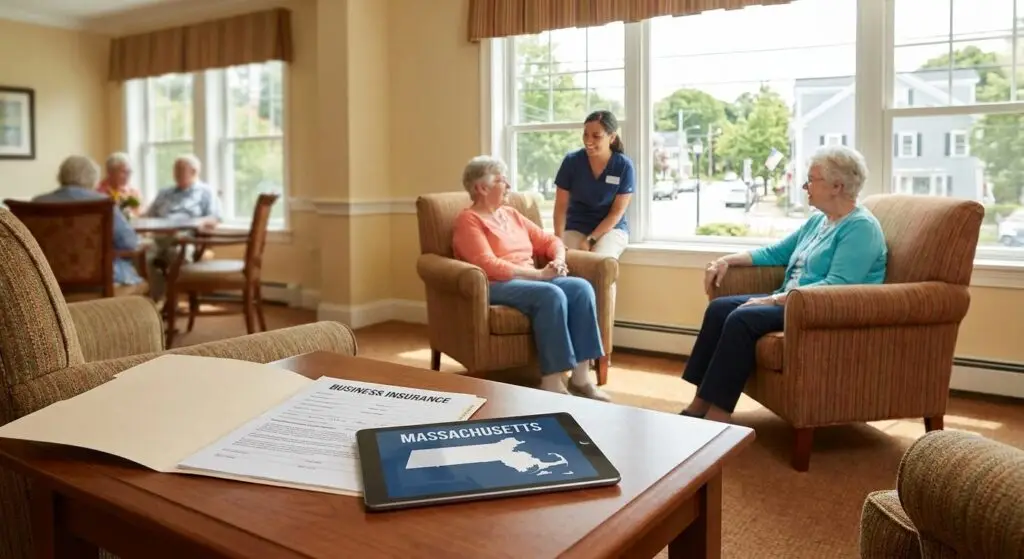
Assisted living facility insurance in Massachusetts covers the liability, property, and staffing risks unique to licensed residential care — and the wrong policy leaves an operator exposed on the one claim that actually happens: a resident fall, a medication error, or a wrongful discharge complaint.
- Assisted living facility insurance in Massachusetts needs general liability, professional liability, and workers’ comp as the base stack — anything thinner is a gap waiting to show up at claim time.
- Standard general liability limits for most Massachusetts assisted living residences run $1 million per occurrence and $3 million aggregate in 2026.
- Professional liability (errors and omissions) is the coverage operators skip most often and regret first — buy it, don’t bundle it down.
- Umbrella coverage matters most for multi-site operators, not single-location residences under 40 units.
- Themello Agency reviews existing assisted living coverage against actual resident-care risk before recommending a change — call before your renewal date, not after a claim.
Why this matters
Massachusetts licenses assisted living residences (ALRs) through the Executive Office of Elder Affairs, not as nursing homes — that distinction changes which liability class your policy needs to sit in. A generic business owner's policy written for an office or retail account almost never fits an ALR's exposure profile: 24-hour staffing, resident falls, medication assistance, and transportation between appointments all carry different risk than a standard commercial building.
Themello Agency reviews existing coverage against the specific risks a Massachusetts assisted living operator carries before recommending a change, rather than swapping in a generic package. Get that review done before your renewal date shows up, not after a claim forces the conversation.
Who this is for
This guide is for owners and administrators of licensed assisted living residences in Massachusetts — single-location operators running 20 to 40 units, multi-site groups managing several communities across the state, and administrators handling their first renewal after a change in ownership or license status. If your business serves residents who need help with daily activities but not skilled nursing care, this is your coverage stack, not a nursing home or hospital policy.
What to look for in assisted living facility insurance in Massachusetts
General liability limits sized to your resident count
A fall in a hallway or a medication mix-up in the dining room turns into a claim fast, and defense costs alone can eat a $500,000 limit before a settlement even gets discussed. Most Massachusetts assisted living residences carry $1 million per occurrence and $3 million aggregate as the working minimum in 2026, not a suggested ceiling.
Professional liability (errors and omissions)
General liability handles slip-and-fall; it does not handle a claim that staff missed a care plan step or delayed calling a family member during a medical event. Professional liability is the coverage that answers allegations about how care was delivered, not just where an injury happened, and it is the line item operators cut first when a quote gets expensive.
Workers' compensation that matches Massachusetts law
Massachusetts requires workers' compensation coverage the moment a facility has even one employee, and staffing agencies or per-diem aides do not always count as contractors the way an operator assumes. Misclassifying caregiving staff to save on premium is the single most common audit finding that turns into back-owed premium plus penalties.
Property coverage for the building and its systems
An assisted living building runs sprinklers, nurse call systems, emergency generators, and HVAC that keeps rooms at a safe temperature for elderly residents — all of it needs to be scheduled on the policy, not lumped into a generic "building and contents" line. A generator failure during a heat wave is a liability event, not just a property loss.
Umbrella liability if you operate more than one location
A single severe claim can blow through primary limits across an entire portfolio, and umbrella coverage sits above general liability, professional liability, and auto to catch that overflow. Single-location operators under 40 units often don't need it yet; three-site operators almost always do.
Business interruption coverage
A fire, burst pipe, or storm that forces a temporary resident relocation still generates payroll and mortgage obligations while the building sits empty. Business interruption coverage replaces that income gap so the operator isn't funding it out of cash reserves.
Coverage priorities, ranked
General liability with $1M/$3M limits — the non-negotiable. Spec that matters: per-occurrence limit versus aggregate limit, because a single bad year with multiple claims can exhaust an aggregate fast. Themello Agency starts every assisted living review with this number first. Buy.
Professional liability (E&O) — the coverage operators skip. Written to match the general liability limit in most Massachusetts placements, this line covers care-delivery allegations that a general liability form won't touch. Skip it and the facility is unprotected on the claim type that actually drives assisted living litigation. Buy.
Workers' compensation — the legal floor. Massachusetts law requires it with one employee on payroll, full stop, and per-diem staffing doesn't change that math once classification gets reviewed. Buy.
Umbrella liability — the wildcard. Adds $1 million to $5 million above primary limits, and it earns its premium the year a claim actually reaches the top of a primary policy. Multi-site operators: Consider. Single-location residences under 40 units: Skip until the portfolio grows.
Business interruption — the safety net. Pays payroll and fixed costs during a covered closure, and it's the line item that keeps a facility solvent through a slow rebuild after fire or storm damage. Consider, especially for operators without six months of cash reserves.
What to avoid
- Bundled BOP policies with a thin professional liability sub-limit. A business owner's policy that adds professional liability as a $100,000 endorsement looks like coverage on paper and folds the moment a real claim shows up.
- Policies missing an abuse and molestation liability endorsement. Standard general liability forms often exclude this exposure by default in senior care settings — it has to be added, not assumed.
- Treating per-diem and agency staff as contractors on the workers' comp application. Massachusetts audits catch this, and the back premium plus penalty usually costs more than the coverage would have.
Verdict comparison table
| Coverage | Typical limit | Priority for MA assisted living | Verdict |
|---|---|---|---|
| General liability | $1M / $3M | Every operator, every size | Buy |
| Professional liability (E&O) | Matches GL limit | Every operator | Buy |
| Workers' compensation | Statutory | Any facility with employees | Buy |
| Umbrella liability | $1M–$5M excess | Multi-site operators | Consider |
| Business interruption | Based on payroll/fixed costs | Operators without deep cash reserves | Consider |
Get your assisted living coverage reviewed
Call or text for a no-pressure review before your renewal date hits.
FAQ
What insurance does an assisted living facility need in Massachusetts?
A Massachusetts assisted living residence needs general liability, professional liability (errors and omissions), workers’ compensation, and property coverage at minimum in 2026. Multi-site operators typically add umbrella liability and business interruption coverage on top of that base.
How much does assisted living facility insurance cost in Massachusetts?
Cost depends on resident count, staffing model, and claims history, so a facility-specific quote is the only reliable number. A coverage review that compares your current limits against typical $1M/$3M general liability benchmarks is the faster way to know if you’re over- or under-insured.
Is professional liability the same as general liability for assisted living?
No — general liability covers physical injuries like slips and falls, while professional liability covers allegations about how care was actually delivered, such as a missed medication or delayed response to a medical event. Assisted living residences need both, not one or the other.
Does Massachusetts require workers’ compensation for assisted living staff?
Yes, Massachusetts law requires workers’ compensation coverage once a facility has even one employee, and this applies regardless of facility size. Per-diem and agency staff can still trigger classification issues during an audit, so job titles on the policy application need to match actual duties.
Do I need umbrella coverage for a single assisted living location?
Most single-location residences under 40 units don’t need umbrella coverage yet, since primary limits of $1M/$3M usually absorb typical claim severity. Once an operator adds a second or third site, umbrella coverage becomes worth pricing out.
What’s not covered by a standard business owner’s policy for assisted living?
A standard business owner’s policy built for a generic small business often excludes or under-limits abuse and molestation liability and caps professional liability far below what an assisted living residence actually needs. Those gaps only show up when a real claim tests the policy.
How often should an assisted living facility review its insurance coverage?
Review coverage at every renewal and any time resident count, staffing model, or ownership changes, since all three shift the underlying risk. A facility that added a memory care wing or grew from 25 to 40 units without updating limits is carrying outdated coverage.
One last thing
Massachusetts assisted living residences are licensed separately from nursing homes, and that classification line on your policy application matters more than the coverage limits themselves — a facility miscoded as a nursing home or a boarding house can end up with exclusions that don't match how the building actually operates day to day. Check the classification code before you check the premium.