
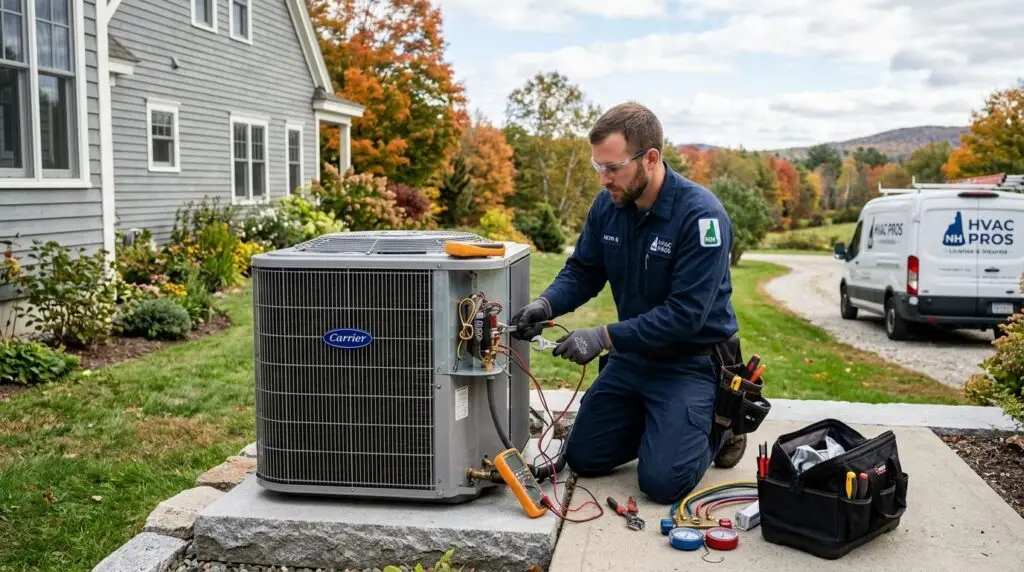
HVAC contractor insurance in New Hampshire is a package of business coverages — general liability, workers' compensation, commercial auto, and tools/equipment protection — built around the specific risks of installing and servicing heating and cooling systems in someone else's home or building. HVAC techs work with gas lines, refrigerant, ladders, and confined crawlspaces on every job, which puts this trade in a different risk bracket than a typical retail or office business. A policy sized for a general contractor rarely fits an HVAC operation cleanly, because the equipment values and on-site hazards run higher.
- HVAC contractor insurance in NH combines general liability, workers’ comp, commercial auto, and tools coverage into one package.
- New Hampshire law (RSA 281-A) requires workers’ compensation once you have even one employee, full-time or part-time.
- Personal auto policies exclude business use, so a service van or truck needs commercial auto coverage before it’s driven to a job.
- Tools and refrigerant recovery equipment left in a van overnight are a common gap — inland marine coverage closes it.
- A business owner’s policy (BOP) bundles liability and property coverage for most solo and small HVAC shops at a lower administrative cost than buying each piece separately.
Why HVAC contractor insurance matters for New Hampshire businesses
HVAC work carries claim exposure that shows up in three places: the customer's property, your crew, and your vehicles. A brazing torch used near combustible framing, a refrigerant line that leaks into a finished basement, or a technician who falls off a roof unit — each of these is a real claim scenario tied to the daily mechanics of the job, not a hypothetical.
New Hampshire's RSA 281-A makes workers' compensation mandatory for almost every employer in the state, and HVAC crews that climb ladders and carry heavy equipment fall squarely into higher-rated classifications. Most commercial clients and general contractors also won't let an HVAC sub on a job site in 2026 without proof of active general liability and workers' comp — a certificate of insurance is now a standard condition of the contract, not a courtesy request.
Steps to build the right coverage for your HVAC business
Confirm your general liability limits match your job size
General liability is the base layer for any HVAC operation and covers third-party bodily injury and property damage from your work.
- Check that your policy carries at least $1 million per occurrence and $2 million aggregate — the limits most GCs and property managers require before signing a subcontract.
- Ask whether completed operations coverage applies after the job is done, since HVAC failures (a leak, a fire from faulty wiring) often surface weeks later.
- Confirm the policy covers refrigerant handling and gas line work specifically, not just generic "contracting" operations.
- Get a certificate of insurance template ready to send commercial clients on request.
Set up workers' compensation before you hire your first employee
New Hampshire requires workers' comp the moment you bring on staff, and skipping it exposes you to fines and direct liability for medical costs.
- Classify each employee correctly — installers, service techs, and office staff carry different rate classes.
- Include part-time and seasonal help; RSA 281-A doesn't carve out an exception for hours worked.
- Review experience modification factors annually, since a clean claims record over 2025 and 2026 can lower your renewal rate.
- If you're a sole proprietor with no employees, check whether you still want a policy for your own on-the-job injury protection.
A workers' compensation policy for New Hampshire small businesses is the piece most HVAC owners underbuy, usually because they wait until the first hire is already on the payroll.
Insure every vehicle used for the business, not just the "work truck"
Personal auto policies exclude commercial use, so any van, pickup, or trailer that carries tools or techs to job sites needs its own coverage.
- List every vehicle on the policy, including a technician's personal truck if it's used for service calls.
- Add hired and non-owned auto coverage if employees ever use their own vehicles for pickups or supply runs.
- Confirm cargo coverage extends to tools and parts stored in the vehicle, not just the vehicle itself.
- Review mileage and radius of operation, since rates shift if you expand service territory beyond your original coverage area.
Commercial auto insurance built for New Hampshire business fleets covers a single service van the same way it covers a five-truck fleet — the policy scales with the business.
Protect tools, refrigerant recovery units, and equipment left in the van
HVAC gear — gauges, recovery machines, brazing kits — represents thousands of dollars sitting unlocked in a vehicle overnight, and standard property or auto policies rarely cover it fully.
- Inventory tools by serial number and replacement cost, updated at least once a year.
- Add inland marine coverage for equipment that moves between job sites rather than staying in one shop location.
- Check theft coverage limits specifically, since job-site tool theft is one of the more common claims in the trade.
- Confirm coverage follows the equipment to a customer's property, not just while it's in your van.
Inland marine coverage for New Hampshire contractors is the line item most solo HVAC operators skip until a break-in wipes out a season's worth of tools.
Bundle liability and property into a business owner's policy where it fits
A business owner's policy combines general liability and commercial property into one contract, usually at a lower combined cost than buying each separately for a small shop.
- Compare a standalone general liability policy against a BOP quote before renewing.
- Confirm the BOP's property limits actually cover your shop, storage unit, or office space at replacement cost.
- Ask if business interruption coverage is included — useful if a fire or storm shuts down your shop for weeks.
- Check exclusions for professional liability, since design or system-sizing errors on an install often aren't covered under a standard BOP.
Review coverage annually as revenue and crew size change
An HVAC shop that adds a second van or hires two more techs in a single season often outgrows its original policy limits without anyone flagging it.
- Recalculate payroll for workers' comp at each renewal, since premiums are tied directly to reported wages.
- Revisit liability limits if you've started bidding larger commercial jobs.
- Confirm new vehicles or equipment purchases are added to the policy the same week they're put into service, not at the next renewal.
- Ask your agent for a coverage review every 12 months rather than waiting for a claim to expose a gap.
Comparing coverage options for HVAC contractors
| Option | Best for | Key limitation |
|---|---|---|
| Standalone general liability | Solo operators with minimal equipment on hand | Doesn't cover vehicles, tools, or employee injuries |
| Business owner's policy (BOP) | Small shops with a fixed location and modest equipment value | Property limits may not match high-value refrigerant equipment |
| Workers' compensation | Any HVAC business with one or more employees | Legally required in NH once staff are hired — not optional |
| Commercial auto | Any business using vehicles for service calls | Personal auto policies exclude business use entirely |
| Full contractor package (GL + WC + auto + inland marine) | Growing HVAC operations with crews and multiple vehicles | Requires more setup time and coordination across coverage lines |
A full contractor package with general liability, workers' comp, commercial auto, and inland marine coverage is the right call for any HVAC shop in New Hampshire with employees and a service vehicle in 2026 — a standalone GL policy alone is not enough once you're on payroll and on the road.
Common mistakes HVAC contractors make on insurance
- Treating a personal auto policy as sufficient for a service van, which leaves a business-use claim denied outright.
- Skipping workers' comp for part-time help, assuming NH law only applies to full-time staff — it doesn't.
- Underinsuring tools and refrigerant recovery equipment, then discovering the standard policy caps equipment coverage far below replacement cost.
- Not updating payroll figures at renewal, which can trigger a large audit bill if actual wages ran higher than the original estimate.
- Assuming a certificate of insurance from last year is still valid for a new commercial contract — most GCs require a current certificate dated within the job's timeframe.
Get your HVAC coverage reviewed
A quick review shows what your current policy actually covers.
FAQ
How much does HVAC contractor insurance cost in New Hampshire?
Cost depends on payroll, revenue, vehicle count, and claims history, so there’s no flat statewide rate. A quick review of your current setup is the fastest way to see where your numbers land in 2026.
Is workers’ compensation required for a one-person HVAC business in NH?
If you have no employees, workers’ comp isn’t legally required under RSA 281-A, but the moment you hire even one part-time helper, coverage becomes mandatory. Many solo owners still carry it for their own injury protection.
Does general liability cover refrigerant leaks or gas line damage?
Standard general liability typically covers third-party property damage from your work, including refrigerant or gas-related incidents, but limits and exclusions vary by carrier. Confirm the policy explicitly addresses HVAC-specific hazards before relying on it.
Can I use my personal truck for HVAC service calls without extra coverage?
No — personal auto policies exclude business use, so a truck used for service calls needs commercial auto coverage. A claim involving business use on a personal policy is typically denied.
What’s the difference between a BOP and buying general liability separately?
A business owner’s policy bundles general liability with commercial property coverage in one contract, usually at a lower combined cost for small shops with a fixed location. Standalone general liability skips the property piece entirely.
Do I need inland marine coverage if my tools stay in a locked shop?
If your tools rarely leave the shop, standard commercial property coverage may be sufficient. Inland marine matters most when tools and equipment travel between job sites in a van, since that’s when theft and damage claims spike.
How often should an HVAC business review its insurance coverage?
Once a year at minimum, and any time you hire, add a vehicle, or take on larger commercial contracts. Payroll and equipment values shift fast in a growing HVAC shop, and outdated limits are a common gap found during claims.
One last thing
The gap that catches the most HVAC owners off guard isn't liability or workers' comp — it's the equipment sitting in the van overnight. A recovery machine and a set of gauges can run into thousands of dollars, and without inland marine coverage, a break-in at a job site parking lot in 2026 comes out of your own pocket, not the insurer's.
Related guides
- Business insurance for contractors in New Hampshire
- How to choose a business owner's policy in New Hampshire