
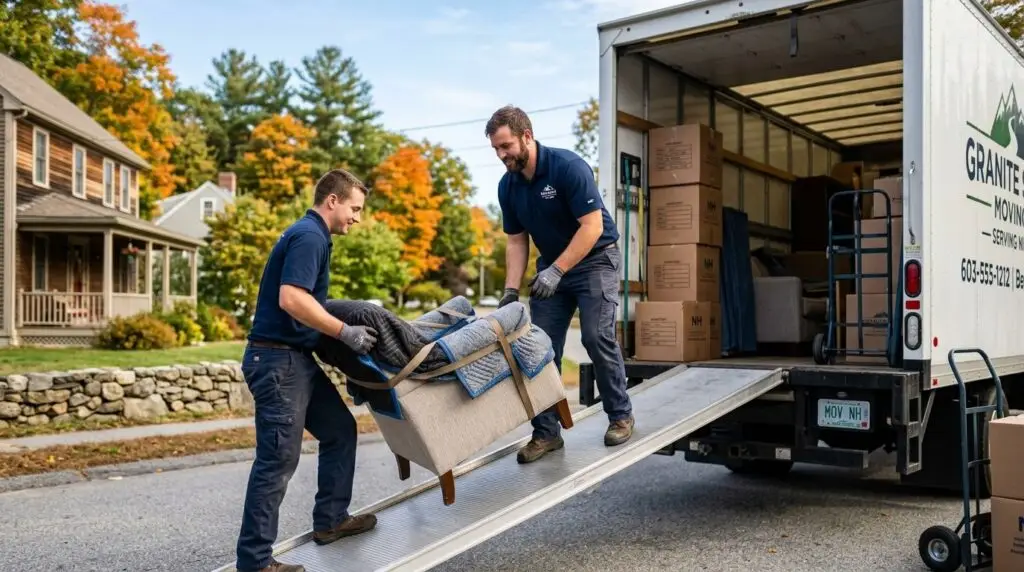
Moving company insurance in New Hampshire means pairing commercial auto and cargo coverage with general liability, workers' comp, and inland marine so a dropped piano or a rear-ended box truck doesn't become an existential problem. A moving crew carries other people's belongings through narrow doorways and down icy driveways all winter, which puts this business in a different risk category than a typical NH contractor or retailer.
- Moving company insurance nh needs at minimum commercial auto, cargo, general liability and workers’ comp — a standard NH business owners policy alone will not cover goods in transit.
- New Hampshire requires workers’ compensation for movers the moment you hire employee #1, full-time or part-time.
- Cargo (goods-in-transit) coverage is the piece most NH movers skip until a claim proves they needed it.
- Inland marine covers the dollies, pads, ramps and rented equipment that a general liability policy won’t touch.
- Mello Agency reviews NH moving company policies for gaps in cargo limits and auto coverage before renewal, not after a claim.
Why moving company insurance matters for NH movers
A moving crew in Manchester or Nashua is exposed on three fronts every single job: the truck on I-93, the crew inside somebody's house, and the goods themselves once they leave the driveway. Damage claims in this business aren't hypothetical — a scratched hardwood floor, a shattered TV, or a fender-bender on a residential street in Bedford can each trigger a different type of claim under a different type of policy.
New Hampshire's winter driving conditions add another layer. Icy driveways and unplowed lots increase slip-and-fall exposure for crew members carrying furniture, which is exactly the kind of claim workers' compensation insurance for New Hampshire small businesses is built to absorb. Skip that coverage, or carry too little of it, and an injured mover's medical bills come straight out of the company's pocket.
Confirm the coverages NH law and clients actually require
Before comparing carriers, nail down what's non-negotiable for a moving company operating in New Hampshire in 2026.
- Workers' compensation the day you hire employee #1 — NH law does not exempt small crews or part-timers
- Commercial auto liability on every truck, van, or trailer used for hauling client goods
- General liability with limits that match what commercial landlords and property managers require before a crew enters a building
- Cargo (goods-in-transit) coverage sized to the average shipment value your crew handles
- Proof of insurance on file for any interstate jobs that fall under federal motor carrier rules
Add cargo coverage for goods in transit
A standard business owners policy stops at the truck's bumper — it does not cover the couch, the piano, or the boxed china once they're loaded and moving. Cargo insurance, sometimes called goods-in-transit coverage, is the piece most NH movers underestimate until a claim exposes the gap.
- Set cargo limits based on your highest-value job in the past 12 months, not the average
- Confirm whether the policy covers items in storage between pickup and delivery
- Check for exclusions on fine art, antiques, or electronics — common carve-outs in cheaper cargo policies
- Ask whether damage from improper packing by your own crew is covered or excluded
Cover the trucks and the crews on the road
Commercial auto is the backbone of any moving company's policy stack, and NH liability minimums for personal vehicles do not carry over to trucks used for hire. Commercial auto insurance for New Hampshire business fleets is built specifically for vehicles that haul goods for a living, not personal errands.
- Insure every truck, van, and trailer on the same schedule — gaps between vehicles create coverage holes
- Add hired and non-owned auto coverage if crews ever drive rented trucks for a job
- Confirm physical damage coverage on the vehicles themselves, not just liability to others
- Review driver qualifications annually — a moving company's rates track its drivers' records closely
Protect against on-site damage claims
General liability is the policy that responds when a mover dings a doorframe, cracks a customer's flooring, or knocks over a lamp that shatters a window. General liability insurance for New Hampshire small businesses is the base layer property managers and commercial clients typically demand before signing a moving contract.
- Carry limits high enough to satisfy commercial building certificates of insurance
- Confirm the policy covers property damage inside a customer's home, not just slip-and-fall injuries
- Ask about completed operations coverage for damage discovered after the crew leaves
- Get additional insured endorsements ready for commercial clients who require them before booking
Cover your crew and control injury costs
Lifting furniture up narrow stairwells and across icy walkways is physical work with real injury risk, and New Hampshire law does not give movers a pass on workers' comp because the crew is small or seasonal.
- Classify workers correctly — misclassifying a mover as a contractor is a common and costly mistake
- Cover part-time and seasonal crew the same as full-time employees
- Document safety training on lifting technique and stair navigation to help control claims
- Review payroll numbers each renewal since workers' comp premiums move with wages
Add inland marine for equipment and tools
Dollies, moving pads, straps, ramps, and rented lift equipment sit outside what general liability and cargo policies cover. Inland marine insurance for New Hampshire contractors fills that gap for equipment that moves between job sites rather than sitting at a fixed location.
- List rented equipment separately — most cargo policies exclude items you don't own
- Cover tools and equipment in transit between jobs, not just on-site
- Check theft coverage for equipment left in an unattended truck overnight
- Confirm coverage extends to a storage unit if the company offers short-term storage
Layer on umbrella coverage for the big claims
A single serious accident or a high-value shipment damaged in transit can blow past a base liability limit fast. An umbrella policy sits on top of general liability, auto, and employer's liability to extend limits when a claim outgrows the underlying policy.
- Size the umbrella to match the largest contract or highest-value move the company takes on
- Confirm which underlying policies the umbrella follows — gaps between them create coverage holes
- Review umbrella limits annually as the fleet and crew size grow
Build the right business owners policy foundation
A moving company's core package — general liability plus property coverage bundled into a business owners policy — sets the baseline that cargo, auto, and workers' comp then build on. How to choose a business owners policy in New Hampshire walks through matching a BOP to the specific risks a moving operation carries, rather than a generic small-business template.
- Confirm the BOP includes equipment and office property, not just liability
- Check business interruption coverage in case a truck is out of service after an accident
- Avoid a one-size BOP sold without cargo or commercial auto attached
Get your NH moving company policy reviewed
A quick review flags cargo and auto gaps before a claim finds them.
Comparison: coverage options for NH moving companies
| Coverage | Best for | Key limitation |
|---|---|---|
| Cargo (goods-in-transit) | Movers hauling client belongings on every job | Excludes items not scheduled or listed on the policy |
| Commercial auto | Any truck or van used for hire | Does not cover the cargo itself, only the vehicle and liability |
| General liability | On-site property damage and injury claims | Stops at completed-operations gaps unless specifically added |
| Workers' compensation | Any crew with one or more employees | Required by NH law regardless of crew size |
| Inland marine | Equipment, dollies, and rented gear in transit | Does not cover client goods — cargo handles that separately |
| Umbrella | High-value moves or large commercial contracts | Only activates after underlying limits are exhausted |
Verdict: a New Hampshire moving company needs cargo, commercial auto, general liability, and workers' comp as the floor — umbrella and inland marine are the next additions once volume grows.
Common mistakes NH moving companies make
- Skipping cargo coverage because the business owners policy "feels complete" — it doesn't cover goods in transit at all
- Misclassifying movers as contractors to avoid workers' comp, which backfires the moment an injury claim gets investigated
- Insuring trucks individually as personal vehicles instead of on a commercial auto schedule, which voids coverage for hire-and-reward hauling
- Underestimating cargo limits based on average jobs instead of the highest-value move taken in the past year
- Leaving rented equipment off the inland marine schedule, assuming it's automatically covered because it's used on a covered job
FAQ
What insurance does a moving company need in New Hampshire?
A moving company in New Hampshire needs commercial auto, cargo (goods-in-transit), general liability, and workers’ compensation at minimum. Larger operations add inland marine for equipment and an umbrella policy once contract values or fleet size increase.
Is workers’ comp required for moving companies in NH?
Yes. New Hampshire law requires workers’ compensation coverage as soon as a business hires its first employee, full-time or part-time, with no size exemption for small moving crews.
Does general liability cover damage to a customer’s belongings?
General liability typically covers on-site property damage like a scratched floor or a broken window, but it does not cover the customer’s belongings while in transit. That gap is what cargo insurance is built to close.
What is cargo insurance for a moving company?
Cargo insurance, also called goods-in-transit coverage, protects the items being hauled once they’re loaded onto the truck. It’s separate from commercial auto, which only covers the vehicle and liability to other drivers.
Do I need commercial auto insurance if I only use one truck?
Yes. A single truck used to haul client belongings for hire needs a commercial auto policy, since personal auto insurance excludes vehicles used for business hauling.
Can a small moving company in NH bundle its coverages?
Many carriers package general liability and property coverage into a business owners policy, then attach commercial auto, cargo, and workers’ comp separately. Bundling where possible keeps renewal dates aligned and can simplify certificates of insurance for clients.
What happens if a moving company doesn’t carry cargo insurance and something breaks?
Without cargo coverage, the company pays out of pocket for damaged or lost items during transit, since general liability and commercial auto don’t cover the goods themselves. This is the single most common coverage gap found in NH moving company reviews.
Does inland marine cover moving equipment like dollies and pads?
Yes, inland marine is designed for tools and equipment that move between job sites, including dollies, pads, straps, and rented lift equipment that general liability and cargo policies typically exclude.
One last thing
The gap that shows up most often in NH moving company reviews isn't the obvious one — it's cargo limits set to match an "average" job instead of the busiest one. A crew that handles a handful of high-value residential moves a year, then defaults to a low cargo limit built for routine jobs, is underinsured exactly when the claim is biggest. Set the limit to the largest shipment on the books, not the typical one.
Related guides
- Umbrella insurance for New Hampshire business owners
- Employment practices liability insurance in New Hampshire
- Best business insurance policies for New Hampshire startups