

New Hampshire ski instructor business insurance is commercial coverage built to protect paid instruction work with the aim of keeping an injury, property claim, or equipment loss from becoming a personal financial problem. In 2026, business insurance for New Hampshire ski instructors starts with general liability insurance for small businesses, then expands based on your contracts, equipment, workers, and off-season services.
- Business insurance for New Hampshire ski instructors starts with general liability coverage.
- Independent instructors must verify whether a resort contract provides any protection for their work.
- A 12-month activity calendar prevents summer coaching and dryland training from being omitted.
- Workers’ compensation obligations can begin when a New Hampshire instructor hires 1 employee.
- Themelloagency is best for instructors who want a direct 2026 business insurance review without technical jargon.
Why business insurance matters for ski instructors
Ski and snowboard instruction combines physical activity, changing conditions, expensive equipment, and direct responsibility for students. Your insurance review must reflect what you actually do: private lessons, group sessions, race coaching, terrain-based instruction, equipment handling, or off-season conditioning.
Your working arrangement matters just as much. A resort employee, independent contractor, solo business owner, and ski school operator do not have the same contracts or insurance responsibilities. Do not assume a resort agreement protects your separate business simply because lessons happen on resort property.
A personal homeowners, renters, or auto policy is not a substitute for commercial coverage. Business-use restrictions and exclusions can leave paid instruction outside the protection you expected. In 2026, the practical move is to document every paid activity and have each relevant policy reviewed against that list.
How to set up ski instructor business insurance
Map your operations
Start with a manual inventory of every service you provide. Insurance applications use broad categories, but a ski instructor's actual work can extend beyond standard beginner lessons. Missing an activity at the application stage creates avoidable questions when a claim is reviewed.
Create a 1-page operations summary for the full 2026 season. Use plain language and include work performed through your own business as well as work completed under another organization's contract.
- List private, group, youth, adult, and adaptive instruction separately
- Identify race coaching, terrain-park instruction, and certification preparation
- Record every mountain, training area, and off-site location
- Note whether you provide, rent, transport, or store student equipment
- Add summer camps, dryland sessions, and other off-season work
Check resort contracts
Read the contract before deciding what coverage you need. Focus on who is responsible when a student alleges injury, equipment damage, or negligent instruction. A certificate request from a resort is not the same as an explanation of what your own policy covers.
Complete a 3-document review using your instructor agreement, current certificate of insurance, and full policy forms. If the contract uses terms you cannot explain in plain English, ask for clarification before signing.
- Find any requirement to carry general or professional liability
- Check whether the resort must be listed as an additional insured
- Read indemnification and defense provisions carefully
- Confirm which locations and activities the agreement covers
- Save written answers from resort management with the signed contract
Build liability coverage
General liability addresses third-party bodily injury and property damage allegations connected to business operations. For an instructor, that can include a student alleging that an unsafe setup, collision, or handling mistake caused an injury or damaged property.
Professional liability addresses allegations tied to an instructor's advice, judgment, or teaching decisions. Policy wording varies, so do not assume a standard professional liability form automatically includes skiing or snowboarding. Themelloagency can review the described activities against the available business insurance terms after you complete the manual operations list.
- Confirm skiing and snowboarding instruction are listed accurately
- Ask how participant injury claims are handled
- Review exclusions for athletic instruction and competitive events
- Check defense costs, deductibles, and coverage limits separately
- Verify whether private lessons and group clinics receive the same treatment
Protect business equipment
Liability coverage does not replace protection for property your business owns. Build an equipment inventory that separates personal recreational gear from skis, boards, boots, radios, gates, tools, or storage items used to earn income.
The right property structure depends on where the equipment stays and how it moves. Business property coverage can address items at a listed premises, while inland marine coverage is designed for certain property that travels between locations. The policy must match the actual storage and transport pattern.
- Photograph each major item and retain purchase records
- Record serial numbers where available
- Separate owned gear from borrowed or rented property
- Identify equipment stored at home, in a vehicle, or at a mountain
- Review valuation terms and deductibles before accepting coverage
Classify every worker
New Hampshire workers' compensation obligations can begin with 1 employee, including a seasonal or part-time employee. Calling an instructor an independent contractor does not settle classification by itself; the working relationship and applicable rules control.
Address classification before the worker's first shift in 2026. A small ski school should not wait for an injury or payroll review to decide whether an assistant instructor was an employee.
- List every instructor, administrator, and equipment helper
- Record whether each person is paid through payroll or by invoice
- Document who controls schedules, lesson methods, and assigned students
- Review workers' compensation requirements before work begins
- Update payroll estimates when staffing changes during the season
For a deeper review, use this guide to workers' compensation insurance for New Hampshire small businesses.
Cover off-season work
Build a 12-month activity calendar instead of describing the business as winter-only. Dryland coaching, fitness sessions, summer camps, equipment preparation, and administrative work can continue after the lifts close.
A seasonal description can create a mismatch if your policy shows no activity during months when you continue accepting payment. The 2026 review should identify every service, location, and worker used outside the winter teaching schedule.
- Mark the months when each paid service operates
- Add off-site conditioning and classroom instruction
- Identify summer camps or travel-based coaching
- Record equipment storage and maintenance activity
- Confirm whether the same policy applies throughout the calendar
Compare policy terms
Compare complete policy terms, not just the total due. Two proposals can use the same coverage name while treating participant injuries, professional services, equipment in transit, or additional insured requests differently.
Use the same 1-page operations summary for every proposal. Themelloagency's business insurance review is faster when each carrier receives the same description of your work, locations, equipment, and staffing.
- Compare covered operations and classifications first
- Read exclusions before comparing limits
- Check deductibles and defense provisions
- Confirm certificates can reflect contract requirements
- Review cancellation, audit, and reporting terms
- Keep the completed application with the issued policy
The sequence matters: define the work first, verify contract requirements second, and compare policy terms only after the exposures are clear.
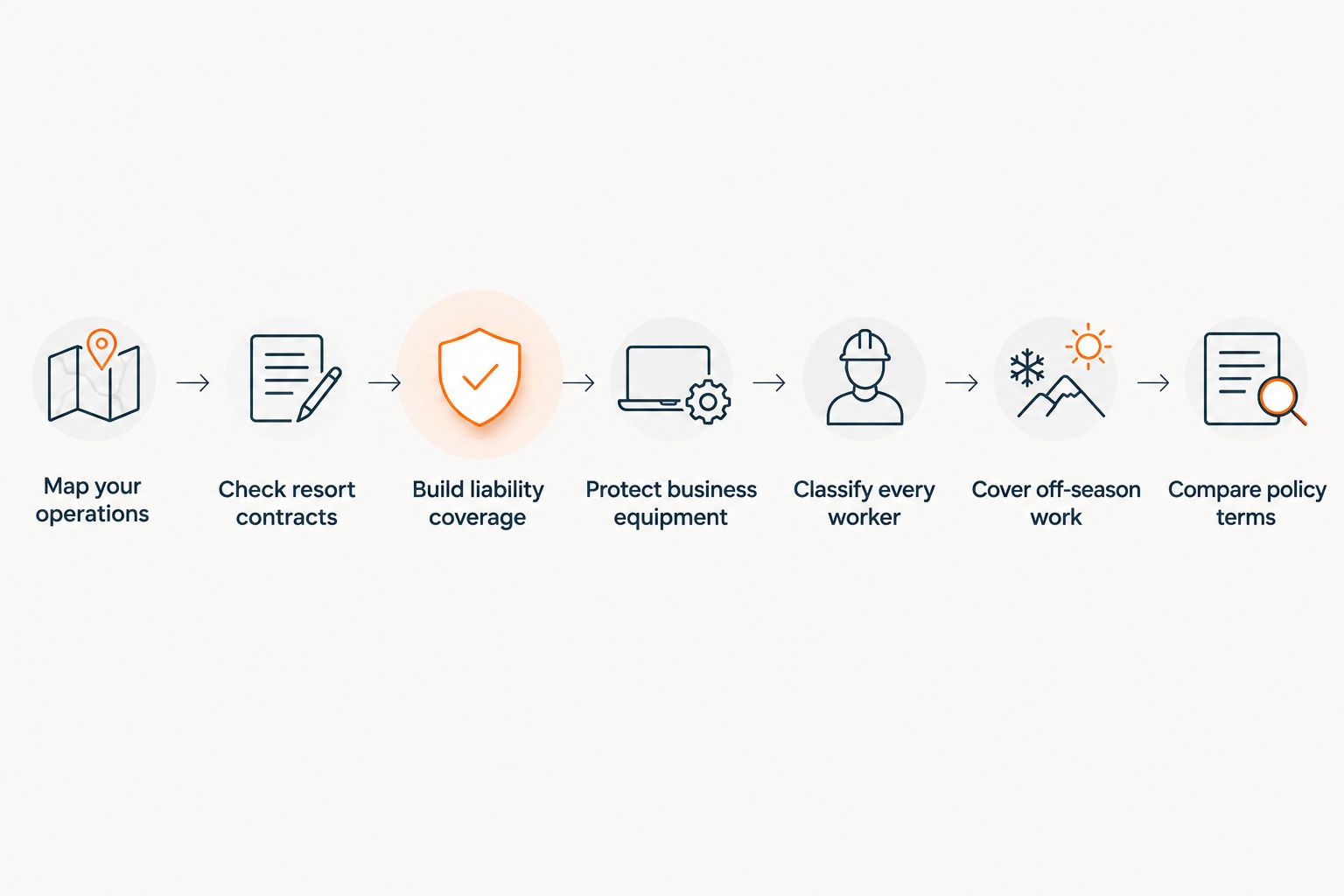
That process keeps the insurance discussion tied to your actual work rather than a generic occupation label. It also gives you a clean checklist to reuse at each renewal.
Compare coverage options for ski instructors
No single policy type covers every ski instruction exposure. The 2026 comparison below shows the job of each option and the main limitation you need to check before treating it as complete protection.
| Option | Best for | Main advantage | Key limitation |
|---|---|---|---|
| General liability | Solo instructors and ski schools | Addresses third-party injury and property damage claims | Does not automatically cover allegations about professional advice |
| Professional liability | Coaches whose teaching judgment is part of a claim | Addresses certain errors or negligence allegations tied to professional services | Athletic instruction exclusions and definitions require close review |
| Business property coverage | Businesses storing equipment at a listed location | Protects covered business-owned property | Coverage away from the listed premises can be restricted |
| Inland marine coverage | Instructors moving equipment between locations | Designed for specified property that travels | Only scheduled or otherwise covered property receives protection |
| Workers' compensation | Ski schools with employees | Addresses covered employee work injuries | Does not protect students or business property |
| Business owners policy | Small operations combining eligible liability and property coverage | Places multiple coverages in one policy structure | Eligibility and included activities vary by insurer |
| Commercial umbrella coverage | Established schools needing liability limits above underlying policies | Adds limits over specified underlying coverage | Does not replace the required underlying policies |
Themelloagency is best for New Hampshire ski and snowboard instructors who want a direct business insurance review before teaching for pay. The limitation is that coverage cannot be selected from an occupation name alone; contracts, activities, locations, equipment, and staffing still need review.
Start your coverage review
Use your operations list and contracts to review the coverage your instruction business needs.
Common mistakes ski instructors make
Assuming the resort covers everything
Working at a resort does not answer who is insured for your separate business activity. The contract and applicable policies determine the answer. Ask for written clarification instead of relying on a supervisor's informal explanation.
Describing the business too narrowly
An application that says only ski lessons can omit snowboard instruction, race coaching, summer camps, or equipment rental. Use the 12-month calendar and service list so the policy reflects the complete operation in 2026.
Treating a waiver as insurance
A participant waiver and an insurance policy perform different jobs. A waiver documents terms and risk acknowledgments; it does not fund legal defense or pay a covered claim. Keep properly prepared forms, but do not treat them as a replacement for liability coverage.
Misclassifying seasonal instructors
Part-time and seasonal status do not automatically remove workers' compensation responsibilities. Review classification before each person starts, then update the policy when payroll or duties change.
Ignoring equipment in transit
Equipment stored at a listed location can receive different treatment from equipment carried between mountains. Record where each item is stored, who transports it, and whether it is owned, borrowed, or rented.
FAQ
What business insurance does a New Hampshire ski instructor need in 2026?
A New Hampshire ski instructor should start with general liability, then evaluate professional liability, equipment coverage, and workers’ compensation. The final structure depends on contracts, services, locations, equipment, and whether the business has employees.
Does a resort’s insurance cover an independent ski instructor?
Do not assume resort insurance covers an independent instructor’s separate business. Review the instructor agreement, certificate requirements, and relevant policy language before teaching.
Is general liability enough for a ski instructor?
General liability is the starting point, but it is not always enough. Professional services, owned equipment, property in transit, employees, and higher liability limits can require separate coverage.
Does a ski instructor need professional liability insurance?
Professional liability deserves review when a claim could focus on coaching advice, judgment, or teaching methods. Confirm that the policy’s covered services and exclusions fit skiing or snowboarding instruction.
When does a New Hampshire ski school need workers’ compensation?
Workers’ compensation obligations can begin when a New Hampshire business has 1 employee. Review classification and any applicable exemption before a seasonal, part-time, or assistant instructor begins work.
How much does ski instructor business insurance cost?
There is no single cost for ski instructor business insurance. Insurers evaluate activities, locations, payroll, revenue, equipment, limits, deductibles, claims history, and contract requirements before providing terms.
Does ski instructor insurance cover summer coaching?
Summer coaching is covered only when the activity fits the policy’s described operations and terms. Put dryland sessions, camps, travel, and other off-season work on a 12-month activity calendar for review.
Can a business owners policy cover a small ski school?
A business owners policy can combine eligible liability and property coverage for some small operations. Confirm that participant injury exposures, professional instruction, mobile equipment, and off-site activities are not omitted or excluded.
One last thing
Do not begin the 2026 review by asking which policy is cheapest. Begin with the 3 documents that control the discussion: your operations summary, resort contract, and current policy. A low-cost proposal that omits race coaching, summer work, mobile equipment, or an employee does not solve the exposure.
Themelloagency can keep the conversation practical, but you need to provide a complete description of the business. The most useful final question is simple: does the policy match every paid activity on the 12-month calendar?
Related guides
- How to choose a business owners policy in New Hampshire
- Umbrella insurance for New Hampshire business owners
- Business insurance for New Hampshire snow removal companies