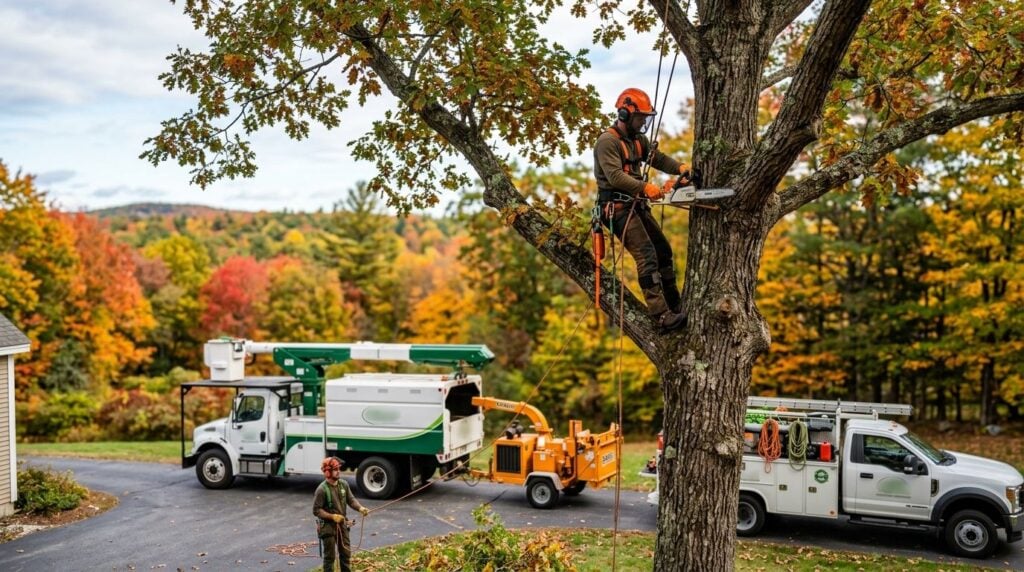
Business insurance for New Hampshire tree service companies means combining general liability, workers' compensation, commercial auto, and equipment coverage into one program built around chainsaws, chippers, bucket trucks, and crews working at height. Tree work carries different exposures than lawn care or plowing — falling limbs, aerial lift operations, and heavy equipment on residential property change what a policy needs to cover.
- Business insurance for New Hampshire tree service companies in 2026 means stacking general liability, workers’ comp, commercial auto, and inland marine — not a single generic policy.
- Themello Agency builds these programs around crews that climb, use bucket trucks, and run chippers on residential property.
- New Hampshire requires workers’ compensation the moment you hire your first employee, under RSA 281-A.
- Skip a bare business owner’s policy for tree work — chippers and stump grinders need equipment coverage a BOP typically excludes.
Why business insurance matters for New Hampshire tree service companies
Tree removal and pruning sit near the top of the injury-severity list for outdoor trades. A falling limb, a chipper accident, or a bucket truck tip-over produces claims that run far past what a landscaping crew or handyman business faces. New Hampshire's mix of century-old hardwoods, ice storms, and utility line proximity means removal jobs regularly involve overhead power, structures, and vehicles all in the same work zone.
Most municipal contracts, utility subcontracts, and even homeowner jobs in general liability insurance for New Hampshire small businesses territory now require a certificate of insurance before a crew shows up. Without proof of coverage that matches the job's risk, you lose the bid before the chainsaw starts.
Building coverage for a New Hampshire tree service company
Start with general liability coverage
General liability is the base layer — it responds when a falling branch damages a roof, a chip pile blocks a driveway, or a client trips over a downed limb during cleanup.
- Confirm the policy covers off-premises work, since almost all tree jobs happen on someone else's property
- Check that limb-fall and property damage from cutting operations aren't carved out as exclusions
- Verify products-completed operations coverage extends to stump grinding and debris hauling
- Ask whether the policy names additional insureds for municipal or utility contracts, since most require it
Add workers' compensation for every crew member
New Hampshire requires workers' compensation coverage as soon as you have one employee, under RSA 281-A — there's no small-business exemption for tree services. Climbing, chainsaw use, and chipper operation put this trade in a higher-rated class than most outdoor businesses, so the experience modifier matters more here than in almost any other segment.
- Classify climbers, ground crew, and equipment operators correctly — misclassification is the fastest way to trigger an audit bill
- Document safety training for chainsaw use, rigging, and aerial rescue
- Track your experience mod year over year; a mod above 1.0 raises every renewal
- Confirm coverage applies to subcontracted climbers, not just W-2 employees
Workers' compensation insurance for New Hampshire small businesses is not optional paperwork for this trade — it's the policy that keeps one bad fall from closing the business.
Cover the fleet with commercial auto insurance
Chip trucks, bucket trucks, and trailers hauling equipment need commercial auto coverage, not a personal policy extended to a work truck. Personal auto policies routinely exclude vehicles over a certain weight or used for commercial hauling.
- Insure bucket trucks and chip trucks under a commercial policy, not a personal one with a business rider
- Add trailer coverage separately if it's not automatically included
- Confirm hired and non-owned auto coverage if crew members ever drive personal vehicles for job duties
- Match liability limits to the size of vehicles on the road — a loaded chip truck causes more damage in a collision than a pickup
Commercial auto insurance for New Hampshire business fleets is the piece most tree services underinsure, because the truck feels like a tool rather than a liability exposure.
Protect chippers, bucket trucks, and stump grinders with inland marine
General liability doesn't cover damage to your own equipment. A stump grinder, chipper, or set of climbing gear stolen from a job site or damaged in transit needs equipment coverage, usually written as inland marine.
- List each major piece of equipment by value so a claim pays actual replacement cost
- Cover equipment in transit between job sites, not just while parked at the shop
- Include hand tools and climbing gear if theft from a truck is a realistic risk
- Review the schedule every year as equipment is added or sold
Crews clearing storm debris often pair a chipper with loader attachments for hauling brush piles off residential lots, and choosing the right skid steer buckets for cleanup work matters almost as much as insuring the machine — the wrong bucket slows debris removal and stretches a job that should take an afternoon into a two-day billing headache.
Add an umbrella policy for high-limit exposures
A single tree-removal claim involving a house, a car, or a utility line can blow past a standard $1 million general liability limit fast. An umbrella policy adds a layer of protection above your underlying limits without rewriting every policy underneath it.
- Stack umbrella limits over general liability, auto, and employer's liability
- Confirm the umbrella follows form — meaning it matches the underlying policy's terms, not a narrower set
- Size the limit to your largest realistic job, not your average one
Get certificates of insurance ready for municipal and utility work
Town contracts and utility subcontracts almost always require a certificate naming the municipality or utility as an additional insured before work starts.
- Keep a standing certificate template ready so it doesn't hold up a bid deadline
- Confirm additional insured status is actually endorsed on the policy, not just claimed on the certificate
- Renew certificates automatically each policy term so an expired one doesn't stall a contract
Factor safety programs into your rate
Insurers price tree services on loss history and safety practices more heavily than most trades, because the injury severity potential is high.
- Document a written safety program covering rigging, chainsaw use, and drop-zone control
- Track near-misses, not just recordable injuries
- Ask your agent how a documented program affects your workers' comp experience mod at renewal
Comparing coverage options for tree service companies
| Coverage type | Best for | Key limitation |
|---|---|---|
| General liability | Every job, from single-tree removal to full-lot clearing | Doesn't cover damage to your own equipment |
| Workers' compensation | Any business with employees climbing or running equipment | Required by NH law once you hire staff — not optional |
| Commercial auto | Chip trucks, bucket trucks, trailers | Personal auto often excludes commercial-weight vehicles |
| Inland marine (equipment) | Chippers, stump grinders, climbing gear | Requires an accurate, updated equipment schedule |
| Umbrella | Companies bidding larger or utility-adjacent jobs | Only pays after underlying limits are exhausted |
Verdict: a New Hampshire tree service running bucket trucks and chippers needs general liability, workers' comp, commercial auto, and equipment coverage together — a bare business owner's policy leaves the equipment and the fleet exposed.
Get your tree service coverage reviewed
A quick review checks gaps before storm season peaks.
Common mistakes New Hampshire tree services make
- Insuring the truck but not the fleet correctly — running a chip truck on a personal policy rider instead of true commercial auto, which insurers deny at claim time
- Skipping equipment coverage — assuming general liability protects a stolen chipper or a stump grinder damaged in an accident, when it doesn't
- Misclassifying climbers as ground crew — cutting a workers' comp premium short by underreporting the riskier job class, which surfaces at audit with a bill attached
- Bidding utility or municipal jobs without confirming additional insured endorsements — a certificate that names the town but isn't backed by an actual endorsement gets rejected or, worse, doesn't respond in a claim
- Setting general liability limits too low for storm-season work — a single tree falling on a house or a line during 2026's ice-storm season can exceed a $1 million limit fast
FAQ
What insurance does a New Hampshire tree service company need in 2026?
A New Hampshire tree service needs general liability, workers’ compensation, commercial auto for trucks and trailers, and equipment (inland marine) coverage for chippers and stump grinders. Companies bidding larger or utility-adjacent jobs typically add an umbrella policy.
Is workers’ compensation required for tree service companies in New Hampshire?
Yes. New Hampshire requires workers’ compensation coverage under RSA 281-A as soon as a business hires even one employee, with no exemption for small crews. Climbers and equipment operators are rated in a higher class than most outdoor trades.
Does general liability insurance cover chainsaw and chipper accidents?
General liability covers third-party injury and property damage, such as a limb falling on a client’s car or a chipper accident damaging a neighbor’s fence. It does not cover injuries to your own employees, which is what workers’ compensation is for.
Can I use a personal auto policy for my chip truck?
No. Personal auto policies typically exclude vehicles used for commercial hauling or above certain weight thresholds. A chip truck or bucket truck needs commercial auto insurance written for business use.
What does inland marine insurance cover for a tree service?
Inland marine covers equipment like chippers, stump grinders, and climbing gear against theft or damage, including while it’s being transported between job sites. General liability does not cover damage to your own equipment.
Do municipal tree contracts require a certificate of insurance?
Most municipal and utility subcontracts in New Hampshire require a certificate of insurance naming the town or utility as an additional insured before work begins. The endorsement needs to actually be on the policy, not just referenced on the certificate.
How does a workers’ comp experience mod affect a tree service’s premium?
An experience mod above 1.0 raises your workers’ compensation premium at every renewal, and tree services carry a higher baseline risk class than most trades. Documented safety programs and low incident rates over time bring the mod down.
Should a tree service carry an umbrella policy?
Companies handling larger removals near structures, roads, or utility lines benefit from an umbrella policy because a single serious claim can exceed a standard $1 million general liability limit. Smaller residential-only operations may not need one yet.
One last thing
The experience mod is the number that quietly decides your workers' comp premium every year, and most tree service owners never ask their agent what it currently sits at. Pull it before your 2026 renewal — a mod even slightly above 1.0 on a trade already rated high for climbing and chipper work adds up fast across a full crew.
Related guides
- Inland marine insurance for New Hampshire contractors
- Umbrella insurance for New Hampshire business owners